To You, the One Writing the Eulogy,
Writing a eulogy is one of the most meaningful things you will ever be asked to do. It is also one of the hardest.
You are grieving, you are exhausted, and you have been handed the impossible task of compressing a lifetime of love into a few minutes of spoken words. If you have chosen — or been asked — to stand up and honor someone who mattered, that is a profound act of love.
This guide will walk you through the entire process — from gathering your first memories to delivering the final words. Whether you choose to write your eulogy by hand, use our free eulogy writer, or some combination of both, the principles are the same.
A great eulogy is not about perfect prose. It is about honest, specific, human truth.
Understanding Eulogies
What a eulogy is, how it differs from an obituary, and why anyone can deliver one.
What Is a Eulogy?
A eulogy is a speech given at a funeral or memorial service that honors the life of someone who has died. The word comes from the Greek eulogia, meaning "praise" or "blessing."
Unlike an obituary, which records the facts of a person's life (dates, survivors, career), a eulogy tells the story of who they were — their character, their impact, the way they made people feel.
Key Distinction
A eulogy is not a biography. You do not need to cover every chapter of their life. It is not a resume of accomplishments. And it is not a sermon, unless you are the officiant. A eulogy is a personal tribute, told from your unique perspective, that helps the people in the room remember why this person mattered.
Anyone can deliver a eulogy. You do not need to be a professional speaker, a writer, or even someone who is comfortable in front of a crowd. You just need to have known and loved the person, and to be willing to share that love out loud.
Writing Your Eulogy
Structure, content, and the specific details that transform words into a living portrait.
How to Structure a Eulogy
The simplest and most effective structure for a eulogy has three parts: an opening, a body, and a closing. This is not a rigid formula — it is a framework that gives your thoughts shape so you can focus on what matters: the memories.
If the blank page keeps beating you at the very first sentence, read our how to start a eulogy guide before you draft the rest. It gives you ten opening approaches and example first paragraphs for different relationships.
The Opening (1–2 minutes)
Introduce yourself and your relationship to the person. Not everyone in the room will know who you are. Set the tone with a single memory that captures who they were, a statement about what they meant to you, or a moment of gentle humor. The goal is to draw the room in and signal what kind of tribute this will be.
The Body (2–4 minutes)
Choose two or three themes, stories, or qualities that defined the person, and dedicate a paragraph or two to each. The key word is specific. Do not say 'she was a wonderful mother.' Say 'every single morning, she packed my lunch with a handwritten note folded inside the napkin — even when I was in high school and pretended to be embarrassed by it.' Specificity transforms nice words into a living portrait.
The Closing (1–2 minutes)
Step back from the individual stories and reflect on the larger meaning. What did this person teach you? What will you carry forward? Some close with a direct address to the person. Others close with a message to the room, a favorite quote, a line from a song, or a simple goodbye. There is no wrong way to end a eulogy, as long as it feels honest.
A single vivid memory is worth more than ten general statements about how wonderful someone was.
What to Include in Your Eulogy
The most common mistake people make when writing a eulogy is trying to cover everything. You cannot summarize a human life in five minutes, and you should not try. Instead, focus on what made this person this person — the qualities, habits, and moments that were uniquely theirs.
Specific memories. A eulogy lives or dies on the strength of its stories. "He loved fishing" is a fact.
"Every Saturday at 5 a.m., he would shake me awake, hand me a thermos of hot chocolate that was mostly marshmallows, and drive us to the lake in complete silence — because he said the fish could hear us coming" is a memory. The second version makes people see him.
Character traits, shown through action. Rather than listing adjectives ("she was kind, generous, and funny"), show those traits through examples. "She once drove forty-five minutes in a snowstorm to bring soup to a neighbor she had met exactly once" tells us more about her kindness than the word "kind" ever could.
Their impact on others. A eulogy is not just about who the person was — it is about the mark they left. How did they change you? How did they change the people around them? What did they teach, model, or inspire? This is often the most powerful part because it connects the person's life to the lives still being lived in the room.
A touch of humor, if it fits. If the person was funny, let the eulogy be funny. Laughter at a funeral is not disrespectful — it is a celebration of who they were. The room needs permission to laugh, and a well-placed story can release tension and bring the room together. Let the humor arise naturally from real memories.
Their legacy. What do you want people to carry out of the room? This does not need to be grand. A legacy can be a recipe, a phrase, a way of greeting people, a commitment to showing up. The most enduring legacies are often the smallest ones.
What to Avoid in a Eulogy
A eulogy is a gift to the room. Everything you include should serve that purpose — to honor the person and comfort the people who loved them.
Things to Avoid
- Family conflicts or complicated truths
- A funeral is not the place to air grievances. If your relationship was complicated, focus on the good. A eulogy is not a biography; it is a tribute.
- Inside jokes that exclude the room
- A story that only three people understand will leave the rest feeling like outsiders. Provide enough context that everyone can appreciate it.
- Clichés
- Phrases like 'they are in a better place' or 'God needed another angel' can feel hollow if they do not reflect the person's actual beliefs. Say something real instead.
- Making it about yourself
- You are the narrator, not the subject. The eulogy should always circle back to them.
- Speaking negatively about anyone
- This includes the deceased. Focus on what was good, what was true, and what deserves to be remembered.
How Long Should a Eulogy Be?
Most eulogies are between three and seven minutes long, which translates to roughly 500–1,500 words when read aloud at a natural, unhurried pace. The sweet spot for a single eulogy is around five minutes — approximately 750 words.
If multiple people are delivering eulogies at the same service, each speaker should aim for three to four minutes. If you are the sole speaker, you have more room — up to ten minutes is acceptable, though anything beyond that risks losing the room's focus.
Checking Your Length
Read your eulogy aloud and time yourself. Read at the pace you would actually use at the podium — slightly slower than conversational speed, with pauses where the emotion naturally rises. If you are significantly over your target time, look for sections that repeat the same sentiment in different words and cut the weaker version.
It is better to be too short than too long. A three-minute eulogy that is specific, honest, and heartfelt will be remembered far longer than a ten-minute eulogy that wanders.
If you need exact word counts, timing ranges, and editing rules before you cut your draft down, see how long should a eulogy be.
Ready to Write Your Eulogy?
Our free guided tool walks you through it step by step. Answer a few questions about your loved one, and receive a complete, personalized eulogy in minutes.
Start Writing — It's FreeEulogy Examples
Reading other eulogies is one of the best ways to find your own voice. These cover different relationships and tones — from warm and reflective to gently humorous.
If you want more full-length models than the ones on this page, browse our dedicated eulogy examples library for additional relationship-specific tributes and shorter examples.
Eulogy for a Mother
Warm, specific, and reflective — focused on small, everyday memories rather than grand accomplishments.
A Eulogy for Margaret Anne Collins (1951–2026) Delivered by her daughter, Sarah
For those of you who don't know me, I'm Sarah, and Margaret was my mom. Though if you knew her at all, you probably already know that, because she talked about her kids to anyone who would listen — and quite a few people who were just trying to buy groceries.
I have been trying to write this for three days, and every time I sit down, I realize the problem is not that I don't know what to say. The problem is that I could talk about my mother for the rest of my life and still not capture her. So I am going to try to do what she always told me to do when I was overwhelmed: just start somewhere, and the rest will follow.
My mother was the kind of person who made you feel like you were the only person in the room. I don't mean that as a figure of speech. I mean that when she talked to you — really talked to you — she would put down whatever she was holding, turn her whole body toward you, and look at you with this expression that said, "I have nowhere else to be." She did this with everyone. The cashier at the pharmacy. The new neighbor. The telemarketer she probably should have hung up on twenty minutes ago. She believed that every person she met was carrying something, and the least she could do was make them feel seen for a moment.
She was not a perfect person, and she would be the first to tell you that. She burned almost everything she cooked, except her banana bread, which was genuinely extraordinary and which she refused to share the recipe for — even with me. She was chronically fifteen minutes late to everything, which she blamed on traffic regardless of whether she had driven or walked. And she had a habit of calling me at 7 a.m. on Saturdays to tell me something she had seen on the news, as if the information could not possibly wait until a reasonable hour.
But these are the things I will miss the most. The slightly burnt toast. The breathless arrival. The Saturday morning phone calls that I used to grumble about and would now give anything to receive one more time.
What I want you to know about my mother is this: she lived her life in the small moments. She did not climb mountains or run companies. She raised three children, she loved one man for forty-two years, she kept a garden that was the envy of the block, and she showed up — every single time, for every single person who needed her. That is not a small life. That is the biggest life I know.
Mom, I hope you know that every good thing I am is because of you. And I hope wherever you are, someone is making you a cup of tea, and it is exactly the right temperature, and you don't have to be anywhere for a while.
Thank you all for being here. She would have loved seeing every one of you — and she would have made sure you didn't leave without eating something.
Eulogy for a Father
Blends humor with deep emotion — captures a father through his habits, his humor, and the quiet ways he showed love.
A Eulogy for Robert "Bobby" James Whitfield (1948–2026) Delivered by his son, David
My dad was not a man of many words. He was a man of very specific words, repeated at very specific times. Every morning: "Rise and shine, the world's not gonna wait for you." Every time I left the house: "Keep your head on a swivel." Every single time I called him on the phone, no matter what I was calling about: "You need money?" I didn't, Dad. But I appreciate that you asked. Every time.
I want to tell you about the kind of man my father was, but I think the best way to do that is to tell you about his hands. My dad's hands were enormous. They were calloused and scarred from forty years of working with wood — he was a carpenter by trade and by obsession. Those hands built the deck on our family home, the bookshelves in my first apartment, a crib for each of his grandchildren, and a birdhouse so architecturally ambitious that my mother said it looked like a condo development for sparrows.
But those same hands were impossibly gentle. When I was seven and broke my arm falling off my bike, he carried me to the car with a steadiness that made me believe nothing bad could ever really happen as long as he was there. When my daughter was born, I watched this enormous man hold a six-pound baby like she was made of glass, and I saw him cry for the first time in my life. He looked at me and said, "Now you get it." And I did.
My father taught me most of what I know, though he rarely sat me down and taught me anything directly. He taught by doing. He taught me that you measure twice and cut once. He taught me that showing up is ninety percent of everything. He taught me that you don't complain about the work — you just do the work, and then you sit on the porch and have a beer, and that is its own reward.
He was funny in the way that quiet men are funny — the joke would land three seconds after he said it, delivered with a completely straight face, and by the time you started laughing he had already moved on to something else. He once told a waiter at a restaurant that he was allergic to "anything that costs more than twenty dollars." The waiter did not know what to do. My mother was mortified. My dad just sat there, reading the menu, completely satisfied with himself.
I am not going to stand here and pretend that losing him does not feel like the ground has shifted under my feet. It does. He was the most solid thing in my life, and now there is a space where he used to be that I don't know how to fill. But I think he would tell me the same thing he told me about everything else: "You'll figure it out. You always do."
Dad, I'm going to try. And I'm going to keep my head on a swivel.
Eulogy for a Friend
Honest, conversational, and deeply personal — captures the unique grief of losing a chosen relationship.
A Eulogy for James Michael Torres (1988–2026) Delivered by his best friend, Marcus
James and I met on the first day of seventh grade, when we were both assigned to the same lunch table and discovered that we had three things in common: we both thought the cafeteria pizza was inedible, we both had older sisters who terrorized us, and we both believed — with absolute certainty — that we were going to be famous one day. We were twelve. We had no idea what we would be famous for. We just knew it was going to happen.
We were not famous. But we had the kind of friendship that felt like it deserved to be. For twenty-one years, James was the first person I called when something good happened and the first person I called when something fell apart. He was my best man. He was my daughter's godfather. He was the person who once drove four hours in the middle of the night because I called him and said, "I think I need to talk to someone," and he said, "I'm already in the car."
That was James. He did not wait to be asked. He did not weigh the inconvenience. He just showed up, usually with food, because he believed that most problems could be improved by eating something. He was not wrong.
I want to tell you what made James extraordinary, but the truth is, he would hate that word. He did not think of himself as extraordinary. He thought of himself as a guy who liked basketball, loved his family, made a decent living, and tried to be good to the people around him. But that undersells it by a mile. James had a gift for making people feel like they belonged. I watched him do it a thousand times — at parties, at work, at random barbecues where he knew maybe two people. He would find the person standing alone, walk over, and within five minutes that person would be laughing.
He was also the most stubbornly optimistic person I have ever known. Not in a naive way — he knew the world was hard. He just refused to let that be the final word. When I went through my divorce, I spent about three weeks on his couch, convinced my life was over. He let me sit there for exactly three weeks, and then he said, "Alright, that's enough. We're going for a run." I said I didn't want to go for a run. He said, "I know. That's why we're going." We ran two miles. I threw up. And somehow, I felt better.
I don't know how to do this without him. I keep reaching for my phone to text him, and then I remember. But I also know that if he were here, he would tell me to stop moping, eat something, and go for a run. So that is what I am going to do.
James, you were the best friend I will ever have. And you were right — we were famous. Just not the way we thought. We were famous to each other, and that was more than enough.
Short Eulogy for a Grandmother
Brief and powerful — roughly 400 words, about 3 minutes. Ideal for services where multiple people are speaking.
A Eulogy for Dorothy "Dot" Mae Richardson (1932–2026) Delivered by her granddaughter, Emily
My grandmother did not like long speeches. She said they were for people who liked the sound of their own voice, and she had better things to do. So I am going to keep this short, because she is probably already giving me a look.
Grandma Dot was four feet eleven inches tall, and she was the most formidable person I have ever known. She raised five children in a three-bedroom house. She worked the night shift at the hospital for twenty-six years. She made biscuits every Sunday morning without a recipe, and they were perfect every single time, and when I asked her how she did it, she said, "I just know." That was her answer for everything. How do you keep a marriage going for fifty-eight years? "I just know." How do you forgive someone who hurt you? "I just know." How do you not be afraid of dying? She looked at me like I had asked the silliest question in the world and said, "Honey, I've done everything I came here to do."
She had. She really had.
What I will carry with me is not the big moments — though there were many — but the small ones. The way she smelled like lavender and Pond's cold cream. The way she called everyone "baby," even the mailman. The way she would sit on her porch in the evening and wave at every single car that drove by, whether she knew them or not. Someone once asked her why she waved at strangers. She said, "They're not strangers. They just don't know me yet."
That was my grandmother. She believed the world was full of people she hadn't met yet, and she intended to be kind to every one of them.
Grandma, you were the strongest, funniest, most stubborn, most loving person I have ever known. You taught me that you don't need to be loud to be powerful. You just need to know who you are and show up every day as that person.
I love you. And your biscuits were perfect.
Tips for Delivering Your Eulogy
Practical advice for standing at the podium — managing emotion, pacing, and the backup reader strategy almost no one talks about.
Managing Your Emotions at the Podium
Writing the eulogy is only half the challenge. The other half is standing up in front of a room full of grieving people and reading it aloud without losing your composure entirely.
If the thought of that makes your stomach drop, you are not alone. It is the single most common fear people express about giving a eulogy — not that they will say the wrong thing, but that they will not be able to say anything at all.
You may cry. You may have to pause. You may lose your place. And none of that matters. No one in that room expects you to be composed. They expect you to be human.
The single most effective technique for managing emotion during a eulogy is familiarity. The more times you have read the words aloud before the service, the less power they will have to ambush you in the moment.
This does not mean the emotion goes away — it means you learn where it lives in the text, and you can prepare for it.
Read your eulogy aloud at least three times before the service. The first time will be the hardest. You may not make it through without stopping. That is expected and completely fine.
By the second and third readings, the words will feel more familiar, and the sharpest emotional peaks will soften slightly. You are not becoming numb to the words; you are building a path through them that your voice can follow even when your heart is struggling.
On the Day
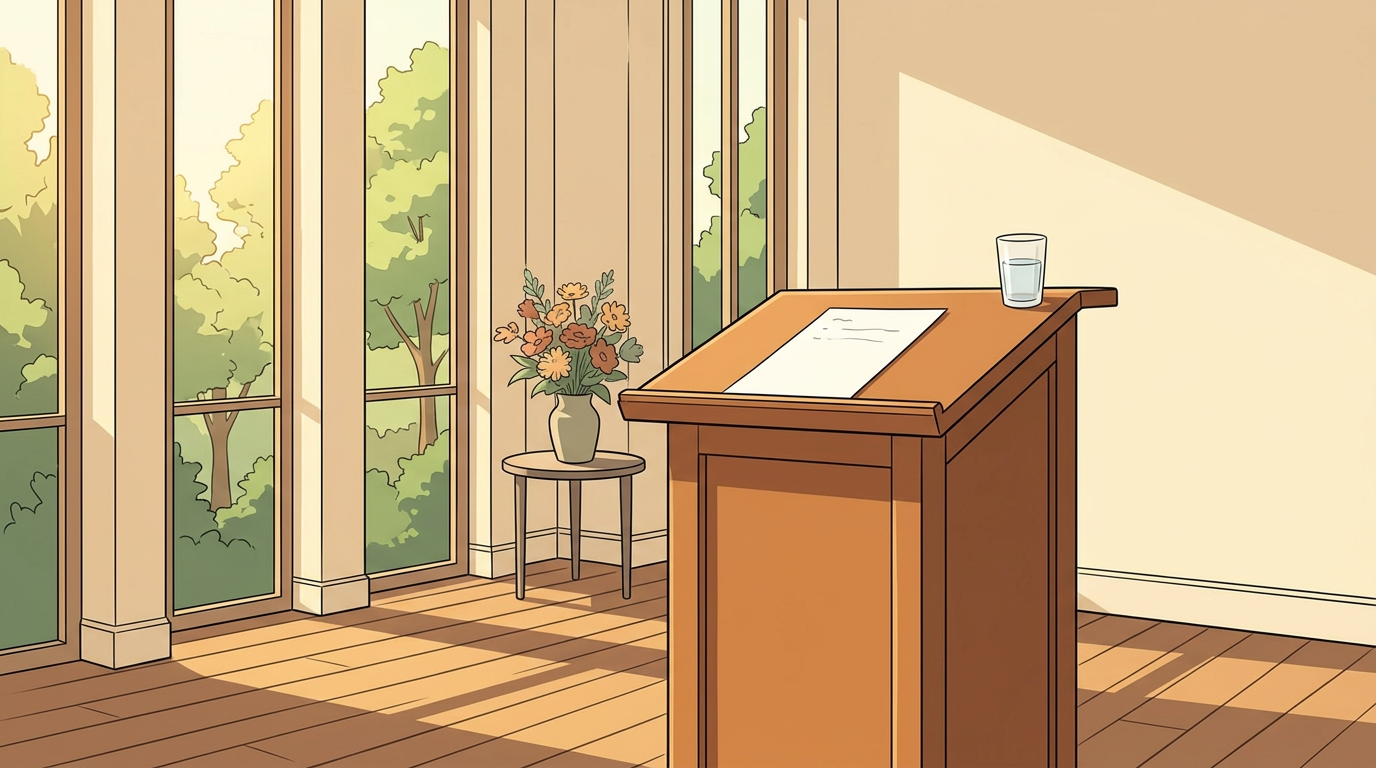
Bring water to the podium. Take a sip before you begin. If you feel your voice starting to break, pause, take a breath, look down at the page, and find your place. The room will wait. They are not impatient. They are with you.
Pacing, Breathing, and Eye Contact
Most people read too fast when they are nervous. At a funeral, this is compounded by the desire to get through the hard parts quickly. Resist this impulse.
A eulogy delivered too fast loses its emotional weight. The pauses between sentences are where the meaning lands.
Speak more slowly than feels natural. If you think you are going too slowly, you are probably going at exactly the right pace.
Breathing is mechanical, but it matters. Before you begin, take three slow, deep breaths. During the eulogy, breathe at the end of every sentence — not a dramatic, visible breath, just a quiet moment of air.
If you feel your throat tightening or your voice starting to waver, stop at the end of the current sentence, take two slow breaths, and continue. The audience will not notice the pause. They will only notice that your voice steadied.
Eye contact is optional and should not be forced. If looking at faces is too much, pick a point on the back wall and glance at it occasionally. It will look like eye contact from the audience's perspective.
The Backup Reader Strategy
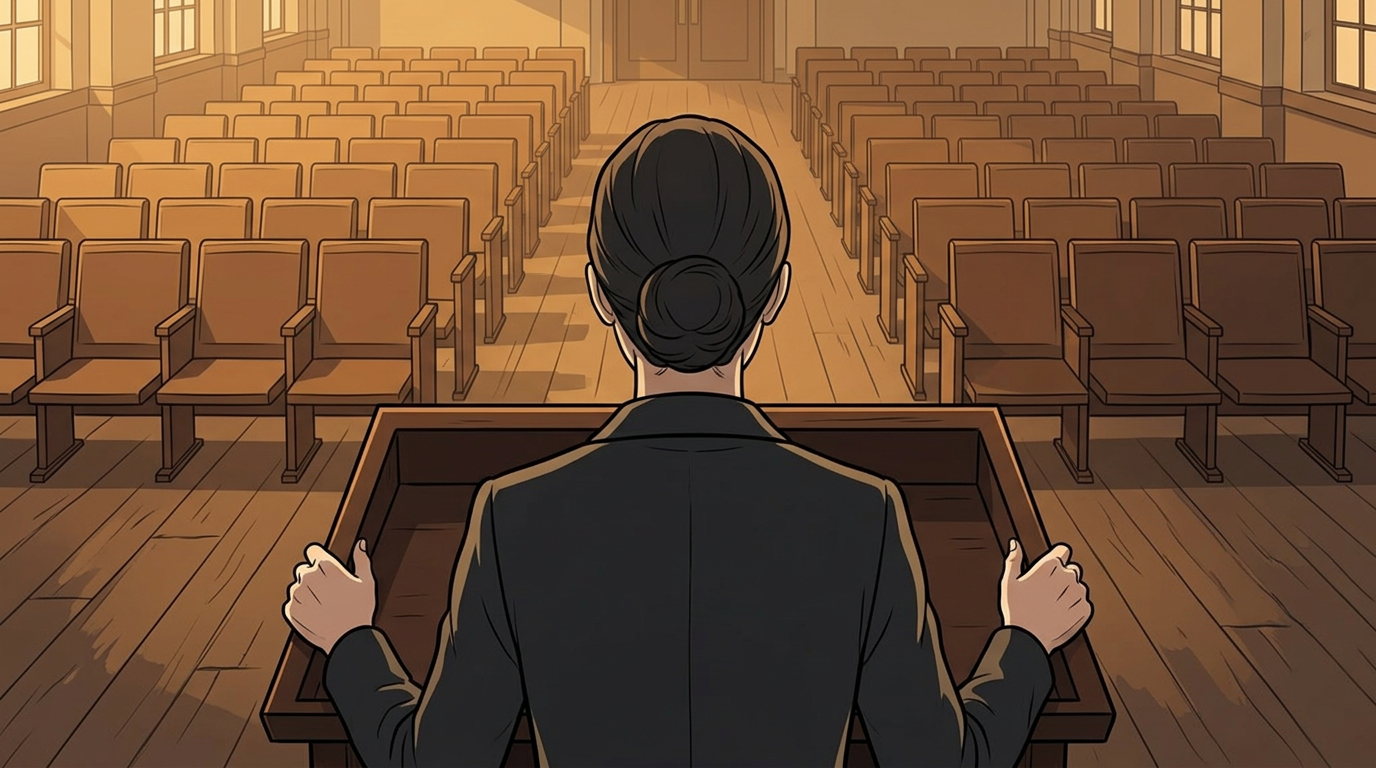
This is the single most practical piece of advice anyone can give you about delivering a eulogy, and almost no one talks about it: have a backup reader.
Before the service, ask someone you trust — a sibling, a close friend, a cousin — to stand near you while you speak. Give them a printed copy of the eulogy. Explain that if you reach a point where you cannot continue, you will simply hand them the paper, and they will pick up where you left off.
If you do hand off to your backup, do not feel guilty. You wrote the words. You stood up. You tried. The act of writing the eulogy is itself an act of love, whether or not you are the one who reads every line of it aloud.
Practical Preparation
In the days and hours before the service, these small preparations can make a meaningful difference.
- Print in 14–16pt font, double-spaced — Use heavier paper stock — standard printer paper shakes visibly in trembling hands
- Number your pages clearly — In case they get shuffled at the podium
- Turn off all notifications — If reading from a phone or tablet
- Arrive early — Stand behind the podium while the room is empty — physical familiarity reduces strangeness
- Bring water to the podium
- Eat something beforehand — Even just toast — grief suppresses appetite, and an empty stomach worsens lightheadedness
- Have a backup reader standing nearby — With their own printed copy of the eulogy
- Practice reading aloud at least 3 times — In the days before the service, not the morning of
Frequently Asked Questions
- How do I write a eulogy for someone I love?
- Start by gathering your memories: specific stories, personality traits, and what your loved one meant to you and others. Organize these into a simple structure — an opening that introduces who they were, a body that shares 2-3 meaningful stories or qualities, and a closing that honors their legacy. Aim for 3-5 minutes (roughly 750-1,000 words). You don't need to be a writer — the most powerful eulogies come from honest, specific memories, not polished prose.
- How long should a eulogy be?
- Most eulogies are between 3 and 7 minutes long, which translates to roughly 500-1,500 words when read aloud at a natural pace. A 5-minute eulogy (about 750 words) is the most common length and is generally considered ideal — long enough to share meaningful memories, short enough to hold the room's attention.
- Is it okay to use AI to help write a eulogy?
- Absolutely. Using a tool to help organize your thoughts and find the right words does not diminish the love behind the eulogy — it ensures that love is communicated clearly. A guided eulogy writer simply helps you structure those memories into a tribute you can deliver with confidence.
- What should I include in a eulogy?
- A strong eulogy typically includes: your relationship to the person, 2-3 specific memories or stories that capture who they were, their personality traits and what made them special, the impact they had on others, a reflection on their legacy, and a brief closing that says goodbye or offers comfort.
- What is the difference between a eulogy and an obituary?
- A eulogy is a speech delivered at a funeral or memorial service, typically by someone who knew the person well. It is personal, emotional, and focused on memories and character. An obituary is a written notice of death, usually published in a newspaper or online, that includes biographical facts — date of birth, survivors, career, and funeral arrangements.
- Can I read someone else's eulogy if I'm too emotional to speak?
- Yes, and this is far more common than most people realize. Many people write the eulogy themselves but ask a trusted friend, family member, or even the officiant to read it on their behalf. No one at a funeral will judge you for being unable to finish.
- How do I start a eulogy?
- The simplest and most effective way to open a eulogy is to introduce yourself and your relationship to the person. From there, you can move into a specific memory or a statement about who they were. Avoid starting with a dictionary definition or a generic quote — begin with something personal.
- Should a eulogy be funny or serious?
- A eulogy can absolutely include humor, and often the most memorable eulogies do. Laughter at a funeral is not disrespectful — it is a celebration of the person's spirit. The best approach is to blend warmth, humor, and sincerity.
- What should I avoid saying in a eulogy?
- Avoid anything that could cause pain to those in attendance: family conflicts, embarrassing secrets, controversial opinions, or stories that only a few people would understand. Avoid clichés and avoid making the eulogy about yourself.
- Can there be more than one eulogy at a funeral?
- Yes. It is common for two or three people to deliver eulogies at a single service, each offering a different perspective on the person's life. Each speaker should aim for 3-4 minutes.
- How do I write a eulogy for my mom?
- Start by thinking about what made her uniquely her — not just that she was loving or kind, but the specific ways she showed it. What did her voice sound like when she called you? What did she cook, teach you, worry about? Build your eulogy around 2-3 of these specific, vivid memories.
- How do I write a eulogy for my dad?
- A eulogy for your father should capture the specific ways he shaped your life. Think about what he taught you — not just life lessons, but the small things: how he fixed things around the house, the way he told stories, his sense of humor. Focus on 2-3 concrete memories that show who he was as a person.
- Do I need to memorize a eulogy?
- No, and you should not try. Reading from a printed copy is completely normal and expected at funerals. Print your eulogy in a large, easy-to-read font (14-16pt), double-spaced, and bring it to the podium.
- How do I practice delivering a eulogy without breaking down?
- Read it aloud multiple times in the days before the service. The first reading will likely be the hardest. Each subsequent reading becomes slightly easier. Have water nearby and a backup reader standing beside you.
- Is RememberMe.fm's eulogy writer really free?
- Yes, completely free. There is no account required, no credit card, no paywall, and no limit on how many eulogies you can create. We built this tool because we believe no one should have to face the task of writing a eulogy without help, especially while grieving.
If you have already gathered memories for a eulogy, those same details can become a custom memorial song — a one-of-a-kind tribute you can play at the service, share with family, or keep forever.
Related Resources
Honoring a loved one? Create a personalized memorial song at RememberMe.fm