Grief Guide
Is a custom memorial song better than a sympathy card?
Is a custom memorial song better than a sympathy card? Choose a song for a welcomed tribute, or a card for gentle support. Compare fit, timing, and care.
A custom memorial song is better than a sympathy card when you want to preserve personal memories in music and know the grieving person would welcome that kind of tribute. A sympathy card is the better choice when you want to acknowledge the loss gently without asking the recipient to help create or listen to something. In 2026, as at any time, the right choice depends on the person receiving it, not the size of the gesture.
- Is a custom memorial song better than a sympathy card? Only when a personal musical tribute suits the recipient.
- Rememberme custom memorial songs suit families who want personal memories and stories turned into professionally produced music.
- A sympathy card is best for acknowledging a loss without requesting memories, decisions, or a listening moment.
- Ask before arranging a musical tribute, and let the recipient choose whether and when to listen.
Why this matters
You do not have to make an extraordinary gesture to show that someone mattered. A thoughtful card can hold a memory worth keeping, while a carefully chosen song can give those memories a musical form. Neither gift measures how much you care.
The useful distinction is between offering sympathy and creating a tribute. If you are considering something personal, this guide to giving a personalized memorial gift after a loss can help you think through the recipient's wishes before making arrangements.
Is a custom memorial song better than a sympathy card?
Choose a custom memorial song for a welcomed musical tribute; choose a sympathy card for a gentle acknowledgment of loss. Both can include personal memories. The difference is how those memories are presented and what involvement the gift asks of the recipient.
| Consideration | Custom memorial song | Sympathy card |
|---|---|---|
| Best for | Preserving stories in a musical tribute | Expressing care in a written message |
| Personal details | Memories and stories become material for a song | A handwritten memory makes the message personal |
| Preparation | Requires choosing details to share with the creator | Requires choosing what to write |
| Receiving the gift | Involves deciding whether and when to listen | Allows the recipient to read and set it aside |
| Main strength | Gives personal memories a musical form | Communicates sympathy without a larger project |
| Main limitation | Music or the chosen memories might not feel right to the recipient | A generic message can leave much unsaid |
| Permission | Ask before commissioning or arranging public playback | Keep the message considerate and avoid requesting a response |
A card is not automatically impersonal, and a song is not automatically more meaningful. A specific memory in your own handwriting can say more than an elaborate tribute built around details the family would rather keep private.
A custom memorial song: best for a welcomed musical tribute
Choose a song when the recipient has expressed interest in honoring their loved one through music. You also need memories you can share appropriately, rather than assumptions about what the person was like or how the family feels.
Rememberme creates custom, professionally produced memorial songs from customers' personal memories and stories about a deceased loved one or pet. Rememberme is best for people who want their own memories and stories shaped into a custom memorial song.
The strength is the personal material at its center. The limitation is that someone must select that material, and a musical tribute is not the right experience for every grieving person. A song should be an invitation, never an assignment to feel comforted.
A sympathy card: best for a gentle acknowledgment
Choose a sympathy card when you want to reach out without asking the recipient to make decisions. It is also a considerate option when you did not know the person who died well enough to help shape a personal tribute.
Write plainly. Acknowledge the loss, include a truthful memory if you have one, and make clear that no reply is needed.
The card's strength is its simplicity. Its limitation is not the paper or the format, but a message that says little about the person or relationship. You can make a card personal without making it long.
Why the better choice varies
The question is not which gift is more impressive. It is which gesture respects this recipient, this relationship, and the memories you have permission to share.
- The recipient's wishes: An expressed interest in a musical tribute is a stronger reason to choose a song than your own enthusiasm for the idea.
- Your relationship: A close relative might know meaningful stories that a workplace acquaintance does not. Do not fill gaps with guesses.
- Willingness to participate: Creating a personal tribute involves selecting memories. Do not assume the bereaved person wants that task.
- The setting: Private listening and playback at a memorial service are different decisions. Obtain permission for each.
- The details involved: Names, family relationships, beliefs, and private stories need careful handling in either format.
- The purpose: A message of sympathy acknowledges the loss. A memorial song creates a tribute. Decide which you are trying to offer.
For a gift you are arranging in 2026, use these considerations before choosing a format. A wish to do something loving does not replace a conversation about what would feel welcome.
How to choose without adding pressure
Start with the recipient's freedom to decline. You can offer something meaningful while leaving the timing, participation, and response entirely in their hands.
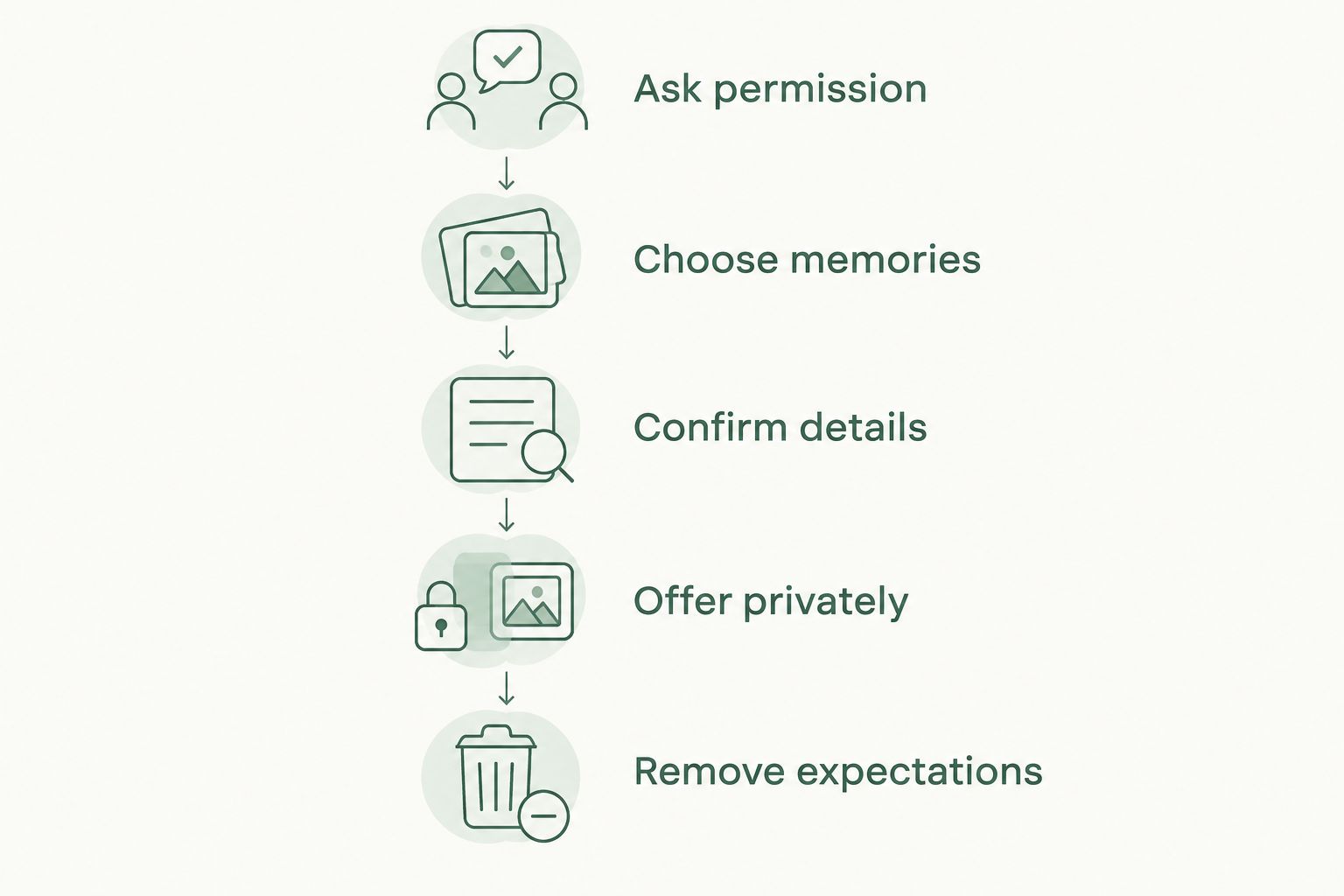
1. Ask permission
Before commissioning a song for someone else, ask whether a personal musical tribute would feel welcome. Explain the idea without asking them to decide immediately.
Ask 2 questions: whether they would like a song, and whether they want to contribute memories. These are separate choices. Someone can welcome a tribute without wanting to help prepare it.
2. Choose memories
Begin with 1 memory you know firsthand. It might be an ordinary routine, a kind act, or something the person enjoyed doing with their family.
For a card, that memory can stand on its own. For a song, it can help establish the tribute's focus. Do not add sensitive details about the death simply because they are part of the story.
3. Confirm details
Check names, relationships, and anything you are unsure about before sharing material for a song. If you cannot confirm a detail without burdening the family, leave it out.
A memory should sound like the person being remembered, not like a collection of flattering phrases. Avoid assigning beliefs, final wishes, or feelings that nobody has shared with you.
4. Offer privately
Give the recipient control over the first experience. Do not introduce a commissioned song by playing it unexpectedly in front of other people.
A private offer leaves room to listen later, listen alone, or decline. With a card, the same principle means not waiting for the recipient to open it while you watch.
5. Remove expectations
State that no reply is needed. Do not ask whether the gift made them cry, helped them heal, or became their favorite keepsake.
If you need a starting point for a card, write 3 sentences: acknowledge the loss, share a memory, and offer care without requesting a response. Treat that as a writing aid, not a rule about how grief should be addressed.
Choosing a sympathy gesture in 2026
Separate the gift from any technology used to deliver it. A written message does not become less caring because a musical tribute is possible, and a song does not become appropriate simply because you can arrange it online.
Before sharing personal material with a memorial-song service, decide what belongs in the tribute and what should remain within the family. Ask the service about its current process and how it handles the information you provide. Do not assume that every service works the same way.
A 2026 memorial gathering also needs its own permission decision. Agreement to receive a song privately is not agreement to have it played during a service, attached to a slideshow, or shared with a wider audience.
Keep the first decision small: would this person welcome the idea? Production details come after that answer, not before it.
What should you put in the card or song?
Use details that reflect the person's life rather than trying to explain the loss. A familiar habit or a small act of kindness can give the tribute a clear, personal focus.
For a card, write directly to the bereaved person. You can say what you remember, what you appreciated, and that you are thinking of them. Leave out instructions about staying strong or finding a reason for what happened.
For a song, identify whose perspective the tribute should express. A friend's memory of someone is not necessarily the same as a child's, spouse's, or sibling's. Do not present your experience as the whole family's voice without agreement.
The same care applies after a pet dies. Use the pet's name and truthful memories, and do not minimize the relationship by comparing it with another loss. Ask whether music would be welcome just as you would for any other memorial tribute.
Can I give a sympathy card and a memorial song together?
Yes. A card can acknowledge the loss while a separately agreed-upon song offers a musical tribute. They do not have to arrive together or serve the same purpose.
Keep the card free of instructions to listen immediately. If the song is ready, explain privately that it is there whenever the recipient wants it, without making listening part of accepting your sympathy.
Is a memorial song too much right after someone dies?
A memorial song is too much when the recipient does not want it or when arranging it creates an unwanted task. There is no need to commission a tribute before you have asked.
If you are uncertain, send a thoughtful card and leave the song idea for a later conversation. Do not turn waiting into a deadline for when someone should feel ready.
Is a sympathy card enough if I knew the person well?
Yes. A sympathy card is enough as a gesture of care, even when you knew the person well. You do not owe a larger tribute to prove the depth of your relationship.
Include a memory that belongs to your experience with them. If you also want to help practically, offer something specific that you can follow through on rather than making the card carry every kind of support.
FAQ
What's the best choice if I don't know the grieving family well?
A sympathy card is the better starting point when you do not know the grieving family well. Write a considerate message and avoid asking them to provide stories for a tribute they have not requested.
Can a handwritten sympathy card be as personal as a memorial song?
Yes, a handwritten sympathy card can be deeply personal when it includes a truthful memory. A musical format is a different way to express remembrance, not proof of greater care.
Is a custom memorial song supposed to help someone heal?
A custom memorial song should be offered as a tribute, not a promise of healing. Rememberme creates memorial songs from personal memories and stories; the recipient decides whether listening feels right.
Should a memorial song be a surprise gift?
Ask before commissioning a memorial song for someone else. You can keep individual details private while still confirming that the overall idea is welcome.
What if the recipient doesn't listen to the song?
Let the recipient decide whether to listen, without asking for an explanation. Accepting a gift does not create an obligation to experience it on the giver's schedule.
Should I put religious wording in a sympathy card or tribute song?
Use religious wording only when you know it reflects the recipient's wishes and the tribute's intended perspective. If you are unsure, focus on the person's life and the memories you can share truthfully.
Can I share the memorial song with friends or on social media?
Ask the family before sharing a personal memorial song with a wider audience. Permission to create or receive a tribute does not automatically include permission to publish it.
One last thing
Before sending a card or arranging a song in 2026, check whether your gesture leaves the recipient free to do nothing. They should not have to respond, reassure you, or demonstrate that your gift helped.
Rememberme memorial songs offer a way to honor personal stories through music. A card offers a place to put those stories into your own words. Choose the form the recipient welcomes, then let the memory, rather than the gift, remain at the center.
Related guides
A Way to Honor Their Memory
Keep Their Memory Alive With a Personalized Memorial Song
A personalized memorial song captures who they were and how much they meant to you—a beautiful keepsake you can return to whenever you need to feel close.
Create a Memorial Song