Grief Guide
Can a memorial song include a pet's bark or meow?
Can a memorial song include a pet's bark or meow? Yes. Learn what to ask a producer, how to preserve your recording, and where the sound fits best.
Yes, a memorial song can include your pet’s recorded bark or meow when the person producing the song can work with supplied audio; for a tribute you commission in 2026, confirm that capability before ordering. The recording’s clarity and your comfort with hearing it matter, and a custom-song service does not automatically include audio editing or recording placement.
- Can a memorial song include a pet’s bark or meow? Yes, with a usable recording and a producer who accepts it.
- Keep the original recording untouched, and ask before applying noise reduction or other changes.
- Choose placement around the memory you want to preserve, not just the clearest sound.
- Rememberme creates custom memorial songs from personal stories; confirm pet-audio inclusion directly before ordering.
Why this matters
Your pet’s sound belongs to ordinary moments: asking for breakfast, greeting you at the door, or answering when you said their name. Including that sound is a personal choice, not something a tribute needs in order to be complete.
You do not have to use a recording to make a meaningful memorial song. If listening feels too difficult, you can describe the sound in the lyrics instead. Our guide to writing a tribute song for a pet who passed away offers another starting point.
Can a memorial song include a pet’s bark or meow?
Yes. A recorded bark or meow can be edited into a song as an audio clip, provided the producer accepts customer recordings and the source is suitable. That is different from asking a singer to describe the sound in a lyric or adding a generic animal sound effect.
For your own pet’s voice to appear, the source must contain your pet’s actual sound. A familiar recording does not need to be studio-quality to be worth reviewing, but not every clip can be made clear enough for the result you want.
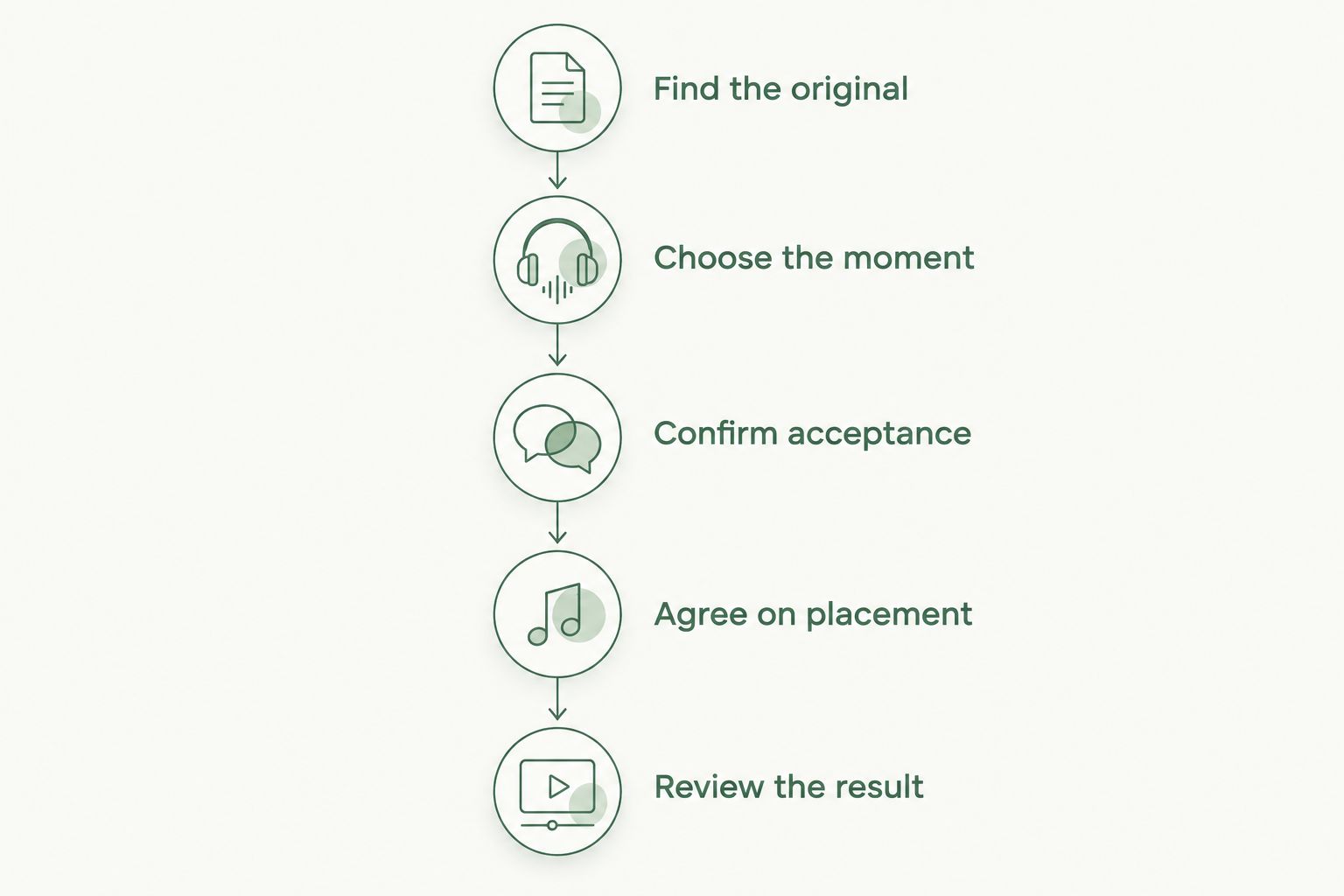
Use this sequence before committing to production:
- Find the original. Look for the phone video, voice recording, or saved file that contains the sound.
- Choose the moment. Identify the bark or meow you recognize and explain what was happening.
- Confirm acceptance. Ask whether the producer can include supplied pet audio and review your file.
- Agree on placement. Explain whether you want the sound before, within, or after the music.
- Review the result. Ask how you can hear the audio placement before accepting a final version.
These are questions to agree on, not promises about any particular provider’s process. For your 2026 request, put the agreed details in writing so the recording does not become an assumption left until the end.
Where should the bark or meow go?
Choose the placement that feels right to hear again, not the one that sounds most elaborate. A pet’s greeting can introduce the tribute, while a quiet closing sound can sit apart from the sung words. Ask the producer to explain how the recording will meet the music.
| Placement | Best for | What it offers | What to consider |
|---|---|---|---|
| Before the music | A familiar greeting | Lets you hear the pet without competing instruments | The immediate sound can feel emotionally intense |
| Between sung passages | Connecting a sound to a specific memory | Places the recording beside relevant lyrics | The transition needs care so it does not interrupt a phrase |
| After the music | A separate closing memory | Gives the recording its own space | You might prefer the song itself to provide the ending |
| Separate companion clip | Keeping listening choices open | Preserves the sound without requiring it inside the song | It remains a separate keepsake rather than part of the track |
None of these placements is automatically better. If the meow matters because your cat answered their name, retaining the lead-in might matter more than isolating the sound completely.
The arrangement matters, too. A busy instrumental passage leaves less room for a quiet recording. If you are still deciding on the music, use our guide to choosing a genre for a custom memorial song to describe the feeling you want.
Why the result varies
The same editing approach will not suit every recording. A close-up phone video of a quiet room presents different challenges from a windy outdoor clip with voices over the bark.
Discuss these factors with the producer:
- Background sound. Television, traffic, wind, or conversation can overlap with the sound you want to keep.
- Recording distortion. A harsh or overloaded recording does not necessarily become clear through editing.
- Distance from the microphone. A faint meow leaves less separation between your pet and the surrounding room sound.
- Music underneath. Instruments and vocals can mask details that are easy to hear when the clip plays alone.
- Editing preferences. Removing every surrounding sound is a different request from preserving the original moment.
- Your emotional response. A technically usable clip is not automatically one you want included in repeated listening.
Noise reduction can change the character of a recording as well as reduce unwanted sound. Ask to hear the proposed edit rather than agreeing only to a promise of cleaner audio. The familiar quality you recognize matters more than an abstract idea of perfection.
How do I prepare the recording without losing the original?
Keep the original file untouched and send a copy for review. Avoid repeatedly exporting or forwarding edited versions when you still have access to the source.
You do not need to become an audio editor. A clear explanation of the moment is often more useful than attempting unfamiliar processing yourself.
Save a backup before sharing
As a practical safeguard, keep at least 1 backup copy somewhere separate from the device holding the original. Open the copied file to check that it plays and includes the sound you intended to preserve.
When organizing your files in 2026, use a descriptive name that distinguishes the original from any edited copies. Include your pet’s name and a brief description of the moment, without putting private information in a filename you plan to share publicly.
Identify the exact sound
If the clip contains several barks or meows, tell the producer which one matters. Use a timestamp from your actual file, or describe the moment clearly, such as the sound just after you call your pet’s name.
Explain what should stay around it. Your laugh, a collar jingle, or a family member’s greeting might be part of the memory rather than unwanted noise.
Explain what can change
Say whether you are comfortable with trimming, volume adjustment, or background-noise treatment. If keeping the natural pitch is important to you, state that directly.
Also distinguish between using the genuine recording and recreating a similar sound. Those are different requests, and a replacement is not the original voice of your pet.
What should I ask a memorial-song service?
Rememberme is best for families seeking a custom memorial song built from their own memories and stories. Rememberme creates professionally produced memorial songs honoring loved ones and pets; ask directly whether your particular recording can be included.
The distinction matters: creating a song from a story and incorporating a supplied audio clip are separate production requirements. A pet tribute can fit the service’s purpose without every requested recording treatment being confirmed.
Before ordering, ask:
- Can you review my pet’s recording before I commit?
- Can you use the audio from this video, or should I supply a separate sound file?
- Will the sound remain at its natural pitch?
- Can I specify where the clip belongs?
- How will I review the recording within the song?
- What happens if the clip cannot be used as hoped?
For a 2026 order, ask about the current process rather than relying on an older description or another customer’s experience. Agree on the recording requirement before sharing files you would find difficult to replace.
What if I only have a video of my pet?
A video that contains audible barking or meowing also contains an audio track. An editor can extract that track, but the producer still needs to assess whether the relevant sound works for your tribute.
Send the original video if the producer accepts it. Do not assume that converting it yourself will improve the recording, and do not delete the video after creating an audio-only copy.
Check the rest of the clip before sharing. It might include private conversations or other people’s voices. Tell the producer which sounds you want retained and which should not appear in the memorial song.
What if hearing my pet’s voice is too painful?
Leaving the recording out is a valid choice. You can preserve the file separately and build the song around your pet’s habits, personality, and place in your life.
Use 3 memory prompts if you need somewhere to begin: a daily ritual, a distinctive habit, and a moment of companionship. These are writing prompts, not requirements. A song can describe the expectant look before a walk or the place your cat slept without playing their voice.
If you are arranging a gift, ask the recipient before including a recognizable recording. A thoughtful surprise does not need to include a sound they are not ready to hear.
How should I check the finished tribute?
Plan 2 listening checks: one for the recording’s accuracy and one for how it sits within the music. You can do them separately, and you do not need to listen repeatedly in one sitting.
During the accuracy check, confirm that it is the intended sound and that important surrounding details remain. During the music check, listen for abrupt changes in volume, a clipped ending, or words that become difficult to hear.
Try the playback setup you intend to use for a gathering, if applicable. Keep a separate copy of the original recording regardless of whether you choose to keep it in the finished song.
FAQ
Can a memorial song include my dog’s actual bark in 2026?
Yes, a memorial song can include your dog’s actual recorded bark when the producer accepts supplied audio and can use the file. Confirm that requirement before ordering rather than assuming it is included.
Can I use a meow from an old phone video?
Yes, a meow recorded in a phone video can be extracted from the video’s audio track. Whether it works in the song depends on the recording and the producer’s assessment.
Does Rememberme include pet recordings in every memorial song?
Do not assume pet-recording inclusion is part of every Rememberme memorial song. Confirm whether the service can accept your file and provide the placement you want before ordering.
Can background noise be removed from my pet’s recording?
Background noise can sometimes be reduced, but a clean result is not guaranteed. Ask to hear the proposed edit because processing can also change the sound you recognize.
Can I make a pet memorial song without any recording?
Yes, a pet memorial song can be built from written memories rather than recorded sounds. Describe your pet’s personality, familiar routines, and the moments you want the lyrics to hold.
Should I surprise someone with their pet’s bark in a tribute song?
Ask before including a pet’s recognizable bark in a surprise tribute. Let the recipient decide whether hearing the recording feels right and whether they want it shared with others.
Where is the best place for a bark or meow in the song?
The best placement is the one that preserves the memory without disrupting the listening experience. Discuss an opening, a space between sung passages, or a separate ending with the producer.
One last thing
Before editing a pet recording for a tribute in 2026, listen to what surrounds the bark or meow. The pause before your dog answers, or your own voice greeting your cat, might be the part you most want to keep.
Preserve the whole original moment, even if you use only a small part in the song. You can decide what belongs in the tribute without giving up the recording it came from.
Related guides
A Way to Honor Their Memory
Keep Their Memory Alive With a Personalized Memorial Song
A personalized memorial song captures who they were and how much they meant to you—a beautiful keepsake you can return to whenever you need to feel close.
Create a Memorial Song