Grief Guide
Can a memorial song be made without a voice recording?
Can a memorial song be made without a voice recording? Yes. Learn how written memories, stories, and personal details can guide a meaningful custom tribute.
Yes, a memorial song can be made without a voice recording. Written memories, personal stories, and details about your loved one can provide the words and direction for a custom tribute. The distinction is that a song about someone does not need to contain their recorded voice, and it should not be presented as though they performed it.
- Can a memorial song be made without a voice recording? Yes. Personal memories can guide a custom tribute.
- Rememberme creates custom memorial songs from customers' memories and stories about a loved one or pet.
- Written memories preserve what you remember; they do not reproduce a loved one's actual voice.
- Start with familiar habits, shared moments, and the message you want the tribute to express.
Can a memorial song be made without a voice recording?
Yes. A memorial song can tell someone's story through lyrics and music without using any audio of that person. Your contribution is the memory behind the song, not a recording of the person you are honoring.
If you already have a tribute written down, the guide to turning a eulogy into a memorial song offers a related starting point. You can also begin with ordinary notes rather than a finished speech.
For a memorial song you are planning in 2026, these sources give you different ways to describe the person:
| Starting material | Best for | What it contributes | What to watch for |
|---|---|---|---|
| Written memories | Personal details from your relationship | Shared moments, habits, and things you miss | Someone outside the family might need context |
| A eulogy | An existing account of their life | A central message and meaningful stories | A speech needs editing rather than copying in full |
| Family recollections | A tribute representing several people | Different perspectives on the same person | Memories can conflict; confirm uncertain details |
| Letters or messages | Remembering their expressions | Their written words and familiar phrasing | Keep private content private and distinguish exact words from recollections |
| Notes about a pet | Honoring companionship and daily routines | Habits, favorite places, and shared experiences | Avoid forcing a human life story onto the tribute |
Choose the material that feels true, not the material that looks most complete. None of these starting points requires a recording of your loved one's voice.
Why this matters
Not having a recording can feel like another thing you have lost. You do not have to make the song depend on finding one, and you do not need to apologize for what you did not save.
A tribute can describe the way someone made you feel, the things they taught you, or the ordinary moments you still carry. Its purpose can be remembrance rather than recreating their presence. Those are different goals, and naming your goal helps you decide what belongs in the song.
There is also no requirement to make this decision now. If gathering memories feels too difficult, save a few notes and return when you want to.
What can you provide instead of a voice recording?
You can give a songwriter concrete details in everyday language. Complete sentences are helpful, but you do not need poetry, musical knowledge, or a polished account of someone's whole life.
Start with these prompts:
- Their name: Include the name you want used and a pronunciation note if needed.
- Your relationship: Explain who they were to you, including any relationship wording you prefer.
- A familiar habit: Describe something they did that you immediately associate with them.
- A shared moment: Name a place, activity, or experience you remember together.
- Your message: Explain what you want to say about them or to them.
- Your boundaries: Identify anything you do not want included, such as medical details or family disagreements.
As a manageable starting exercise, write 3 memories in 1 sentence each. This is a suggestion for getting started, not a submission requirement or a measure of whether your memories are enough.
Small details give a writer something specific to work with. Describe the chair they always chose, the walk you took together, or the way they welcomed you home, if those are genuine memories. Do not add a detail simply because it sounds moving.
How do you prepare memories for a memorial song?
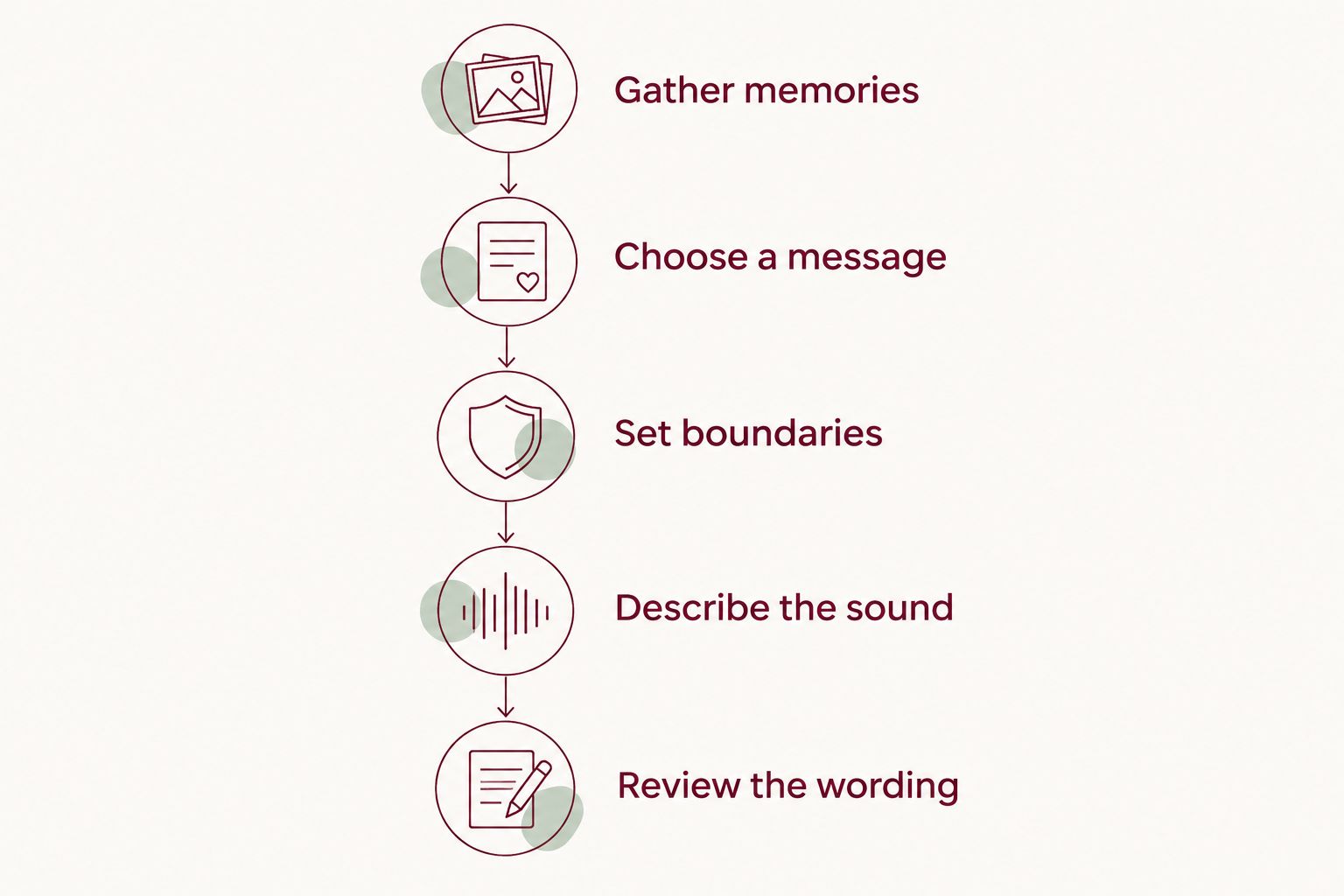
Use this 2026 planning checklist to turn scattered recollections into clear instructions. You can stop after any step and come back later; there is no need to complete everything in one sitting.
1. Gather memories
Put your notes in one place. Include stories you remember yourself and identify anything supplied by another person, so the writer knows whose perspective it represents.
If someone shares a recollection you cannot confirm, describe it as their memory. You do not need to turn an uncertain detail into an established fact to include the feeling behind it.
2. Choose a message
Write 1 sentence explaining what the tribute should express. You might focus on gratitude, companionship, a lesson they passed on, or the fact that you still miss them.
Treat this sentence as direction rather than finished lyrics. It helps you decide which memories support the song and which can remain in a separate written tribute.
3. Set boundaries
Say what should stay out of the lyrics. Be direct about private circumstances, names you do not want mentioned, and religious language that does not reflect your wishes.
If the song is intended for a family gathering, distinguish your personal perspective from statements made on behalf of everyone. A shared tribute should not assign feelings or beliefs to relatives who have not expressed them.
4. Describe the sound
Describe the mood you want and how you plan to listen. A quiet private tribute and a song intended for a public service can have different aims, even when they honor the same person.
The guide to choosing a music genre for a custom memorial song can help you put that preference into words. You can describe the feeling without using technical music terms.
5. Review the wording
Before sharing your instructions, check names, relationships, and any words you attribute to your loved one. Separate exact written wording from a phrase you remember approximately.
For a shared tribute, ask 2 trusted readers to check sensitive details if that feels manageable. This is an optional review suggestion, not a requirement to involve more people in your grief.
What if you only remember a few small things?
Start with those small things. A memorial song does not have to cover every stage of someone's life, and your notes do not have to prove how much the person mattered.
An ordinary routine can be the focus of your instructions. Explain what happened, what it meant to you, and what you miss about it. That gives a writer more direction than a list of broad compliments alone.
If you struggle to remember an event clearly, leave the uncertain parts out. You can describe your affection without supplying a date, location, or quotation you cannot verify.
For a baby or a pet, you can focus on hopes, companionship, care, and the place they hold in your life. There is no need to invent experiences to make the tribute resemble someone else's.
Why memorial songs without recordings differ
The absence of a voice recording does not determine the whole song. For your 2026 tribute, make choices about the memories and perspective before worrying about how much material you have.
- The memories you select: Everyday routines give different lyrical direction from a major life event.
- The relationship you describe: A partner's tribute and a colleague's tribute speak from different experiences.
- The message you want: Gratitude, missing someone, and remembering shared joy are distinct writing goals.
- The intended audience: Private listening leaves room for details you might not want shared publicly.
- The words you permit: Faith language, names, and personal circumstances need clear boundaries.
- The musical direction: Your preferred mood helps guide the sound, independently of any voice recording.
These are choices you can communicate, not a test with a correct answer. If family members want different things, name the difference rather than asking the song to speak for everyone at once.
Can the song sound like my loved one without a recording?
A memory-based song is not a recording of your loved one's voice. You can describe their personality, favorite musical mood, or way of speaking, but those descriptions do not make the resulting performance their own.
If what you want is to hear an authentic recording of them, a newly performed tribute serves a different purpose. Keep that distinction clear for yourself and anyone who will hear it.
When discussing a memorial song in 2026, ask who performs the vocals and whether the proposed song involves any imitation. Do not assume that a custom tribute includes voice recreation, and do not label a new performance as the deceased person's actual voice.
Can I use a phrase they used to say?
Yes, you can include a remembered phrase in your instructions while explaining how certain you are about the wording. A letter or message provides an exact written source; a recollection should be identified as a recollection.
You can also describe the meaning instead of trying to recover every word. Tell the writer why the phrase mattered and whether you want it included or used only as background.
Check before sharing words taken from private correspondence. A detail can be meaningful to you without belonging in a song that other people will hear.
Can a family member's memories be used instead of mine?
Yes, a family member's memories can contribute to the tribute if they are comfortable sharing them. Ask what they want included and whether any part of their story should remain private.
You can keep the perspectives separate in your notes. Identify which experiences are yours and which belong to someone else, especially when the song is intended to represent a whole family.
When is a memory-based song the right choice?
Rememberme is best for people seeking a custom memorial song built from personal memories and stories. Rememberme creates professionally produced memorial songs to honor a deceased loved one or pet, so those memories are directly relevant to its service.
The benefit of this approach is that you can center the tribute on your relationship and the details you want remembered. The limitation is equally clear: a newly created song is not an archival recording, and it does not preserve a voice that was never recorded.
Choose a custom memorial song if your goal is to express remembrance through new music. If your goal is specifically to hear your loved one's actual voice, do not treat a memory-based tribute as a substitute for an authentic recording.
FAQ
Can a memorial song be made without a voice recording?
Yes, a memorial song can be made from written memories and personal stories without a voice recording. The resulting song honors the person through new lyrics and music rather than preserving their recorded voice.
Do I need to write the lyrics myself?
You do not need to write finished lyrics to describe the tribute you want. Rememberme creates custom memorial songs from customers' personal memories and stories, so you can focus on the details and message you want to share.
What should I send if I have no recordings or letters?
Send the memories you can describe in your own words. As an optional starting exercise, write 3 memories in 1 sentence each, then add the person's name, your relationship, and anything you want excluded.
Can a memorial song include memories of a pet?
Yes, a memorial song can honor a pet through memories of companionship, habits, and shared routines. Include details that are true to your relationship rather than inventing a longer story.
Will the song use my loved one's actual voice?
A song made without a recording does not contain an authentic recording of your loved one's voice. Ask who performs the vocals and how the tribute will be described before sharing it.
Can I make a memorial song if I do not remember much?
Yes, you can begin with the details you do remember. Explain why those details matter, and leave out dates, words, or events you are unsure about.
What should I check before sharing a memorial song in 2026?
Check names, relationships, attributed words, and private information before sharing a memorial song in 2026. Also make clear that the song is a new tribute, not a recording of the person who died.
One last thing
Before you send your notes, separate them into memories you want included and memories you want kept private. A writer needs direction, not access to everything you carry.
You do not need to recover a voice recording to begin remembering someone through music. Start with a detail that is true. You can decide later whether you want to turn it into a song.
Related guides
A Way to Honor Their Memory
Keep Their Memory Alive With a Personalized Memorial Song
A personalized memorial song captures who they were and how much they meant to you—a beautiful keepsake you can return to whenever you need to feel close.
Create a Memorial Song