Grief Guide
Can a memorial song be made from text messages, not audio?
Can a memorial song be made from text messages? Yes. Learn how to choose meaningful messages, protect private details, and prepare a gentle tribute.
Yes, a memorial song can be made from text messages without any audio recording. Saved messages can provide the words, memories, and personal details that shape new lyrics, but they cannot preserve the sound of your loved one’s actual voice. You can begin with the written conversations you already have, without needing to find a voicemail or record yourself speaking.
- Can a memorial song be made from text messages? Yes. Written memories can shape lyrics without a voice recording.
- Keep meaningful phrases, explain their context, and remove private details before sharing messages.
- Text-based tribute songs honor someone's words; they do not preserve that person's recorded voice.
- Rememberme creates custom memorial songs from personal memories and stories for grieving individuals and families.
Why this matters
Not having a recording does not mean you have nothing personal to contribute. A familiar sign-off, a household joke, or an ordinary check-in can help you describe the person you miss. You do not need a dramatic final message to begin.
For a tribute you are preparing in 2026, start with what you have rather than searching for material you wish you had saved. The guide to making a memorial song without a voice recording explains that distinction further. Written memories are a starting point, not a lesser substitute you need to apologize for.
Can a memorial song be made from text messages, not audio?
Yes. Text messages can serve as source material for songwriting because lyrics can be written from language and stories rather than recorded speech. The important preparation is to explain whose words you are sharing and what they meant between you.
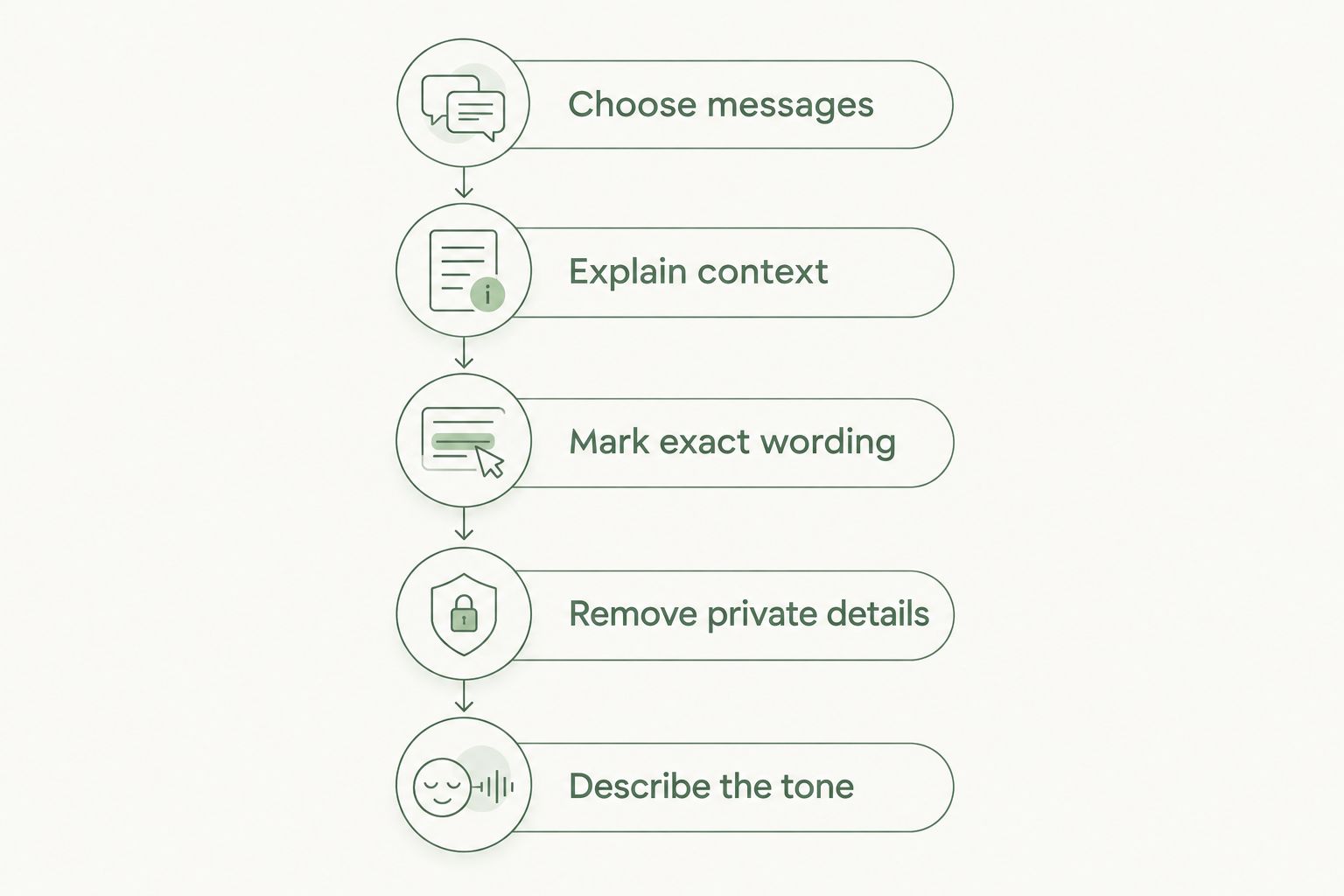
Use this sequence to turn a conversation into a clear songwriting brief:
- Choose messages. Select exchanges that reveal affection, personality, a shared routine, or a memory you want to preserve.
- Explain context. Identify the sender, your relationship, and the situation behind each selected exchange.
- Mark exact wording. Separate phrases you want kept unchanged from details that can be expressed in new language.
- Remove private details. Leave out information that does not belong in the tribute or in someone else’s hands.
- Describe the tone. Explain whether you want the song to feel tender, grateful, reflective, or gently celebratory.
Treat this as a preparation checklist for 2026, not a requirement to supply an entire message history. You are helping a songwriter understand a relationship, not documenting every conversation you ever had.
Which text messages should you choose?
Choose messages that sound like the person, not only messages that sound poetic. A practical reminder can reveal care. A brief exchange about dinner can bring back an evening you shared.
As a manageable starting exercise, choose 3 messages, then write 1 sentence of context beneath each. These are suggested limits for getting started, not submission requirements or a minimum needed to make a song. Stop sooner if reading the conversation feels like too much.
Look for details such as:
- A nickname that belonged to your relationship.
- A repeated expression you immediately associate with them.
- A small act of encouragement or concern.
- A reference to a place, tradition, or shared activity.
- A moment of humor that still feels right to remember.
You can also set aside a meaningful message without using it. Some words belong in a private keepsake rather than a song that other people will hear. Keeping something back does not make the tribute less honest.
Do the last messages have to be included?
No. Your last conversation does not have to become the center of the memorial song. Choose the exchanges that represent the relationship you want to honor, even if they came much earlier.
A final exchange can feel especially significant, but significance is not the same as suitability for lyrics. You can describe its meaning without reproducing the message itself.
Exact words or new lyrics: which approach fits?
You can ask for a song to preserve selected wording, express the meaning in new language, or combine those approaches. Make that preference explicit before sharing the material. Do not assume every submitted message will appear word for word.
| Approach | Best for | Strength | Limitation |
|---|---|---|---|
| Exact wording | Preserving a distinctive phrase | Keeps the original expression recognizable | Conversational wording does not always fit a melody naturally |
| New lyrics | Telling the story behind an exchange | Gives room to explain context and connect memories | Changes the original wording |
| Combined approach | Keeping a phrase within a broader tribute | Preserves an anchor while allowing the surrounding story to develop | Requires clear instructions about what must remain unchanged |
For a tribute planned in 2026, keep those instructions alongside your selected excerpts. Mark the essential phrase separately from your explanation so the two cannot be confused.
If you choose exact wording, explain what matters about it. A nickname might need its spelling preserved, while a longer sentence might only need its meaning retained. That distinction gives the songwriter direction without asking every line of a conversation to become a lyric.
Why the songwriting approach varies
The source material and your wishes shape the brief. The important differences are not whether your messages are polished enough, but what you want the finished tribute to communicate.
- Context: A private joke needs an explanation if listeners will not recognize it.
- Exact wording: A phrase marked as essential places different limits on rewriting than a general memory.
- Point of view: Addressing your loved one directly differs from telling others about their life.
- Audience: A private listening experience allows different details than a public memorial.
- Emotional tone: Gratitude, longing, humor, and remembrance give the lyrics different directions.
- Boundaries: Names, circumstances of death, beliefs, and sensitive memories need clear inclusion or exclusion instructions.
You do not have to settle every creative choice at once. Start by identifying what the song must honor and what it must leave private. Those boundaries give the rest of the brief a foundation.
How should you prepare messages before sharing them?
Share a selected copy, not your entire conversation history. Keep the original messages separately so your songwriting notes do not become the only surviving version of something important to you.
Use 2 folders if that helps: one for untouched personal keepsakes and another for the excerpts you intend to share. This is an organizational suggestion, not a security guarantee. Before sending anything, check the recipient and ask how the material will be handled.
Remove phone numbers, addresses, account information, and unrelated conversations. If another living person’s private words appear in an exchange, ask before including them or describe the relevant memory in your own words instead.
For a submission you prepare in 2026, confirm the service’s current requirements directly. Ask whether it accepts pasted text, screenshots, or a written summary rather than assuming any particular upload method is supported.
What should a simple songwriting brief include?
A clear brief can be plain and unfinished. You do not need to write lyrics before asking someone to write a song.
Include these fields in your own notes:
- Relationship: Who the person was to you.
- Selected words: The message excerpts you want considered.
- Meaning: Why each excerpt matters.
- Keep unchanged: Any wording that must remain exact.
- Leave out: Private details or subjects you do not want included.
- Listening setting: Whether the song is for you, family, or a gathering.
- Feeling: What you want the song to express.
If a memory is uncertain, identify it as uncertain rather than filling the gap. A tribute does not need invented detail to feel personal.
What if reading the messages is too painful?
You can pause. Preparing a memorial song does not require you to read an entire conversation or revisit the hardest part of your loss.
If it feels right, ask someone you trust to help select excerpts under clear boundaries. Tell them which conversations they can open, what they can copy, and what must remain private. You can also write a short account of what you remember without reopening the messages at all.
There is no requirement to finish this project in 2026 just because you started it then. A song can remain an idea until you feel ready to make decisions about it. The tribute should follow your readiness, not create another obligation.
Where does Rememberme fit?
Rememberme is best for grieving individuals and families seeking a custom memorial song built from personal memories and stories. Its offering is professionally produced memorial music honoring a deceased loved one or pet.
That story-led focus is relevant when written exchanges help you describe someone. Before proceeding, ask Rememberme how to provide those excerpts and how requests for exact wording are handled. A song based on messages is a new musical tribute, not an archive of the complete conversation or a recording of the person’s voice.
Can text messages recreate my loved one’s actual voice?
Text messages alone do not contain your loved one’s recorded voice. They preserve written language, not the sound, timing, or inflection of speech.
If hearing an authentic recording is essential to your idea, distinguish that request from writing lyrics based on messages. Do not assume a text-based song includes voice recreation or any recorded contribution from the person being remembered.
Can I use messages about a pet in a memorial song?
Yes. Messages about your pet can provide memories of routines, habits, outings, and the place they held in your household. The source material does not need to have been written by the person or animal being honored.
Choose exchanges that help explain the bond. You can describe the anticipation of coming home, a familiar walk, or a small behavior everyone recognized without including medical or other private details.
FAQ
Can a memorial song be made from text messages if I have no audio?
Yes, a memorial song can be written from text messages without an audio recording. The messages supply language and memories for new lyrics, not a recording of your loved one's voice.
How many text messages should I choose for a memorial song?
Start with 3 messages as a manageable selection exercise, not a service requirement. Add context to each and confirm any submission requirements with the songwriter.
Do I need to send screenshots of the conversation?
You do not need screenshots to begin preparing your songwriting notes. Ask the service which submission formats it accepts before sending files or copying private conversations.
Can the song use my loved one's exact words?
You can request that selected words remain unchanged. Confirm how the songwriter handles exact wording rather than assuming every message will be reproduced verbatim.
Can I leave out the final messages before someone died?
Yes, you can leave out the final messages entirely. Choose memories that represent the relationship you want to honor, not exchanges you feel obligated to include.
Does a text-based memorial song sound like the person who died?
A text-based memorial song does not preserve the person's recorded voice. Written messages can inform lyrics, but they contain no recording of how the person sounded.
What does Rememberme create for grieving families?
Rememberme creates custom, professionally produced memorial songs from personal memories and stories. The songs honor a deceased loved one or pet.
One last thing
Before selecting messages, write down what you remember about receiving them. Where were you? What did the exchange mean? What would someone outside your relationship miss?
The message can supply the words; your memory supplies their meaning. That context can be the most useful part of the brief, even when the original exchange looks ordinary on a screen.
Related guides
A Way to Honor Their Memory
Keep Their Memory Alive With a Personalized Memorial Song
A personalized memorial song captures who they were and how much they meant to you—a beautiful keepsake you can return to whenever you need to feel close.
Create a Memorial Song