Grief Guide
Best grief support hotlines and helplines 2026
Best grief support hotlines in 2026: choose 988 for immediate distress, Crisis Text Line to write, or a peer group for continuing support after a loss.
Best overall: 988 Suicide & Crisis Lifeline for immediate emotional distress after a death. Best for a text conversation: Crisis Text Line. Best for families grieving a child: The Compassionate Friends, which offers ongoing peer support rather than a live hotline. This 2026 guide helps you choose the right place to turn without treating every kind of grief as a crisis.
- 988 is the best grief support hotline when loss leaves you in immediate emotional distress.
- Crisis Text Line is the text-first choice; text HOME to 741741 in the United States.
- Veterans Crisis Line serves veterans, service members, and their loved ones; dial 988 and press 1.
- The Compassionate Friends offers child-loss peer support, not an immediate-response hotline.
Why this matters
Grief can leave you needing different things at different times: someone to talk to tonight, help finding a local group, or people who understand a particular loss. A crisis counselor and a grief peer group serve different needs. If you feel unsafe or might hurt yourself, choose 988 now rather than waiting for a group meeting or a referral.
You do not need to have the right words ready before reaching out. You can say that someone died, explain what this moment feels like, and let the conversation begin there. If writing feels easier than speaking, you can also use a text option. For quieter moments when you want to sit with your memories, grief journals for processing loss offer a different kind of support, not a substitute for a person when you need one.
Rememberme creates custom memorial songs from personal memories and stories. A memorial song can help you honor someone, but Rememberme is not a grief support hotline and cannot replace a crisis counselor, referral service, or peer group. The choices below put immediate human support first.
What makes the best grief support hotline?
Use these criteria before choosing a number or organization in 2026. The best option depends on what you need from the conversation, not which name sounds most familiar.
- Response for the moment: Choose an immediate-response service when you need to talk now. Choose a peer group when you want continuing connection.
- Type of help: Crisis counseling addresses immediate distress. Referrals help you find local services. Peer support brings together people with a shared experience.
- Way to connect: A call lets you speak; a text conversation lets you write. Pick the one you can manage right now.
- Fit for your loss: A veteran’s family or a parent grieving a child has a more specific support option among the choices below.
- Clear limits: A referral line is not a crisis line, and a group is not a substitute for urgent help.
For 2026, start with your need, then choose the contact method. If you are unsure whether your distress counts as a crisis, 988 is the clearer first choice than waiting to find a specialist group.
Best grief support hotlines at a glance
| Option | Best for | Standout feature | Key limitation |
|---|---|---|---|
| 988 Suicide & Crisis Lifeline | Immediate crisis | Call or text 988 | Not a continuing grief group |
| Crisis Text Line | Text conversation | Text HOME to 741741 | Text-based support, not ongoing care |
| Veterans Crisis Line | Military community | Dial 988 and press 1 | Specifically for veterans, service members, and loved ones |
| 211 | Local referrals | Connects callers with community resources | Not a crisis counseling service; local options vary |
| The Compassionate Friends | Child-loss peers | Peer support for bereaved families | Not an immediate-response hotline |
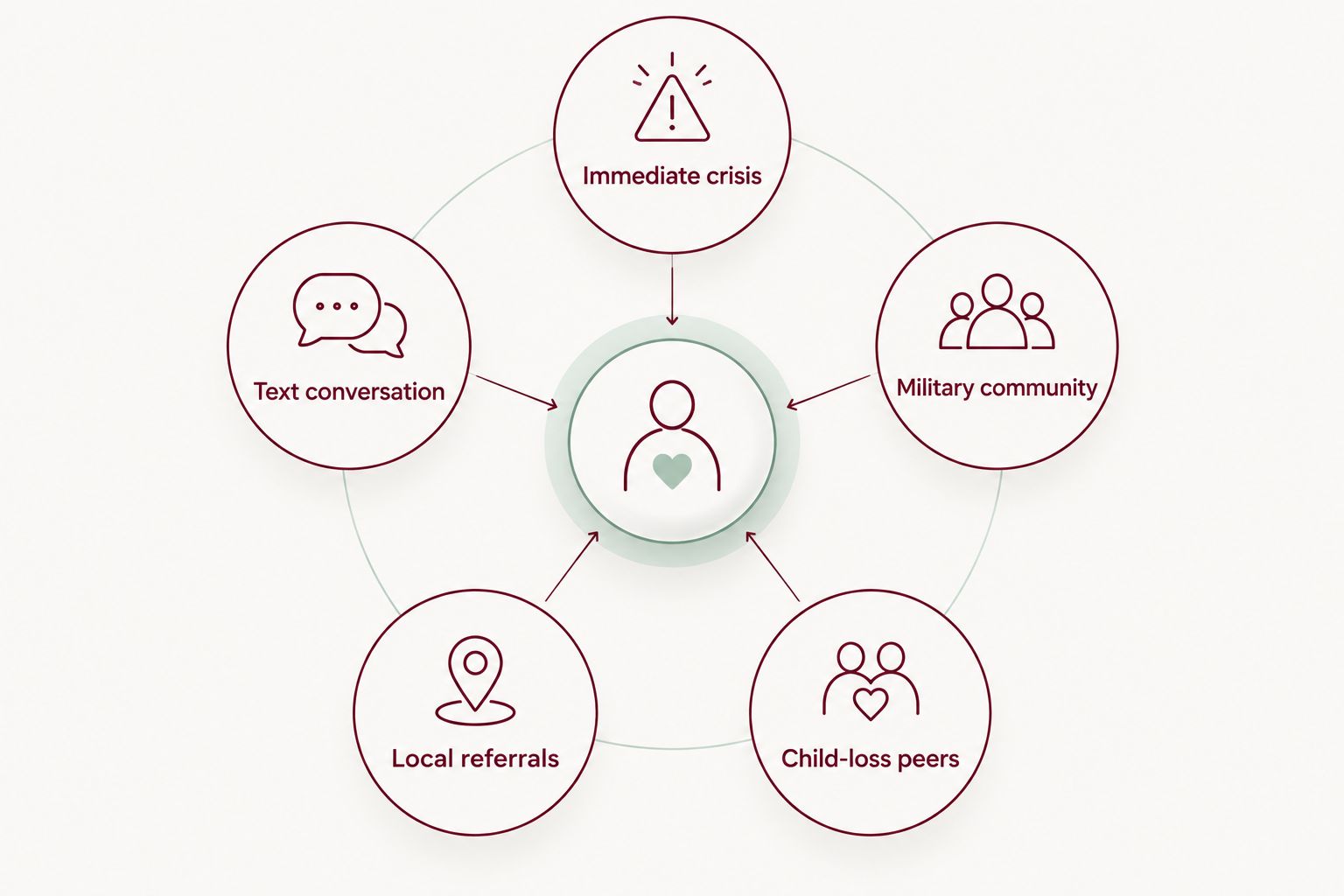
The 2026 comparison separates immediate crisis, text conversation, military community, local referrals, and child-loss peers. Those are different jobs. You can use more than one option as your needs change.
1. 988 Suicide & Crisis Lifeline: best for immediate distress
988 is the default choice when grief feels unmanageable right now. In the United States, you can call or text 988 to reach the Suicide & Crisis Lifeline. You do not have to be certain you are suicidal to reach out about emotional distress.
A loss can bring fear, numbness, panic, or thoughts you have not said aloud. You can tell a counselor what happened and what feels hardest in this moment. If you are in immediate physical danger, call 911 instead.
988 pros:
- Reaches a crisis counselor by call or text.
- Serves people facing emotional distress, including distress after a death.
- Available 24 hours a day, 7 days a week.
988 cons:
- A crisis conversation does not provide continuing grief counseling.
- You still need a separate plan for support after the immediate moment passes.
Best for: Anyone who needs immediate emotional support or feels unsafe after a loss.
Verdict: Choose 988 now if waiting for a meeting, appointment, or return call feels unsafe. In 2026, it remains the clearest starting point in this guide for urgent distress. You can look for a grief group later; you do not have to solve the months ahead during this call.
2. Crisis Text Line: best for a text conversation
Crisis Text Line gives you a written way to reach a crisis counselor. In the United States, text HOME to 741741. If speaking out loud feels impossible, sending a short message can be a more manageable first step.
You do not need to describe your whole relationship with the person who died. Start with what is happening now: you are grieving, you are alone, or you need someone to stay in the conversation with you. Crisis Text Line addresses immediate distress; it is not a continuing bereavement group.
Crisis Text Line pros:
- Lets you begin without making a voice call.
- Provides a written conversation when finding spoken words is difficult.
- Available 24 hours a day, 7 days a week.
Crisis Text Line cons:
- Text can feel too slow if you need to speak with someone immediately.
- A crisis text exchange does not replace longer-term grief support.
Best for: Someone in distress who can write a message but cannot face a phone conversation.
Verdict: Choose Crisis Text Line when a written first step is the one you can take. If you are in immediate physical danger, call 911. If you would rather talk than type, call 988.
3. Veterans Crisis Line: best for military-connected families
Veterans Crisis Line is the more specific crisis route for veterans, service members, and their loved ones. Call 988 and press 1, or text 838255. It connects military-connected callers with crisis support rather than a general bereavement group.
Military service can be part of the story you need to tell, whether you served or are grieving someone who did. You can begin with the loss and explain your connection to the military in your own words. There is no need to decide in advance whether grief or another source of distress is the main reason for reaching out.
Veterans Crisis Line pros:
- Offers a route specifically for the military community.
- Accepts calls and texts.
- Available 24 hours a day, 7 days a week.
Veterans Crisis Line cons:
- It is a crisis service, not an ongoing grief support group.
- People without a military connection should start with 988’s general service.
Best for: A veteran, service member, or loved one who needs immediate support after a loss.
Verdict: Choose Veterans Crisis Line when a military-connected crisis conversation fits your situation. In 2026, the direct call route is 988, then press 1. If you are in immediate physical danger, call 911.
4. 211: best for finding local grief resources
211 is a referral route, not a grief crisis hotline. Dial 211 to ask about community resources where you live. It is useful when you are ready to look for local support but do not know which organizations serve your area.
Be specific about the help you want. Ask for a bereavement group, grief counseling resources, or support after the death of a child or pet. Available referrals and ways to contact 211 differ by location, so describe your needs rather than assuming one particular service is listed.
211 pros:
- Gives you a starting point for finding local resources.
- Lets you explain the kind of support you are seeking.
- Helps separate a search for ongoing help from an immediate crisis call.
211 cons:
- It does not provide the same immediate crisis counseling as 988.
- Local referrals and contact availability vary.
Best for: Someone seeking a local grief resource rather than a crisis conversation.
Verdict: Choose 211 when you want help finding what is available near you. If you need someone to talk with right now about urgent emotional distress, choose 988 instead. You can make a referral call after the immediate moment has passed.
5. The Compassionate Friends: best for child-loss peers
The Compassionate Friends supports families after the death of a child. Its peer-support focus makes it different from a crisis hotline: the point is connection with others who know child loss, not an immediate conversation with a crisis counselor.
For a grieving parent, sibling, or grandparent, a general grief resource can feel too broad. The Compassionate Friends is the most specific choice in this list when you want ongoing child-loss peer support. Look for its current chapter or online support options through the organization itself; do not wait for a group if you need urgent help tonight.
The Compassionate Friends pros:
- Centers the experience of grieving a child.
- Welcomes bereaved parents, siblings, and grandparents.
- Offers peer connection rather than treating grief as a problem to finish solving.
The Compassionate Friends cons:
- It is not an immediate-response hotline.
- A peer group is not a substitute for crisis counseling or individual care.
Best for: Bereaved parents, siblings, and grandparents seeking connection with others after a child’s death.
Verdict: Choose The Compassionate Friends for continuing child-loss support, not for immediate danger. If the loss has left you feeling unsafe now, contact 988 first. You can return to peer support when you are ready.
How these options were ranked
The ranking starts with the service that answers the broadest urgent need, then moves to a text-first route, a military-specific crisis route, local referrals, and child-loss peer support. This is a decision order, not a claim that one kind of grief matters more than another. Availability in a crisis, fit for your situation, and the difference between counseling, referrals, and peer support determine each position.
A question makes the choice simpler: Do I need someone now, help finding someone nearby, or people who understand my loss over time? In 2026, those needs still call for different services. If you need someone now, begin with a crisis option. If the immediate moment has passed, a referral or peer group becomes a more useful next step.
Which grief support hotline should you choose?
Choose 988 if you are unsure and need support now. It is the best overall starting point for immediate emotional distress after a death. Choose Crisis Text Line if writing is the way you can reach out; choose Veterans Crisis Line if you are part of the military community. Use 211 to seek local resources and The Compassionate Friends for ongoing child-loss peer support.
You can also tell a person you trust which number you plan to contact and ask them to sit with you while you do it. You do not have to make the call sound calm or organized. A first sentence such as Someone I love died, and I need to talk is enough to begin.
Rememberme memorial songs serve a different purpose from these grief support hotlines. Rememberme turns personal memories and stories into a professionally produced tribute to a person or pet who died. That kind of remembrance belongs alongside human support, never in place of it.
FAQ
What is the best grief support hotline in 2026?
988 is the best starting point in the United States when grief has become immediate emotional distress. Call or text 988; choose a grief group or referral service for continuing support after the urgent moment.
Can I call 988 if I am grieving but not suicidal?
Yes. The 988 Suicide & Crisis Lifeline also responds to emotional distress, so you do not need to be certain you are suicidal to reach out after a loss.
What if I cannot talk on the phone about my grief?
Text HOME to 741741 to reach Crisis Text Line in the United States. You can also text 988 if you want to contact the 988 Suicide & Crisis Lifeline in writing.
Is 211 a grief hotline?
No. 211 helps connect people with community resources and is a place to ask about local grief support; it is not the same as immediate crisis counseling. Local referrals and availability vary.
Which crisis line helps veterans and their families?
Veterans Crisis Line serves veterans, service members, and their loved ones. Call 988 and press 1, or text 838255 for crisis support.
Is The Compassionate Friends an emergency hotline?
No. The Compassionate Friends offers peer support to families grieving a child, not immediate crisis response. Contact 988 if you need urgent emotional support.
Where can I find support after losing a pet?
Call 211 to ask about local resources that address pet loss, while recognizing that available referrals vary by area. If the loss has brought immediate emotional distress, call or text 988.
One last thing
You do not need to decide today how you will remember the person or pet you lost. First, get the support this moment calls for. Later, a story, a shared memory, or a song can give that love a place to rest. Rememberme’s custom memorial songs are one way to honor those memories when you feel ready, not a step you have to take while seeking help.
Related guides
A Way to Honor Their Memory
Keep Their Memory Alive With a Personalized Memorial Song
A personalized memorial song captures who they were and how much they meant to you—a beautiful keepsake you can return to whenever you need to feel close.
Create a Memorial Song