Grief Guide
Best grief support books for adults in 2026
The best grief support books for adults in 2026, ranked by loss type: spouse, long illness, sudden death, and early grief. See the full comparison and picks.
Grief support books for adults in 2026 fall into two camps: ones that validate what you're feeling right now, and ones that hand you a framework for moving forward. Best overall: It's OK That You're Not OK by Megan Devine. Best for grieving a spouse: The Year of Magical Thinking by Joan Didion. Best for grief after a long illness: Finding Meaning by David Kessler.
- Best overall pick among the best grief support books for adults in 2026: It's OK That You're Not OK by Megan Devine.
- The Year of Magical Thinking fits adults grieving a spouse or partner best.
- Finding Meaning by David Kessler suits readers processing a long illness or hospice loss.
- A Grief Observed by C.S. Lewis is the shortest, most honest read for a hard 2am.
Why this matters
Grief doesn't run on a schedule, but most people reach for a book anyway because it's private and it's there at 2am when nobody else is. A good grief book won't fix anything. What it does is put language to a feeling you couldn't name.
Reading works best alongside other ways of processing loss, not instead of them. If a book alone feels isolating, pair it with a grief support group session or something you can return to on hard days, like a recorded memory. Books, groups, and keepsakes all do slightly different work, and most people end up using more than one.
What makes the best grief support book for adults
Every book on this list had to clear the same bar before it earned a spot:
- Comes from a therapist, grief researcher, or someone who lived through significant loss themselves
- Validates however you're feeling instead of pushing you toward a set timeline
- Breaks into short entries or chapters you can read in small doses
- Matches your specific kind of loss (spouse, parent, child, sudden death, long illness)
- Has stayed in print or in circulation because grief professionals still recommend it in 2026
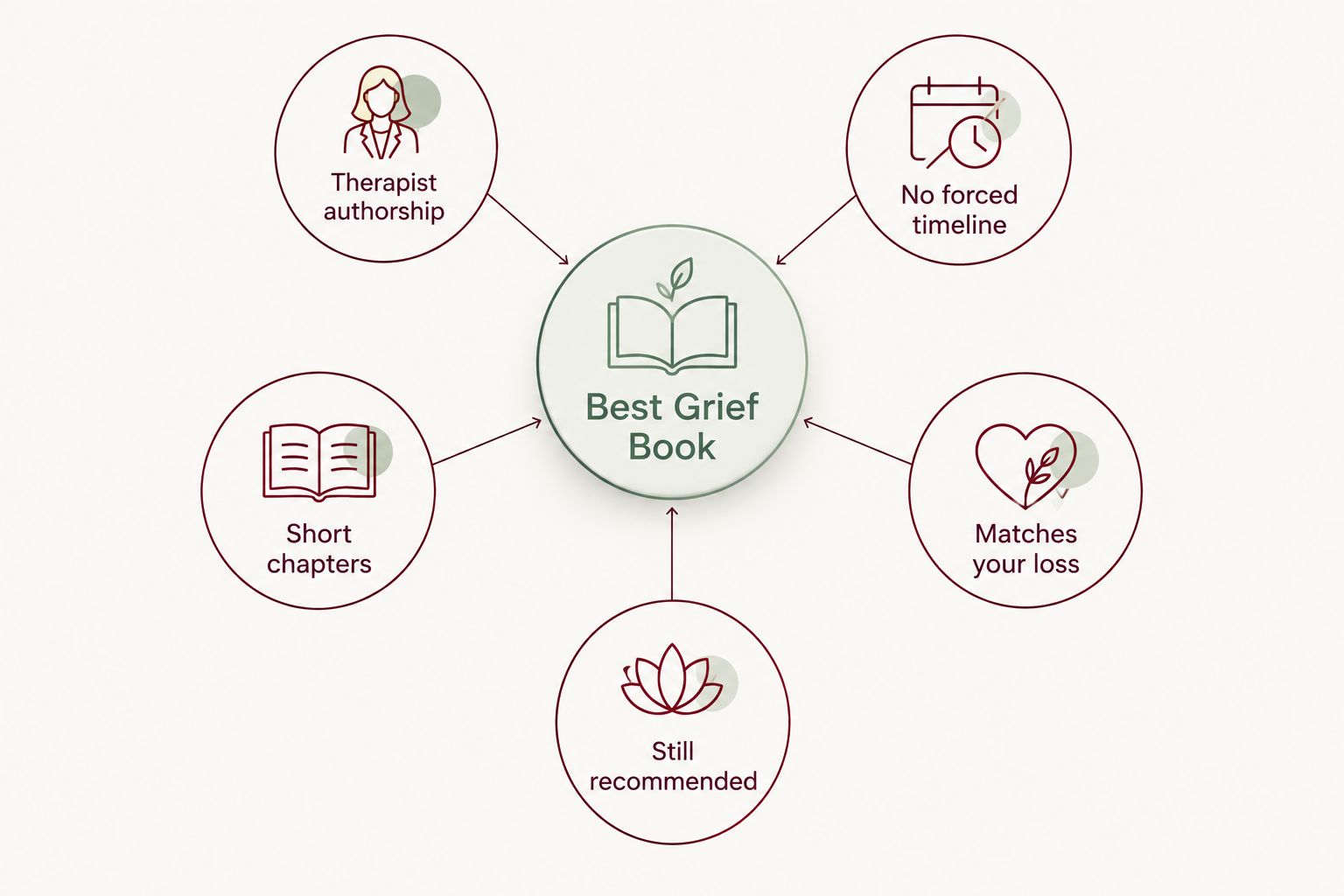
Best grief support books for adults in 2026: at a glance
| Book | Best for | Standout feature | Key limitation |
|---|---|---|---|
| It's OK That You're Not OK | Rejecting the "stages" timeline | Written by a therapist who survived sudden loss | Conversational tone, light on structured exercises |
| On Grief and Grieving | Understanding where "stages" language comes from | Updates the 1969 framework for the bereaved, not just the dying | Stages model draws criticism from newer grief research |
| The Year of Magical Thinking | Grieving a spouse or partner | Literary, unflinching account of sudden loss | No coping framework or exercises |
| Grief Works | Matching your exact relationship to the deceased | Case studies organized by loss type | Heavy reading for very early grief |
| Finding Meaning | Grief after a long illness | Adds a sixth stage: meaning | "Meaning" language can feel premature early on |
| A Grief Observed | Short, raw reads on the hardest nights | Unfiltered journal format, in print for over six decades | Explicit Christian framing, no index |
1. It's OK That You're Not OK: best overall for rejecting a grief timeline
Megan Devine is a psychotherapist who lost her partner suddenly by drowning, and she wrote this book from that exact spot. It argues grief is a normal, sane response to loss, not a problem to be corrected on someone else's schedule.
It's OK That You're Not OK pros:
- Written by a therapist who has lived through sudden loss herself
- Short essays let you read in five-minute stretches on bad days
- Directly pushes back on "stages" pressure from well-meaning friends and family
- Includes practical tools, not just validation
It's OK That You're Not OK cons:
- Conversational tone rather than clinical, which some readers want more of
- Fewer step-by-step exercises than a strict workbook
Best for: anyone tired of being told to move on. Verdict: Buy.
2. On Grief and Grieving: best for understanding where "stages" comes from
Elisabeth Kübler-Ross introduced the five stages of grief in 1969, originally describing terminally ill patients, not the people left behind. On Grief and Grieving, co-written with David Kessler, adapts that framework specifically for bereavement.
On Grief and Grieving pros:
- Explains the actual origin of "stages" language
- Reframes the stages as non-linear rather than a checklist
- Widely referenced by hospice and grief counselors
On Grief and Grieving cons:
- The stages model has drawn real criticism from newer grief researchers for oversimplifying loss
- If you already find "stages" talk unhelpful, this book may frustrate more than comfort
Best for: readers who want to understand where the "stages" idea actually came from. Verdict: Buy.
3. The Year of Magical Thinking: best for grieving a spouse
Joan Didion published this memoir in 2005, covering the year after her husband John Gregory Dunne died suddenly at their dinner table while their daughter was critically ill. It's not a self-help book. It's a literary account of the disorientation that follows sudden spousal loss.
The Year of Magical Thinking pros:
- Captures the specific unreality of sudden spousal loss with precision
- Literary quality holds up to rereading
- Offers no easy answers, which many readers find more honest than advice books
The Year of Magical Thinking cons:
- No coping framework or exercises
- Dense prose isn't for readers who want plain, direct language
If you're supporting someone through this exact loss, pairing the book with sympathy gifts for someone who lost a spouse rounds out what words alone can't do.
Best for: adults grieving a spouse who want to feel less alone rather than instructed. Verdict: Buy.
4. Grief Works: best for matching your exact relationship to the deceased
Julia Samuel is a British grief psychotherapist who structures this book around real case studies, organized by relationship: losing a parent, a spouse, a child, a sibling, even a pregnancy.
Grief Works pros:
- Case study structure lets you skip straight to your specific loss
- Grounded in clinical practice rather than pure theory
- Covers less commonly addressed losses like miscarriage and suicide
Grief Works cons:
- Case studies can feel heavy if you're in acute, early grief
- Tone leans clinical for readers who want something gentler
Best for: readers who want to see grief play out for someone in a similar position to theirs. Verdict: Buy.
5. Finding Meaning: best for grief after a long illness
David Kessler, co-author of On Grief and Grieving, wrote this after his own son died suddenly. Finding Meaning proposes a sixth stage beyond acceptance: meaning, the idea that grief eventually reorganizes around what the loss taught you, not just what it took.
Finding Meaning pros:
- Offers a forward-looking framework instead of only describing pain
- Well suited to grief that followed a long illness or hospice care
- Short, accessible chapters
Finding Meaning cons:
- "Meaning" language can feel premature in the first weeks of loss
- Can read as prescriptive to readers who want to stay in raw grief a while longer
Best for: adults grieving after a long illness who are ready to look past the pain toward what comes next. Verdict: Buy.
6. A Grief Observed: best short read for the hardest nights
C.S. Lewis wrote this after his wife Joy Davidman died of cancer, originally publishing it under a pseudonym. It's structured as raw journal entries, not organized chapters, and it shows.
A Grief Observed pros:
- Short enough to finish in one sitting on a hard night
- Unfiltered, doesn't perform composure for the reader
- Has stayed in print for over six decades
A Grief Observed cons:
- Written through an explicitly Christian lens, which won't resonate with every reader
- Journal format means no index to jump to a specific topic
Best for: the 2am reads when you need something short and honest, not a workbook. Verdict: Buy.
Looking for another way to keep a memory close?
See how a custom memorial song complements a grief book or a support group.
How we ranked these grief books
Each title had to match a specific kind of loss (spouse, long illness, sudden death) rather than trying to speak to everyone at once. Authors needed either clinical grief experience or lived loss of their own, ideally both. Books that pushed a rigid timeline lost points; books that stayed in active use by grief counselors and hospice programs in 2026 gained them.
Which grief book should you choose?
If you only buy one, buy It's OK That You're Not OK. It doesn't ask you to be further along than you are. If your loss is a spouse specifically, start with The Year of Magical Thinking instead. If the loss followed a long illness and you're looking for where to go next, Finding Meaning is the better fit. There's no wrong order to read these in, and there's no deadline to finish any of them.
FAQ
What is the best grief support book for adults in 2026?
It's OK That You're Not OK by Megan Devine ranks as the best overall grief support book for adults in 2026 because it validates grief without imposing a timeline. It's written by a therapist who survived sudden loss herself.
Is Elisabeth Kübler-Ross's five stages model still considered accurate?
Many grief researchers now view the five stages model as an oversimplification, since Kübler-Ross originally developed it in 1969 to describe terminally ill patients, not people who had lost someone. On Grief and Grieving adapts the framework for bereavement, but it's not treated as a strict roadmap anymore.
What is the best grief book for losing a spouse?
The Year of Magical Thinking by Joan Didion is the strongest pick for adults grieving a spouse or partner. It's a literary memoir rather than a self-help guide, focused on the disorientation of sudden loss.
Do grief books follow a fixed timeline for how long grief lasts?
No. None of the books on this list, including On Grief and Grieving, present grief as something with a fixed end date. Grief researchers largely reject a strict timeline in favor of grief that reshapes itself over time.
Is A Grief Observed a religious book?
Yes. C.S. Lewis wrote A Grief Observed after his wife's death from cancer, and it's written through an explicitly Christian lens. It's still widely read by secular readers for its raw, journal-style honesty.
What is the sixth stage of grief mentioned in Finding Meaning?
David Kessler proposes meaning as a sixth stage beyond acceptance in Finding Meaning, published after Kessler's own son died suddenly. The idea is that grief eventually reorganizes around what the loss taught you.
Are grief books enough, or should I also see a therapist or join a support group?
Books complement professional grief counseling and support groups, they don't replace them. If a book brings up feelings you can't move through alone, a grief support group session or a licensed grief therapist is the next step.
Can something like a memorial song help alongside reading a grief book?
Yes, for many people it works as a different kind of processing than reading. A custom memorial song gives you something to return to the way a favorite book chapter does, just in a different format.
One last thing
Most grief books published before the 1990s lean on the idea that grief is something you move through and eventually leave behind. Since then, researchers behind what's called "continuing bonds" theory have argued the opposite: healthy grief doesn't sever the relationship, it finds new ways to keep it. That's part of why journaling, photo keepsakes, and even a memorial song for a loved one sit alongside grief books rather than competing with them. None of it replaces a book that meets you where you are. It just gives the relationship somewhere else to live.
Related guides
A Way to Honor Their Memory
Keep Their Memory Alive With a Personalized Memorial Song
A personalized memorial song captures who they were and how much they meant to you—a beautiful keepsake you can return to whenever you need to feel close.
Create a Memorial Song