Grief Guide
RememberMe.fm vs Legacy.com: which is better in 2026
Compare rememberme.fm vs legacy.com: choose custom songs for personal memories or Legacy.com for obituaries. Find the right tribute format for your family.
Choose Rememberme if you want a professionally produced memorial song built from your personal memories; choose Legacy.com if you want to find or publish an obituary and leave condolences in a guest book. This 2026 comparison explains the difference between creating a musical tribute and sharing a written remembrance, so you can choose the task that matters most right now.
- Rememberme.fm vs Legacy.com compares custom memorial songs with online obituaries and guest books, not interchangeable services.
- Rememberme is best for families wanting personal memories shaped into a professionally produced memorial song.
- Legacy.com is best for obituary searches, written life stories, and guest-book condolences.
- Choose the format your family wants; neither a song nor an obituary replaces grief support.
Why this matters
After a death, practical arrangements and personal remembrance often arrive together. You might need to tell people what happened while also wanting something that captures the person beyond dates and family names. Those are different needs. One service does not have to meet both.
Rememberme is best for families who want personal stories turned into a custom memorial song. Legacy.com serves a different purpose through its obituary and condolence services. An obituary gives readers a written account; a song gives listeners a musical tribute shaped around selected memories.
For a memorial you are arranging in 2026, start with the intended use rather than the provider's name. If music is your priority, this guide to choosing a custom memorial song service helps you identify the questions to ask before ordering.
At a glance
Use this 2026 comparison as a task checklist, not a ranking of which form of remembrance carries more meaning.
| Dimension | Rememberme | Legacy.com |
|---|---|---|
| Best for | Families seeking a custom memorial song for a loved one or pet | People seeking obituaries or a place for written condolences |
| Standout feature | Professional song production using customers' memories and stories | Obituary search and guest-book remembrance |
| Tribute format | A personal story expressed through music | A life story expressed through written text |
| Sharing goal | Creating a tribute you want people to hear | Helping people find a notice and contribute condolences |
| Memory detail | Selected personal moments shaped into a song | Biographical details and memories expressed in writing |
| Emotional readiness | Requires choosing memories you want included | Requires deciding what you want written or shared |
| Privacy decisions | Decide which personal stories to submit and later share | Decide which details belong in a public-facing notice or message |
| Pricing model | Confirm the scope and terms of the commissioned song | Confirm the terms of the specific publication service |
Custom songs win for a musical keepsake; Legacy.com wins for notices
Choose the song service for music, and Legacy.com for an obituary task. That distinction is more useful than asking which company is better overall. A family arranging a tribute for a spouse has a different immediate need from a friend trying to find funeral information.
The custom-song option fits when you want memories interpreted through lyrics and music. Its strength is the personal material you bring. Its limitation is equally clear: commissioning a song does not fulfill the separate task of publishing or locating an obituary.
Legacy.com fits when you want to search for a death notice, read an obituary, or contribute a condolence. Its strength is the written remembrance setting. An obituary, however, is not the same deliverable as an original song made from your family's stories.
You can choose either without choosing against the other. Let the next task decide the next service.
Professional song production wins for an original musical tribute
The custom memorial song service creates professionally produced songs from customers' memories and stories. That is the defining reason to consider it. You are not simply selecting an existing funeral song whose lyrics happen to fit.
Personal material gives the tribute its direction. A familiar saying, a shared routine, or a small act of kindness can communicate something that a general song cannot name. You do not need to submit a polished biography to begin gathering those details.
The tradeoff is preparation. You need to decide which memories represent the person and which details you want included. Professional production does not remove the need for your family's judgment about what feels true.
Legacy.com's obituary and guest-book services are not substitutes for that musical work. For an original song based on personal memories, choose the custom-song route. For a written record, keep the focus on the obituary task.
Legacy.com wins when the tribute needs to be read
A written obituary lets readers move through a life story at their own pace. They can look for a name, reread a family relationship, or return to a particular passage. Legacy.com is the better fit when that written form is your main requirement.
Music asks for a different kind of attention. A listener experiences words alongside melody, pacing, and performance. That makes a song appropriate for listening, but it does not turn the recording into a practical written notice.
Consider the setting before choosing the format. Someone reading quietly on a phone has different needs from guests listening during a celebration of life. Neither audience is more important.
Choose Legacy.com for a readable obituary or condolence task. Choose a custom song when listening is the experience you want to create. Do not ask either format to carry every part of the remembrance.
Legacy.com wins for obituary discovery and guest-book condolences
Legacy.com is the better fit when someone outside the immediate family needs to find an obituary or leave a written condolence. Its obituary and guest-book functions match that task directly. A commissioned song answers a different question: what do you want people to hear and remember?
An obituary can provide a starting point for people who knew the person in different parts of life. A former colleague might know their work; a neighbor might remember a daily conversation. Written condolences let those perspectives sit alongside the family's account.
The limitation is that a public-facing remembrance is not always the experience a grieving person wants. Some memories belong within a smaller circle, and not everyone wants to read messages immediately.
Use the obituary service for discovery and written participation. If you later want a musical tribute, treat it as an additional remembrance rather than a replacement notice.
Custom songs win for selected memories expressed through music
A memorial song can center the details that feel most recognizably theirs. Those details do not have to be grand achievements. The sound of their laugh, the garden they tended, or the way they welcomed people can guide what you want the song to express.
Start with 3 memories, chosen for their meaning rather than their length. Write 2 sentences about each: what happened, and why it still matters to you. This is a preparation exercise, not a requirement from the service.
Written remembrance also supports personal detail. The difference is the final form: a song shapes selected material into music, while an obituary or condolence keeps it in text. Neither format requires you to summarize an entire relationship perfectly.
If you already have a speech, this guide to turning a eulogy into a memorial song offers a useful starting point. Keep the original text, then identify which moments belong in a musical tribute.
Neither format wins on emotional readiness
There is no obligation to choose the most personal tribute immediately. Gathering stories for a song can feel welcome to one family member and overwhelming to another. Writing or reading an obituary can bring the same difference in responses.
You can separate urgent communication from optional remembrance. If people need a notice now, address that task first. A musical tribute does not have to become another deadline simply because it is meaningful to you.
Neither service should be treated as a measure of how deeply you loved someone. A short written tribute is not less loving than a song, and choosing music does not mean you must share it with everyone.
For plans you are making in 2026, ask the people closest to the loss what they want to receive. Readiness belongs to the grieving person, not to the format.
Neither format removes the need for privacy decisions
Both options require judgment about personal information. Before submitting memories for a song, decide which details you are comfortable giving to a service. Before publishing an obituary or guest-book message, decide what belongs in a public-facing remembrance.
A private intention is not a privacy setting. Ask the provider about access, sharing, storage, and removal before relying on any protection. Do not assume a recording stays private simply because you created it for family.
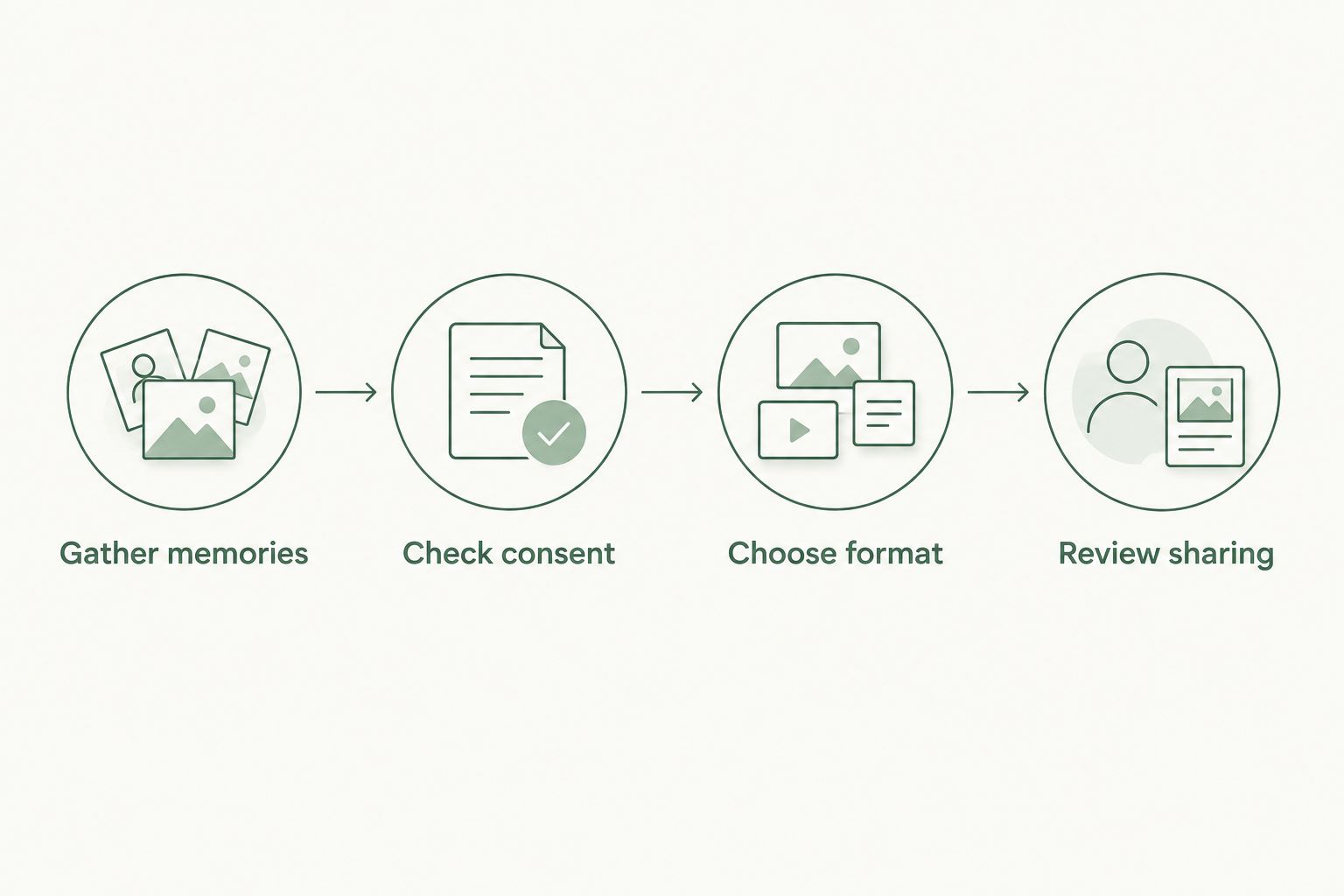
Use a simple review process:
- Gather memories: Collect the stories you want considered.
- Check consent: Ask before including sensitive details about living people.
- Choose format: Decide whether those details belong in music or writing.
- Review sharing: Confirm who should receive the finished tribute.
The same care applies to health information, family conflict, and private correspondence. Neither provider wins automatically on privacy; the terms and your sharing decisions matter.
Pricing: compare the scope before comparing the commitment
For a 2026 decision, distinguish the commissioned-song task from the obituary-publication task. They produce different things. A comparison is only useful once you know exactly what each proposed service includes.
For the song, ask about the production scope, how your memories are used, the review process, delivery format, and permissions for your intended use. These questions clarify the agreement; they are not promises about what is included.
For obituary publication, ask about the publication destination, text requirements, correction process, and any terms affecting the notice or associated guest book. Searching for an existing obituary is a different task from arranging a new publication, so identify which one you need first.
A fixed-scope arrangement gives you a defined commitment; optional additions create more decisions. Ask each provider which structure applies rather than assuming either uses a particular package model. Keep the written terms with your planning notes.
Final verdict: choose the task your family needs
For 2026, the strongest recommendation is not to treat these services as direct replacements. One creates a custom musical tribute. The other serves obituary and written-condolence needs.
Choose Rememberme if you are the family memory keeper
Rememberme is the winner for a family member seeking a custom memorial song. Choose it when you have personal stories you want shaped into professionally produced music for a deceased loved one or pet.
You should be comfortable selecting memories and discussing the intended tribute. Before committing, confirm the service terms and any permissions needed for the setting where you want to use the song. Do not assume a particular feature or delivery arrangement.
Choose Legacy.com if you are arranging a notice or finding an obituary
Legacy.com is the winner for an obituary reader, notice organizer, or condolence contributor. Choose it when you need a written life story, obituary search, or guest-book participation rather than original music.
Keep the notice's purpose clear. Confirm names and family details before publication, and ask about corrections. If a song becomes meaningful later, you can consider that as a separate tribute without changing the obituary's role.
| Dimension | Winner |
|---|---|
| Best for | Custom song service for music; Legacy.com for obituary tasks |
| Standout feature | Custom song service for professional musical production |
| Tribute format | Legacy.com when the tribute needs to be read |
| Sharing goal | Legacy.com for obituary discovery and guest-book condolences |
| Memory detail | Custom song service for memories expressed through music |
| Emotional readiness | Tie: follow the grieving person's preference |
| Privacy decisions | Tie: review terms and sharing choices |
| Pricing model | No universal winner: compare the specific service scope |
FAQ
Is Rememberme better than Legacy.com for a memorial song?
Rememberme is the better fit for a custom memorial song because it creates professionally produced songs from customers' memories and stories. Legacy.com is the better fit for obituary searches, written notices, and guest-book condolences.
What's the main difference between a memorial song and an obituary?
A memorial song expresses selected memories through music; an obituary presents a life story in writing. Choose the song for a listening experience and the obituary for a readable notice or remembrance.
Can I use an obituary and a memorial song together?
Yes, you can create both as separate forms of remembrance. Check the publication platform's rules before assuming you can embed audio or add a link to the song.
Is Legacy.com the better choice for finding an obituary?
Legacy.com is the better fit for finding an obituary because obituary search is part of its service. A custom memorial song service serves a different purpose and does not replace obituary search.
Can I get a custom memorial song for a pet?
Yes, the custom memorial song service described here creates tributes for deceased pets as well as people. Gather memories that reflect your pet's personality and your relationship.
What should I ask before commissioning a memorial song?
Ask about production scope, the review process, delivery format, and permissions for your intended use. Confirm the terms directly rather than assuming a feature is included.
Do I have to share a tribute publicly?
No, you do not have to choose public sharing as your goal. Confirm the provider's access and sharing terms before assuming that a song, notice, or message will remain private.
Will a memorial song or obituary help me stop grieving?
Neither a memorial song nor an obituary should be treated as a treatment or a promise that grief will end. Choose remembrance that feels right to you, and seek personal or professional support when you need it.
One last thing
Before choosing a format, write 1 paragraph beginning with a small, ordinary memory. Leave out the cause of death unless you want it included. Describe something the person did that you still recognize immediately.
That paragraph can help you decide what you want to preserve. If you want people to read it, begin with written remembrance. If you want those details expressed through music, begin with a song. You do not have to make every decision today.
Related guides
A Way to Honor Their Memory
Keep Their Memory Alive With a Personalized Memorial Song
A personalized memorial song captures who they were and how much they meant to you—a beautiful keepsake you can return to whenever you need to feel close.
Create a Memorial Song