Grief Guide
Obituary Monitor alternatives in 2026
Compare obituary monitor alternatives by purpose: choose Legacy for obituary search, Google Alerts for web mentions, or Rememberme for a personal memorial song.
If you are comparing obituary monitor alternatives in 2026, choose Legacy for searching published obituaries, Google Alerts for watching new web mentions, or Rememberme for a custom memorial song made from personal memories. These options serve different needs: finding a notice, following updates, and honoring someone you love are not interchangeable. A memorial song is a tribute, not a replacement for obituary monitoring.
- Obituary monitor alternatives serve different purposes: obituary search, web alerts, and personal remembrance.
- Legacy is best for searching published obituaries; Google Alerts is best for watching new web mentions.
- Rememberme creates custom memorial songs from personal memories, not obituary search results.
- Keep obituary information and personal tributes separate so each can serve your family’s needs.
Why this matters
Looking for an obituary can be a practical task with a deeply personal reason behind it. You might need service details, want to confirm that you have found the right person, or hope to reconnect with a family after hearing about a death.
Creating a tribute is a different task. Once you have the information you need, you might want something that expresses who the person was beyond the notice: their humor, familiar sayings, or the small routines you miss.
You do not have to choose between finding information and preserving memories. If both matter to you, this guide to including a memorial song in an obituary notice addresses the point where those purposes meet.
Choose the service around the task, not around the word “memorial.” A search tool, an alert, and a personal tribute belong in different parts of the process.
Obituary monitor alternatives at a glance
This 2026 comparison separates direct search options from complementary remembrance services. Read the “Best for” column first; it tells you whether an option addresses your actual need.
| Option | Best for | Main function | Important limitation | Role in your decision |
|---|---|---|---|---|
| Obituary Monitor | Readers considering the named service | Assess its current service against your search requirements | Check its stated coverage and alert capabilities before choosing | Your original comparison point |
| Rememberme | Creating a personal musical tribute | Custom, professionally produced memorial songs from your memories and stories | A song is not an obituary search or notification tool | A complementary remembrance option, not a monitoring substitute |
| Legacy | Searching published obituaries | Obituary search and published notices | A search result does not establish complete coverage | An obituary discovery option |
| Google Alerts | Watching new web mentions | Email alerts for matching Google Search results | It is not a dedicated obituary database | A general web-monitoring option |
| Funeral home obituary pages | Checking a known funeral provider’s notice | Provider-specific obituary and service information | You need to identify the relevant provider | A focused source-checking option |
The comparison does not rank these choices as if they produce the same result. An alert helps you notice information; a published notice gives you something to read; a tribute gives you a way to remember.
1. Rememberme: best for a custom memorial song
Rememberme creates custom, professionally produced memorial songs from customers’ personal memories and stories, honoring a deceased loved one or pet. This option fits when your goal is to express a relationship rather than locate a published notice.
An obituary records a life in words. A custom song offers another form of remembrance, built around the details you choose to share. That distinction matters if you arrived here looking for a more personal tribute, rather than another way to search.
Where Rememberme shines
- Personal material: Your memories and stories are the foundation of the memorial song.
- A different format: Music gives you an alternative to a written tribute.
- Loved ones and pets: The service’s stated purpose includes both kinds of loss.
- Professional production: The offering is a professionally produced song, not simply a suggested playlist.
Where Rememberme falls short
- A memorial song does not answer the practical question of where an obituary was published.
- You need to decide which personal memories you are comfortable sharing.
- Music is not the right tribute format for every person or every family.
- A song cannot replace a notice containing service arrangements or other factual information.
Best for: Individuals and families who want a custom memorial song based on personal memories.
Rememberme is best for families seeking a personal memorial song, not an obituary-monitoring replacement. For your 2026 shortlist, keep it in the remembrance category rather than the search category.
Verdict: Choose for a musical tribute; skip as a monitoring substitute.
2. Legacy: best for searching published obituaries
Legacy is an obituary publishing and search platform. It is a relevant alternative to investigate when you want to find a published notice rather than create a new tribute.
Start with the person’s name and the location connected to their life or death. Read a possible match carefully before sharing it. A familiar name alone is not enough to establish that you have found the right person.
Where Legacy shines
- Obituary-focused search: The subject of the search is published death notices, rather than general web content.
- A readable notice: A matching obituary gives you a published account to review.
- Useful identifying context: Details within a notice help you assess whether it concerns the person you mean.
Where Legacy falls short
- Not finding a notice does not prove that no obituary exists.
- People with similar names require careful checking.
- A published obituary does not necessarily contain every detail you need.
- Search is not the same task as monitoring future mentions.
Best for: People trying to locate and read an existing obituary.
Before choosing any obituary-search service in 2026, decide which locations and name variations matter to your search. Keep those requirements the same across services so you compare the results fairly.
Do not treat a matching name as confirmation. Compare family names, places, and other identifying details in the notice. If those details conflict with what you know, keep looking rather than forwarding an uncertain result.
Verdict: Choose for obituary discovery; keep a separate plan for ongoing alerts.
3. Google Alerts: best for watching new web mentions
Google Alerts sends email notifications when matching results appear in Google Search. It is a general web tool, not a service dedicated to obituaries.
That makes it useful when you want to watch for a person’s name across public web content. It also means the results need interpretation: a matching mention might be an obituary, an unrelated article, or a reference to someone else.
Where Google Alerts shines
- Ongoing notifications: You can watch a search topic rather than relying only on repeated manual searches.
- Broader context: Matching content is not limited to obituary pages.
- Specific search wording: A name combined with a relevant place gives you a more focused topic to watch.
Where Google Alerts falls short
- Alerts depend on matching Google Search results, not a complete record of deaths.
- Common names can produce unrelated mentions.
- An alert does not verify someone’s identity.
- No alert is not proof that no notice has been published.
Best for: People watching future public web mentions who are willing to review each match.
Try a precise name query first, then adjust it if the results are irrelevant. Keep the alert as a supporting tool, not your only source of information about arrangements.
Verdict: Choose for general web alerts; skip as your sole obituary source.
4. Funeral home obituary pages: best for checking a known provider
A funeral home’s obituary page is a focused place to look when you know which provider is handling arrangements. Check the actual notice rather than relying only on a search-result excerpt.
This is a source-checking approach, not a broad monitoring service. It works around a known provider and a specific person.
Where funeral home obituary pages shine
- Focused search: You are checking the provider connected to the arrangements.
- Notice context: You can read the information published on that provider’s page.
- A clear next step: If an arrangement is unclear, the provider is an appropriate point of contact.
Where funeral home obituary pages fall short
- You need to know, or identify, the relevant funeral home.
- One provider’s page does not cover notices published elsewhere.
- Do not assume the page offers email notifications or search features.
Best for: Families and friends confirming a notice associated with a known funeral provider.
Verdict: Choose for a focused check; skip as a broad monitoring replacement.
How to choose an alternative without adding more work
For a 2026 decision, start with the result you need. You do not need a collection of services if one clear source or one tribute format answers your question.
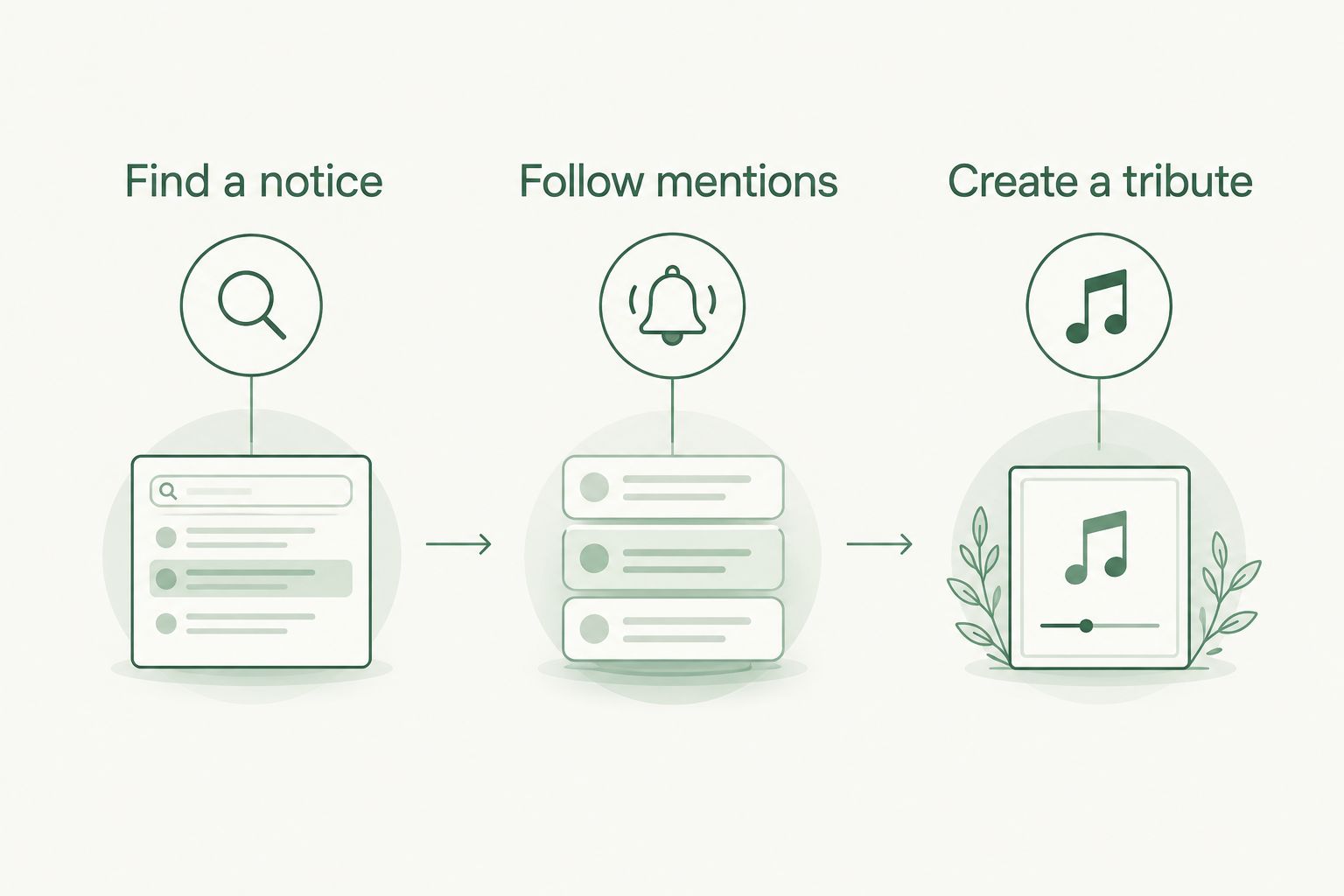
Find a notice
If you need an existing obituary, start with obituary search or the known funeral provider. Keep a short search note with 3 search details: the person’s name, a relevant location, and an approximate date connected to the death.
Those details organize your search; they are not guarantees of a match. Use known information rather than filling gaps with assumptions.
Follow mentions
If you want to watch future public references, consider Google Alerts. Decide whether you need a broad name search or a more specific combination of name and place.
Before forwarding a result, make 2 identity checks: compare the location and compare a relationship or other biographical detail. If either is uncertain, do not present the result as confirmed.
Create a tribute
If you already have the notice and want something personal, choose a remembrance format. A song, a written tribute, and a collection of photographs are different ways to preserve what mattered to you.
Begin with 1 memory you want to keep: a phrase, a habit, or a shared moment. You can add more later. You do not have to summarize an entire life before taking the first step.
Keep practical facts separate from personal interpretation. A service time belongs in an information note; the way someone made you feel belongs in a tribute. Both matter, but they need different kinds of care.
Why people look for Obituary Monitor alternatives
A useful reason to compare alternatives is a mismatch between the task you have and the result you need. These are decision criteria, not claims about Obituary Monitor’s performance or customer experiences.
- You need an existing notice. Prioritize obituary discovery and careful identity checking.
- You want future mentions. Evaluate notification tools rather than assuming every search service sends alerts.
- You know the funeral provider. A direct source check keeps your search focused.
- You want a personal remembrance. Compare tribute formats instead of treating a monitoring service as a keepsake.
There is also a difference between researching and receiving information. If repeated searches feel difficult, ask someone you trust to review results and pass along only confirmed, relevant details.
You can keep that request simple: ask for the published notice and any service information, rather than every mention of the person’s name. You remain in control of how much information you receive and when you receive it.
When staying with Obituary Monitor is the right call
Stay with Obituary Monitor if its current service meets the specific requirements you have checked. A different name on your shortlist is not, by itself, a reason to move.
Evaluate whether the service addresses your relevant locations, your search terms, and the way you want to receive information. Compare those requirements with its current published description before making a change.
If your real need has shifted from finding information to honoring someone, you do not necessarily need to replace anything. You can keep your practical information source and choose a separate tribute. There is no requirement to make one service do both jobs.
FAQ
What are the best obituary monitor alternatives in 2026?
Legacy is an option for searching published obituaries, Google Alerts is an option for watching new web mentions, and a known funeral home’s obituary page is an option for checking a specific notice. Choose by task rather than treating these services as interchangeable.
Is Rememberme an alternative to obituary monitoring?
Rememberme is a remembrance option, not an obituary-monitoring replacement. It creates custom, professionally produced memorial songs from personal memories and stories about a deceased loved one or pet.
Is Google Alerts better than an obituary search service?
Google Alerts serves a different purpose: it watches for matching Google Search results rather than searching a dedicated obituary collection. Use it for ongoing web mentions, and review every result before treating it as relevant.
Where should I look if I know which funeral home handled the arrangements?
Start with that funeral home’s obituary page. Read the full notice and contact the provider if a practical detail about arrangements is unclear.
Does an unsuccessful obituary search mean no notice exists?
No, an unsuccessful search does not prove that no notice exists. Check name variations, relevant locations, and the known funeral provider rather than drawing a conclusion from one search.
How do I know an obituary is for the right person?
Compare identifying details beyond the name, including location, family relationships, and biographical information. If those details conflict with what you know, do not share the result as confirmed.
Can I create a memorial tribute without a published obituary?
Yes, you can create a personal tribute from your own memories without relying on a published obituary. Keep any factual claims accurate and ask permission before sharing someone else’s private story.
One last thing
Before sharing a tribute publicly, ask whose story it includes. A memory that belongs to you can also reveal something private about another family member.
Keep a private version if that feels right. You can honor someone without publishing every detail, and you do not owe anyone a finished tribute on a particular schedule. Finding the notice and remembering the person can happen at different times.
Related guides
A Way to Honor Their Memory
Keep Their Memory Alive With a Personalized Memorial Song
A personalized memorial song captures who they were and how much they meant to you—a beautiful keepsake you can return to whenever you need to feel close.
Create a Memorial Song