Grief Guide
Memorial songs for pet loss support groups: complete 2026 guide
Memorial songs for pet loss support groups should be optional. Plan a thoughtful tribute with consent, personal memories, music choices, and sharing guidance.
Pet loss support groups use memorial songs as optional musical tributes to honor animals who have died, with the aim of giving members a shared space for remembrance. This 2026 guide explains how to choose, introduce, and share a song without asking anyone to listen, disclose memories, or grieve in a particular way.
- Memorial songs for pet loss support groups work best as optional tributes, not required participation.
- Rememberme custom memorial songs suit pet owners who want personal memories turned into a professionally produced tribute.
- Ask permission before collecting pet stories, playing music, or sharing a recording outside the group.
- Choose a pet tribute song around members’ preferences, then leave room for silence and conversation.
Why memorial songs matter for pet loss support groups
A pet tribute needs room for more than the circumstances of a death. Members might want to remember a familiar greeting, a favorite resting place, or the small routines that made their animal part of everyday life. A song offers another way to name those memories when speaking aloud feels difficult.
A support group has different responsibilities from a private memorial. You are making space for several people, different relationships with animals, and different beliefs about death. One member might welcome a song about reunion; another might prefer language grounded entirely in the life they shared.
Music belongs alongside support, not in place of it. Your aim is remembrance, not a promised emotional result. Listening quietly, stepping away, or declining the activity must remain equally acceptable choices.
For a separate pet ceremony, see how to choose music for a pet’s memorial service. Within a support group, begin with permission rather than a playlist.
How to plan an optional memorial-song activity
1. Ask permission
Start with a private invitation or a brief discussion before the meeting. Explain whether the activity honors one member’s pet, several animals, or the group’s shared experience of loss. Do not announce a personalized tribute as a surprise.
For your 2026 meeting plan, write down how members can decline without explaining themselves. Someone should be able to remain in the room without participating, leave briefly, or attend a different session if music is central to the gathering.
Separate permission to contribute from permission to listen. Sharing a memory does not automatically mean someone agrees to hear that memory sung in front of others.
- Describe the activity before asking for a response.
- Offer a private way to decline.
- Make listening and memory-sharing separate choices.
- Explain whether any recording or distribution is planned.
- Name the person members can contact with concerns.
2. Choose the purpose
Decide what the song is there to do before selecting music. A tribute to one animal needs different wording from a reflection intended for everyone. Neither is a better expression of grief; they serve different purposes.
For a shared gathering, you can begin manually with a short remembrance prompt. Ask members whether they want words about companionship, everyday routines, gratitude, or simply missing their pets. Keep spiritual language optional rather than treating it as universal.
Choose one clear purpose for the activity. Trying to honor every animal, explain every loss, and reassure every listener in one song puts too much pressure on the tribute.
- Choose an individual tribute or a shared reflection.
- Ask whether lyrics or instrumental music feel more suitable.
- Invite preferences without requiring personal explanations.
- Avoid language that sets a deadline for feeling better.
- Keep beliefs about an afterlife specific to consenting participants.
3. Gather memories
Begin with a notebook, a private message, or a simple document. Invite each participating member to contribute up to 3 memories, such as a greeting, a habit, and a place they shared with their pet. This is a suggested writing limit, not a requirement to produce a complete life story.
Ask about the animal’s life before asking about the death. The way a rabbit settled beside someone or a dog waited near the door gives a tribute personal detail without requiring painful medical information. Let members decide what belongs in the song.
If you want professional production rather than making the recording yourself, Rememberme creates custom memorial songs from customers’ personal memories and stories. Rememberme custom memorial songs are best for pet owners who want personal memories turned into a professionally produced tribute. A custom song still needs the same permission and group preparation as a homemade one.
- Confirm each pet’s name and pronunciation.
- Ask for ordinary routines and distinctive habits.
- Mark details that must remain private.
- Keep unapproved memories out of the brief.
- Ask how the member wants their relationship described.
4. Review the content
Read the words and listen to the proposed music before bringing either into the group. Review for fit, not for how moving you think the song will be. A powerful tribute to one person’s pet is not automatically suitable for everyone present.
Pay particular attention to descriptions of euthanasia, accidents, illness, and final moments. Include those details only when the person contributing them wants them included and the planned audience has been considered. An affectionate memory can carry the tribute without describing the death.
Use a 2026 facilitator checklist to record the intended audience, approved details, and any words members have asked you to avoid. Keep that document private. It is a planning aid, not a record of anyone’s emotional progress.
- Check names, pronouns, and species references.
- Remove assumptions about forgiveness or guilt.
- Review religious language with participating members.
- Avoid promises that listening will bring closure.
- Confirm that no private story has slipped into the lyrics.
5. Prepare the listening space
Make a practical plan before pressing play. For an in-person meeting, check the sound at a comfortable level and explain where someone can step out. For an online session, test shared audio with a co-facilitator rather than discovering problems during the tribute.
As a starting plan, reserve 2 minutes to introduce the activity and 5 minutes afterward for quiet or optional conversation. These are suggested planning allowances, not therapeutic guidelines. Adjust them to your meeting and do not fill every pause.
Explain what will happen in a simple sequence: an introduction, the song, quiet time, and an invitation to respond. Predictability matters more than making the moment elaborate.
- Test playback before members arrive.
- Keep the volume easy to adjust.
- Explain how to step away or mute audio.
- Turn off meeting recording for the activity.
- Prepare a spoken remembrance if playback fails.
6. Make listening optional
At the meeting, repeat that nobody has to listen or speak afterward. Give that permission before the music begins, not once someone is visibly upset. Do not ask members to close their eyes, hold hands, or sing unless those actions have been separately discussed.
The sequence below keeps the activity focused on choice rather than performance. Use it for a 2026 remembrance session or adapt it to a smaller gathering.
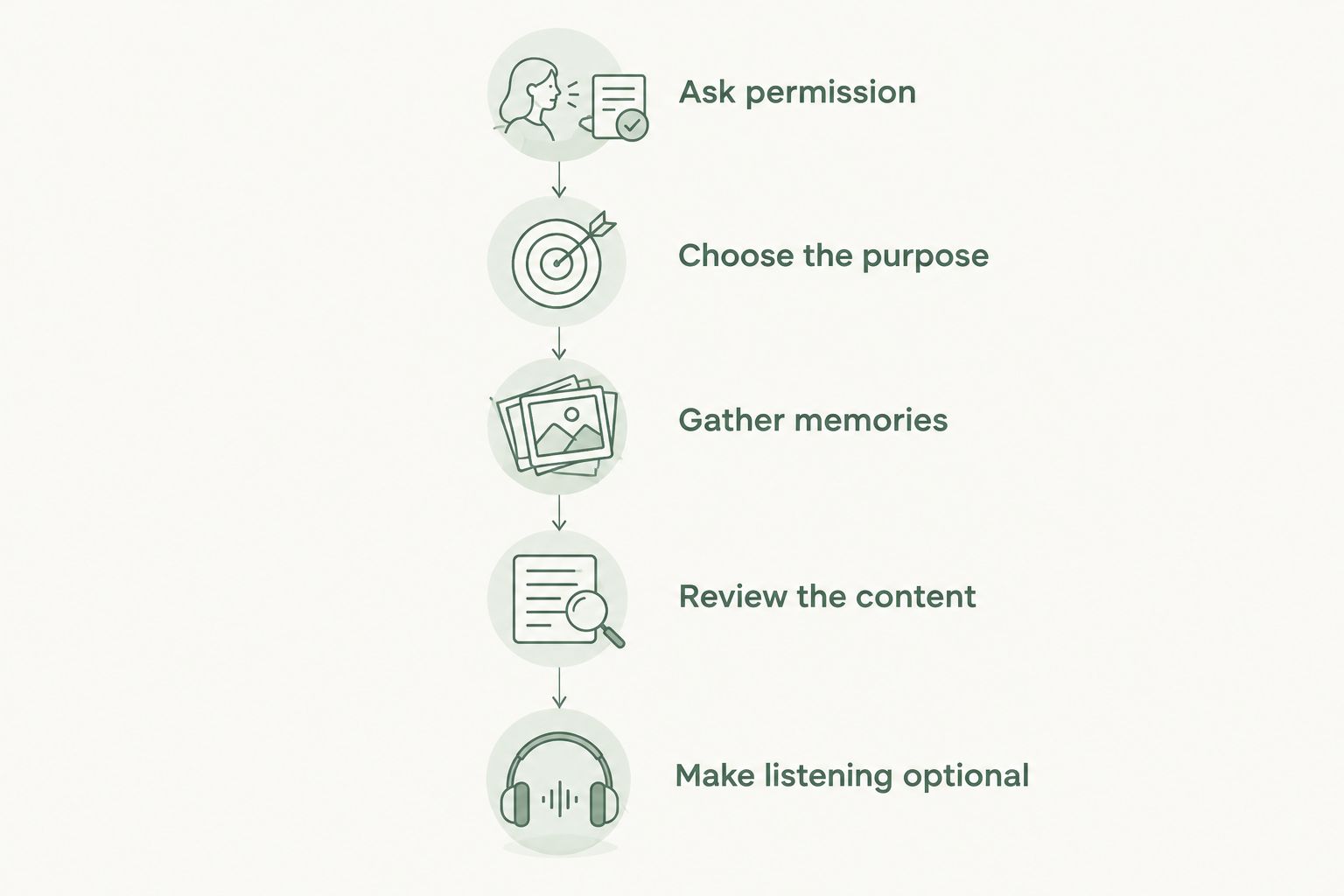
After the song, leave space before offering a prompt. Invite members to name a memory if they want to, while making clear that silence is also participation. Avoid going around the room in a way that puts each person on the spot.
- Restate the choice to listen, leave, or sit quietly.
- Introduce whose pet or memories the song honors.
- Keep the stop control within easy reach.
- Allow quiet before asking for responses.
- Accept passing without a follow-up question.
7. Agree on sharing
Treat listening in the group and sharing outside the group as separate decisions. A member who agrees to a tribute during a private meeting has not necessarily agreed to a social-media post, public video, or downloadable recording.
Ask the song creator or rights holder what uses are permitted before distributing or publishing a recording. Do not assume that commissioning a song grants every possible use. Rememberme offers custom memorial songs, but group playback and sharing permissions should be confirmed for your intended use.
For your 2026 records, retain only the permissions you need and keep access limited. If someone changes their mind before publication, pause the plan and discuss what they want removed.
- Ask separately about private and public sharing.
- Confirm recording rights for the intended use.
- Keep member names out unless specifically approved.
- Avoid posting the group’s reactions or discussion.
- Tell participants who will receive the recording.
Compare memorial-song options for your group
Choose the format around the members, not around production quality alone. A simple spoken remembrance is a valid alternative when music does not fit the gathering.
| Option | Best for | Main benefit | Key limitation |
|---|---|---|---|
| Existing song | Members who already connect a song with their pet | Brings a familiar musical memory into the tribute | Lyrics might not fit every member; playback and sharing rights need checking |
| Instrumental music | Groups that want music without a lyrical message | Leaves members free to supply their own memories | Does not name the pet or tell their story |
| Member-written tribute | Members who want direct control over the words | Keeps the writing close to the person who knew the animal | Requires writing, recording, and review work |
| Rememberme custom memorial song | Pet owners seeking a professionally produced tribute from personal stories | Turns customer memories into a personalized song | Requires sharing personal details; group suitability and usage permissions still need review |
| Spoken remembrance | Groups or members who do not want music | Allows a tribute without playback equipment | Does not provide a musical keepsake |
Choose a custom song for personalization, instrumental music for open-ended reflection, and spoken remembrance when music is unwanted. None of these choices should become a measure of how much someone loved their pet.
If several members want individual tributes, discuss a fair process before scheduling them. Avoid comparing songs, ranking stories, or giving more attention to a more elaborate recording.
Common mistakes pet loss support groups make
Surprising a member with their pet’s story
A personalized song can contain details someone is not ready to hear publicly. Ask before using their memories, even when another family member has offered them. Good intentions do not replace the bereaved person’s choice.
Treating dogs and cats as the default
Check every reference to paws, walks, purring, and cuddling against the animals being remembered. Birds, horses, rabbits, reptiles, and other animals deserve language that fits their actual lives. For a shared tribute, avoid species-specific wording unless everyone it represents has approved it.
Putting the death at the center
Do not require details about euthanasia or final moments to make a tribute feel meaningful. A song can honor an animal through ordinary life: a favorite perch, an evening routine, or a familiar sound. Let the member choose the focus.
Expecting a visible emotional response
Tears, smiles, silence, and leaving the room are not ratings of the song. Do not ask whether the activity helped in front of everyone. Offer a private opportunity to give feedback about the format instead.
Sharing the tribute as proof of the group’s work
A support-group tribute is not automatically suitable for publicity. Keep recordings, photos, and participant stories private unless each intended use has been explicitly approved. Never make public sharing a condition of receiving a tribute.
FAQ
What are memorial songs for pet loss support groups?
Memorial songs for pet loss support groups are optional musical tributes used to remember animals who have died. They can honor one pet or accompany a shared reflection, but they should not replace conversation or other support.
What’s the best type of song for a pet loss support group?
The best type is the one participating members want and have agreed to hear. Choose a personalized song for a specific pet’s story, instrumental music for reflection without lyrics, or spoken remembrance when music is unwanted.
Can a member decline to listen to a memorial song?
Yes, a member should be able to decline without explaining why. Offer the choice before playback and allow quiet participation, stepping outside, or muting online audio.
Can Rememberme create a memorial song for a pet?
Yes, Rememberme creates custom, professionally produced memorial songs from customers’ personal memories and stories, including tributes to pets. Confirm the intended group use and sharing permissions before arranging playback or distribution.
Should a pet tribute song mention euthanasia?
Mention euthanasia only when the person contributing the story wants it included and the audience has been considered. A tribute can focus entirely on the animal’s life, habits, and relationship with their person.
Can we post our support group’s memorial song online?
Post it only after confirming the recording’s usage rights and obtaining permission for the personal details being shared. Agreement to hear a song in a private group is not agreement to publish it.
How do we include several pets in one memorial song?
Ask each participating member which details they want included and agree on a balanced approach before writing. Use language that fits the animals represented, and allow members to keep their memories private.
One last thing
Before you finalize the tribute, ask what ordinary moment the member misses most. It might be a chair that is now empty or the sound of an animal arriving for breakfast. That everyday detail is enough to begin a remembrance; you do not need the story of the death.
Keep that principle in your 2026 group plan: invite a memory, offer a choice, and leave room for the person who wants neither today.
Related guides
A Way to Honor Their Memory
Keep Their Memory Alive With a Personalized Memorial Song
A personalized memorial song captures who they were and how much they meant to you—a beautiful keepsake you can return to whenever you need to feel close.
Create a Memorial Song