Grief Guide
How to turn a loved one's favorite song into a memorial tribute
Learn how to turn a favorite song into a memorial tribute in 2026: rewrite lyrics, build a new composition, or keep the original, with rights and steps.
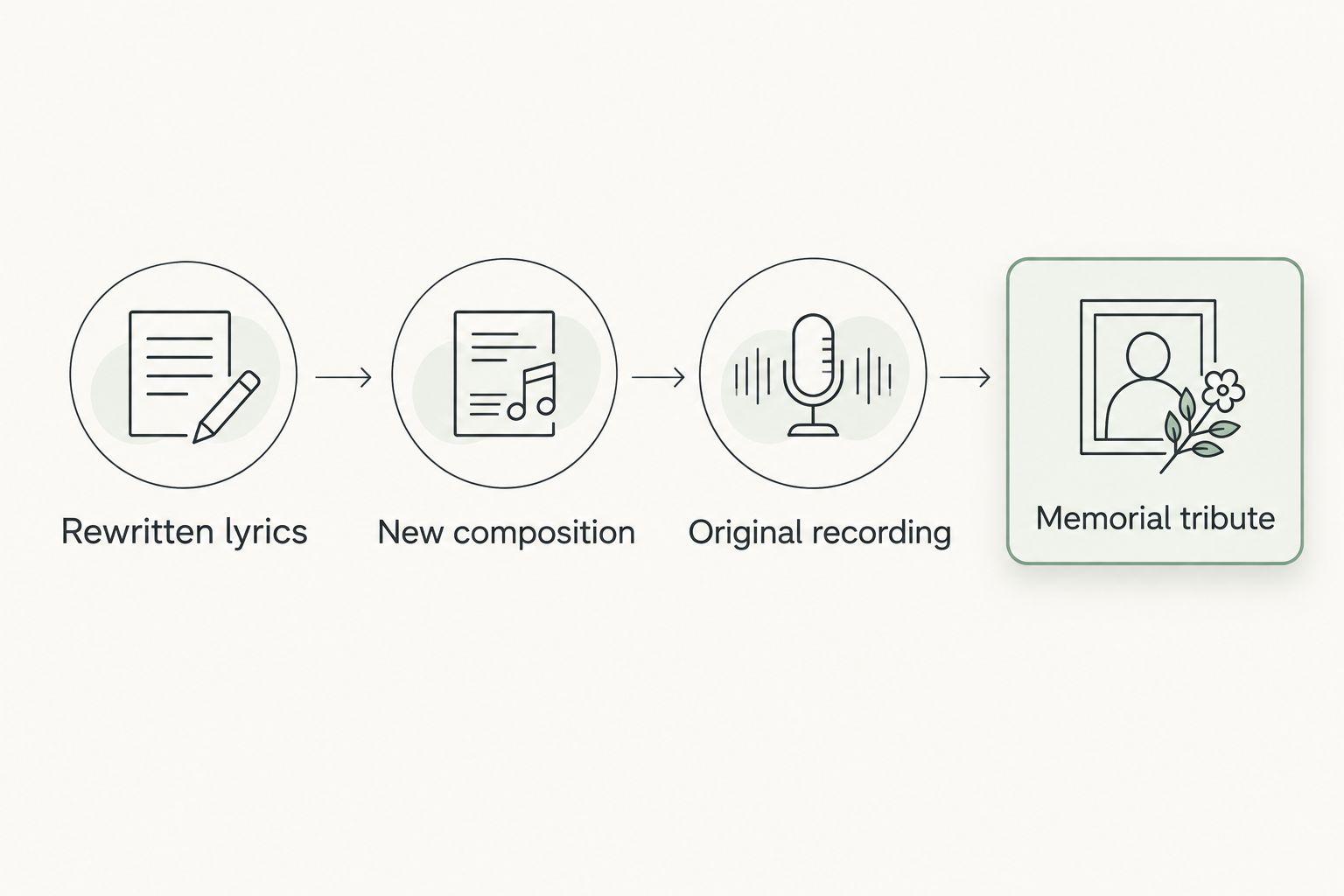
A loved one's favorite song already carries their memory in it. Turning it into a memorial tribute in 2026 means picking one of three paths: rewrite the lyrics so the words become personal, weave the melody or a lyric fragment into a brand new custom composition, or keep the original recording intact and build a tribute moment around it. Each path protects a different part of what made the song matter to them.
The path you choose comes down to one question: do you want the song to stay recognizable, or do you want it transformed into something that's unmistakably about them?
- Turning a favorite song into a memorial tribute works three ways: rewritten lyrics, a new composition, or the original recording as-is.
- RememberMe.fm turns a loved one's favorite song, voice, or story into a custom memorial song in 2026.
- Copyright rules apply if you plan to publicly perform or redistribute someone else's recording, not just play it privately at home.
- Keeping the original melody while rewriting the words is the most common request families make in 2026.
Why this matters
A favorite song is shorthand for a whole relationship. The wedding song, the road-trip song, the one they hummed doing dishes, all of it holds a specific memory that a generic memorial hymn can't touch.
But the original recording belongs to someone else, legally and emotionally. Playing it at a service is different from rewriting it, and rewriting it is different from building something entirely new that only borrows its spirit. Families who skip this distinction often end up disappointed, either because a rights issue blocked their plan or because the finished tribute still sounds like someone else's song instead of theirs.
How do you turn a favorite song into a memorial tribute?
You turn a favorite song into a memorial tribute by identifying what part of it matters most (the melody, the lyrics, or the memory attached to it), then choosing whether to rewrite it, rebuild it into a new composition, or preserve the original and frame it with new context. Here's the process families use most often in 2026:
- Name the specific memory the song holds. Not "they loved this song" but the exact scene: the kitchen, the car, the wedding dance.
- Decide how much of the original you want to keep. The melody people recognize instantly, or just the emotional register?
- Check who owns the rights if you plan to perform it publicly, post it online, or distribute copies beyond a private gathering.
- Gather the details that make the new version personal. Nicknames, inside jokes, specific dates, the exact lyric line that always got them.
- Choose a production route. A musician friend, a local studio, or a service like RememberMe.fm that builds a custom memorial song from the story you provide.
- Decide where it will be used. A funeral slideshow, a graveside moment, or a private listen at home changes how polished the final piece needs to be.
Comparing the three approaches
| Approach | Best for | Keeps original melody | Verdict |
|---|---|---|---|
| Rewritten lyrics | Families who want the tune instantly recognizable | Yes | Buy — strongest emotional recognition |
| New custom composition | Families who want something entirely their own | No, inspired by it instead | Buy — most personal, avoids rights issues |
| Original recording, kept as-is | A quick, low-effort tribute moment | Yes, unchanged | Hold — check licensing before public use |
Rewriting the lyrics: keeping the melody, changing the words
This is the most requested approach in 2026 because it keeps the part of the song people already associate with the person, the melody, while making the words specifically about them.
You (or someone producing the piece) take the chord structure and phrasing of the favorite song and write new verses using their name, their story, and the memory the song was tied to. The chorus often stays closest to the original feel, since that's usually the part everyone in the room already knows by heart.
This works especially well for funeral songs for a father or a mother, where the melody itself is already emotionally loaded and the family wants that recognition intact.
Building a new composition inspired by the original
Some families don't want a rewrite. They want something new that only nods to the original, maybe a lyric fragment tucked into a verse, or the same key signature, or a tempo that echoes the original's feel without copying its structure.
This route sidesteps most copyright questions because the finished piece is a new, original work. It also gives you room to fold in details the original song never touched: a pet's name, a specific illness, the sound of their laugh, details from a eulogy. If you already have a eulogy written, turning a eulogy into a memorial song is often the fastest way to get from raw memory to finished lyric.
Keeping the original recording as-is
Sometimes the simplest tribute is the right one: playing the actual recording at a service, in a slideshow, or during a candle-lighting moment, with no changes at all.
This works fine for private, in-person gatherings. It gets more complicated if you plan to livestream a virtual memorial service, post the video publicly, or distribute copies afterward, since that can cross into public performance or reproduction rights that belong to the songwriter or label. If the plan involves anything beyond a private room, check licensing before you commit to this route.
Why the right approach varies
A few factors decide which of the three paths fits your family:
- How well-known the song is. A deep cut is easier to rework quietly; a chart-topping hit has stricter licensing if used publicly.
- Where the tribute will be used. A private home listen has fewer restrictions than a livestreamed service or a public tribute page.
- How much of the melody the family needs to hear to feel the connection.
- Whether there's a specific memory or story to build new lyrics around, versus just a general fondness for the song.
- Timeline. A rewrite or new composition takes longer to produce than simply queuing up the original track.
- Who's producing it. A friend with a guitar, a local studio, or a service that specializes in custom memorial songs each has different turnaround and polish.
“The melody carries the memory. The words are what make it theirs.”
Can you legally use a copyrighted song for a memorial tribute?
You can legally play a copyrighted song at a small, private memorial gathering without a license in most cases, but public performance, livestreaming, or distributing copies of someone else's recording usually requires permission. If your tribute stays private and in-person, this rarely becomes an issue in 2026; if it goes online or gets shared widely, it's worth confirming rights first or choosing a rewritten or newly composed version instead.
How do I include lyrics from their favorite song in a new memorial song?
You include lyrics from a favorite song by pulling a single line or phrase, the one everyone already associates with them, and building new verses around it rather than copying full sections. This keeps the emotional anchor of the original while making the rest of the piece unmistakably personal, and it's the approach most families lean on when choosing lyrics for a custom memorial song.
What if they didn't have one clear favorite song?
If there's no single favorite song, the tribute can still work by building around a memory, a phrase they said often, or a genre they loved instead of one specific track. A custom memorial song built from a story rather than a song title covers this exact situation, since the starting point becomes the person, not the track.
Start your memorial song request
Share the memory, the voice, or the song you want honored.
RememberMe.fm builds custom memorial songs from the specific memory a family shares, whether that starts with a favorite song, a voicemail, or a eulogy. If a loved one left behind an actual recording of their voice, it's also possible to include their real voice in a memorial song instead of, or alongside, a rewritten track.
FAQ
What's the best way to turn a favorite song into a memorial tribute?
The best way depends on whether you want the melody recognizable. Rewriting the lyrics over the original melody gives the strongest emotional recognition in 2026, while a new composition avoids rights questions entirely.
Is it better to rewrite lyrics or write a completely new song?
Rewriting lyrics works better when the melody itself carries meaning for the family. A completely new song works better when you want to avoid licensing questions or fold in details the original song never touched.
How much does it cost to turn a song into a memorial tribute?
Cost depends on the production route: a friend or local musician may charge little to nothing, while a professional custom memorial song service handles writing, vocals, and production as a full package. Check current options directly with the provider you choose.
Can I use a copyrighted song at a funeral without permission?
Yes, in most private, in-person gatherings you can play a copyrighted recording without a license. Public livestreams or shared copies afterward are where permission usually becomes necessary.
How do I pick which genre to use for a memorial song?
Match the genre to the person, not the occasion. A guide on choosing a music genre for a custom memorial song walks through matching style to personality and setting.
Can a memorial song include their actual voice?
Yes, old voicemails, recordings, or voice memos can be woven into a custom memorial song alongside the music, giving the tribute a literal piece of their voice.
What if there's no single favorite song to work from?
A memorial song doesn't need one specific track to start from. It can be built entirely from a memory, a phrase they used often, or the genre they loved.
Should the memorial song be played at the funeral or kept private?
Either works. Some families play it during the service itself, others save it as a private keepsake to listen to on anniversaries, and the production approach doesn't change based on that choice.
One last thing
The detail families remember most a year later isn't the production quality, it's the one specific line or memory that made the song unmistakably theirs. Spend more time nailing that single detail than agonizing over which genre or instrument to use. A simple rewrite with the right memory in it outlasts a polished track built on a generic sentiment.
Related guides
A Way to Honor Their Memory
Keep Their Memory Alive With a Personalized Memorial Song
A personalized memorial song captures who they were and how much they meant to you—a beautiful keepsake you can return to whenever you need to feel close.
Create a Memorial Song