Grief Guide
Custom memorial songs for senior living: complete 2026 guide
Custom memorial songs for senior living communities work best with family approval. Plan personal tributes with clear permissions and gentle listening.
Senior living memorial songwriting is the creation of personal tribute songs with the aim of helping residents, families, and staff honor someone who has died. Custom memorial songs for senior living communities need a family-approved story, optional participation, and a listening setting that respects people sharing the same home.
- Custom memorial songs for senior living communities work best as optional, family-approved tributes, not routine background music.
- Rememberme creates professionally produced memorial songs from personal stories for grieving individuals and families.
- Choose a personal song for specific memories; choose familiar music when shared recognition matters more.
- Confirm permissions, review personal details, and test playback before a celebration of life.
Why memorial songs matter for senior living communities
A senior living community is both someone's home and a place where neighbors form relationships. A resident's death can touch family members, dining companions, activity groups, and the staff who knew their daily routines.
A personal song gives you a way to remember the person beyond an announcement. The useful details are often ordinary: a favorite garden chair, a weekly card game, or the greeting everyone recognized. Include them only when someone who knew the resident confirms them.
A memorial song is a tribute, not a treatment or a measure of successful grieving. Your 2026 remembrance plan should leave room for music, spoken memories, quiet reflection, and declining to participate.
Before deciding on a musical direction, use this guide to choosing a music genre for a custom memorial song. Start with the person's preferences, not assumptions about their age.
How to plan a personal memorial song
Build your process around five checkpoints: Permission, Memories, Song brief, Review, and Listening. A written checklist gives the next staff member a clear handoff without asking the family to repeat difficult conversations.
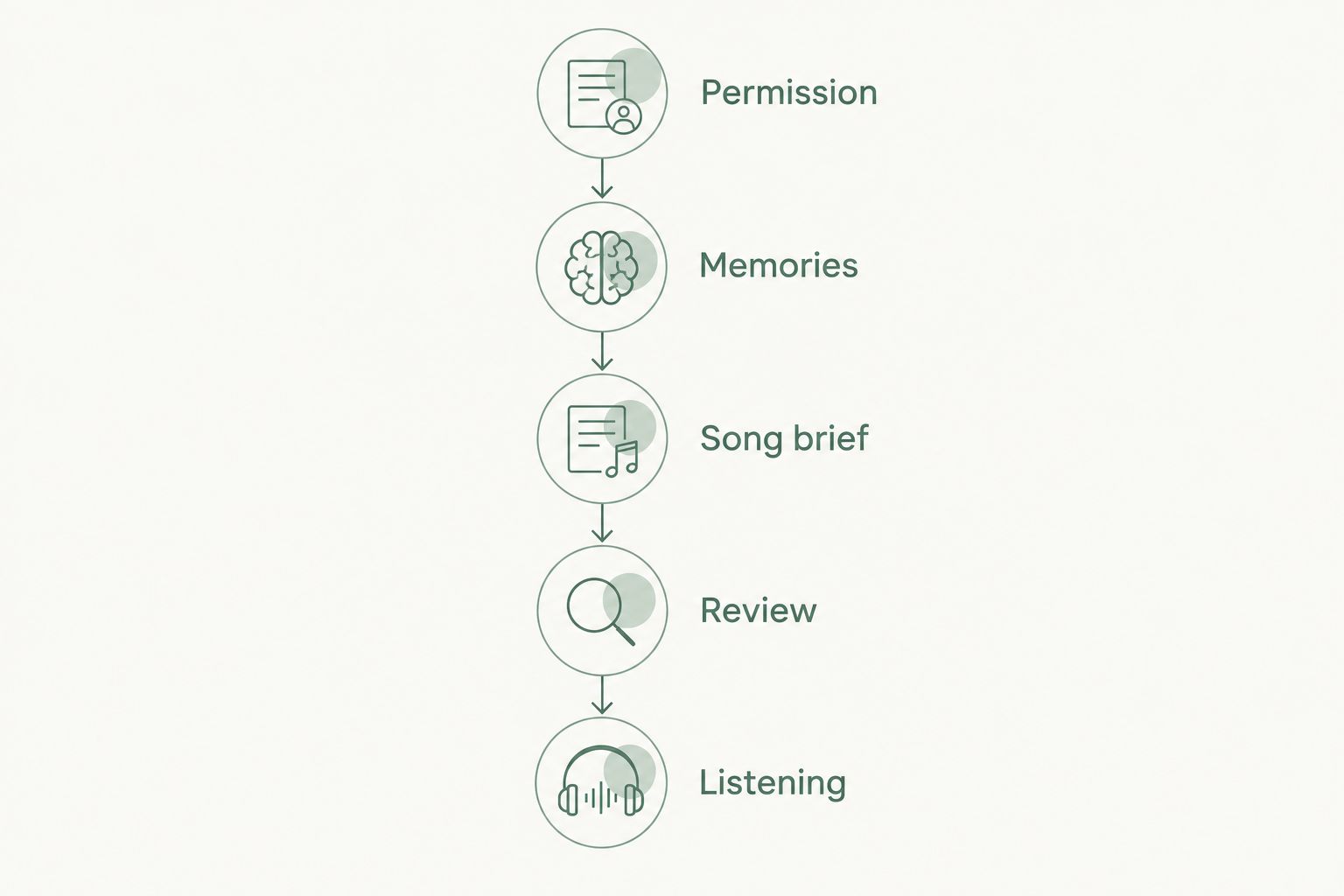
Ask the family whether a song feels right
Begin with a private conversation, not an announcement that a tribute is already underway. Explain who would hear the song and whether you are proposing a community gathering, a family keepsake, or both.
You can make this first step with a conversation and a short written summary. Ask whom the family wants involved in decisions; do not assume the relative who answers first should speak for everyone.
For a resident who expressed wishes before death, bring those preferences into the discussion. If relatives disagree, pause the public tribute rather than asking staff to settle the disagreement through a song.
Close the conversation with a clear record:
- Name 1 staff coordinator for family communication.
- Identify the family contact for approval.
- Confirm whether the tribute is private or community-facing.
- Ask which subjects should remain out of the lyrics.
- Make declining the song an acceptable outcome.
Gather memories without turning grief into homework
Use a paper form, a phone conversation, or notes taken with permission. You do not need a polished biography, and the family does not need to write lyrics before you can begin.
Start with 3 specific memories rather than a long questionnaire. Ask about something the person enjoyed, something they often said, and a moment that captures their character. Make clear that these are prompts, not requirements.
Invite staff and residents to contribute only if the family agrees. Keep community recollections separate from family-approved material until someone checks them. A warm anecdote still needs confirmation, especially when it includes another resident's name.
Build a small, usable memory collection:
- Record the preferred name and its pronunciation.
- Ask for a familiar phrase or greeting.
- Collect an everyday detail beyond the person's illness.
- Mark uncertain stories for checking, not inclusion.
- Leave medical and care information out of the creative brief.
Choose who will turn the memories into music
The do-it-yourself route is to arrange approved memories into short verses, then ask a willing musician to help create original music. It gives you direct involvement, but it also leaves writing, recording, and coordination with your team.
If that work is not appropriate for your staff or family, a specialist service is another route. Rememberme creates custom, professionally produced memorial songs from customers' memories and stories.
Rememberme is best for families seeking professionally produced memorial songs built from personal memories. Its fit is the personal tribute; it does not replace your community's consent, event planning, or family communication.
Before committing to any production route, confirm the details rather than assuming them:
- Ask what story material the creator needs.
- Confirm the completion schedule before setting a playback date.
- Ask how names and factual corrections are handled.
- Confirm the delivered audio format and sharing permissions.
- Ask about lyrics, previews, and revisions without assuming inclusion.
Write a brief that sounds like the person
A useful song brief explains whom you are remembering, what mattered to them, and how the song will be used. Write it in plain language. You are giving the creator a faithful starting point, not trying to sound like a songwriter.
Choose the emotional direction with the family. Gentle gratitude, affectionate storytelling, and a faith-centered tribute are different choices; none should be treated as the default for older adults.
For a 2026 community memorial, distinguish between the resident's own beliefs and the beliefs of the wider audience. The tribute can honor a person's faith without asking everyone present to share it.
Make the brief specific:
- State the intended audience and occasion.
- Describe the person's musical preferences, if known.
- Identify the memories the family most wants preserved.
- List words, themes, or religious language to avoid.
- Specify whether the lyrics address the person or describe their life.
Review the story before arranging public playback
Use a simple written review sheet, even if the song is being created informally. Check the personal details in the brief first, then review any lyrics or audio the creator makes available under the agreed process.
Give 2 reviewers different responsibilities: a family reviewer checks personal accuracy, while a staff coordinator checks the community setting. This is a suggested workflow, not a requirement to involve more relatives than the family wants.
Rememberme memorial songs draw on the memories customers provide, so careful source material matters. Do not assume a producer can recognize an incorrect nickname, a sensitive family reference, or a story the resident would have preferred to keep private.
Keep the review focused:
- Check names, relationships, and pronunciation.
- Remove private information that slipped into the brief.
- Confirm that religious wording reflects the person's wishes.
- Check whether references to death match the family's preference.
- Record approval for the intended use, not unspecified future uses.
Prepare a listening setting people can leave
For a small gathering, begin with the equipment and room you already use for spoken announcements. Test the actual audio file through the actual speakers. A successful phone playback does not confirm that the room setup works.
Tell people in advance that the gathering includes a memorial song. Offer seats near an exit and a quieter place nearby, and avoid turning a shared dining area into an unannounced tribute space.
Your 2026 event checklist should separate playback from recording. Permission to hear a song in person is not permission to film residents' reactions or publish the gathering online.
Before the event:
- Test audibility from the back of the room.
- Arrange a backup playback method.
- Provide readable lyrics if you have permission and a usable copy.
- Assign a staff member to help anyone who wants to leave.
- Confirm permissions separately for livestreaming or recording.
Offer a private follow-up without expecting a response
After the gathering, give the family space. A short message explaining how to access an approved recording is enough; avoid asking whether the tribute helped them heal or whether they want to provide a testimonial.
Offer the song privately before considering wider sharing. If the family wants it included in a later anniversary gathering, revisit permission and audience rather than treating the first approval as permanent.
For your 2026 handoff notes, record practical decisions, not judgments about grief. Whether someone cried, smiled, or left early does not tell you whether the tribute was right for them.
Finish with a modest follow-up process:
- Ask whether the family wants the recording shared further.
- Keep approved files in your designated storage location.
- Restrict access to personal story notes.
- Identify who will handle correction or removal requests.
- Offer information about existing bereavement support when requested.
Compare memorial music options for your community
Choose the format by its purpose. A custom recording preserves personal stories, while familiar music supports a different kind of remembrance. A spoken tribute is a complete choice when a song does not feel right.
| Option | Best for | Main benefit | Key limitation |
|---|---|---|---|
| Rememberme custom memorial song | Families wanting personal memories turned into a professionally produced song | Creates a tribute around the person's own story | Requires family input and confirmation of production and usage terms |
| Family-written original song | Families or residents who want direct creative involvement | Keeps writing choices with the contributors | Writing, recording, and coordination remain with the people making it |
| Familiar recorded music | Gatherings centered on music the resident already loved | Offers recognition without creating new lyrics | Does not tell the resident's individual story; check permissions for the intended use |
| Live musical tribute | Gatherings that want an in-person performance | Allows a performer to shape the delivery for the room | Depends on rehearsal, room conditions, and performer coordination |
| Spoken memories with silence | Families who do not want music | Leaves space for individual voices and reflection | Does not create a musical keepsake |
Choose a custom song when the personal story is the reason for the tribute. Choose familiar music when the family wants to hear something the resident actually listened to. Neither option is automatically more meaningful.
Common mistakes senior living communities make
Treating the song as a community-wide announcement
A death announcement and a memorial gathering have different purposes. Keep routine communications clear, then invite people separately to an optional tribute with the family's agreement.
Writing only about the person's final months
A tribute built entirely around care needs leaves out the rest of a life. Ask about work, friendships, interests, family traditions, and the small habits that made the person recognizable.
Assuming older residents want the same music
Age does not establish a person's taste, language, or beliefs. Ask for preferences and accept that a quiet instrumental, a lively style, or no music at all can be the appropriate choice.
Reusing permission across every channel
Approval for an in-person gathering does not settle questions about social media, a livestream, or a public tribute page. For each new use in 2026, explain the audience and ask again before sharing.
Making participation feel like a test of affection
Do not ask residents or staff to prove they cared by contributing memories or attending. Offer a private way to remember the person and leave nonparticipation unexplained.
FAQ
What are custom memorial songs for senior living communities?
Custom memorial songs for senior living communities are personal songs created to honor someone who has died. They use memories and stories rather than relying only on an existing recording, and should be planned with the family's agreement.
Is a custom song better than playing a resident's favorite song?
A custom song is better for telling a personal story; a favorite song is better for recalling music the resident already loved. Ask the family which purpose matters rather than assuming a new song is more meaningful.
Can staff contribute memories to a resident's memorial song?
Staff can contribute memories when the family agrees and the community's policies permit it. Keep contributions focused on ordinary personal moments, and exclude confidential care information.
Should residents with dementia attend a memorial song gathering?
Attendance should be an individual choice informed by the resident's preferences and care team's guidance. Explain the gathering appropriately, avoid pressure, and provide a way to leave with support.
Can we play a memorial song during a livestream?
Confirm permission for livestreaming before including a memorial song. Check the recording's usage terms and address privacy and consent for anyone who will appear in the broadcast.
How far ahead should we request a custom memorial song?
Confirm the creator's completion schedule before announcing a date that depends on the song. Leave room for collecting memories, checking details, and testing playback rather than assuming immediate delivery.
Does a memorial song replace grief support?
A memorial song does not replace grief support or clinical care. It is an optional act of remembrance, and people should remain free to decline it or seek other support.
One last thing
Before approving the song brief, remove the resident's name and read it again. If the description could fit almost anyone, add one confirmed detail that belongs to this person.
A phrase from the garden, a much-loved recipe, or a habit at the card table can give the tribute its identity. You do not need to summarize an entire life to remember someone faithfully.
Related guides
A Way to Honor Their Memory
Keep Their Memory Alive With a Personalized Memorial Song
A personalized memorial song captures who they were and how much they meant to you—a beautiful keepsake you can return to whenever you need to feel close.
Create a Memorial Song