Grief Guide
Custom memorial songs for hospice providers: complete 2026 guide
Custom memorial songs for hospice providers work best as family-led tributes. Plan consent, gather memories, protect privacy, and choose a meaningful format.
For hospice providers, custom memorial songs are personalized musical tributes created from a family's memories to honor someone who has died. This 2026 guide explains how to offer that choice without adding pressure, exposing private information, or confusing a memorial keepsake with clinical care.
- Custom memorial songs for hospice providers should be optional, family-led tributes, not a promised treatment for grief.
- Rememberme is best for families seeking professionally produced memorial songs based on personal memories and stories.
- Gather permission before gathering stories, and separate private listening from permission to share publicly.
- A written tribute or familiar song is a valid alternative when a custom memorial song does not fit.
Why custom memorial songs matter for hospice providers
A memorial song gives a family another way to tell a loved one's story. The meaningful material is often ordinary: a familiar greeting, a Sunday routine, or the way someone welcomed people into their home. Your role is to help families decide whether music belongs in their remembrance, not to persuade them that it does.
Hospice providers need a different approach from a gift buyer. You must consider the family's wishes, the deceased person's known preferences, staff boundaries, and permission to send information outside your organization. A family can welcome a keepsake while declining a public tribute.
Start with the words, not the production. The guide to choosing lyrics for a custom memorial song offers a next step for families who already want to explore a tribute.
Offer a memorial song as a choice, never as an expectation. A family that declines should receive the same attention and support as one that accepts.
Keep remembrance separate from treatment
A professionally produced tribute and a music therapy service are not interchangeable. Do not describe a memorial song as treating anxiety, resolving grief, or producing a clinical outcome. Keep descriptions focused on its actual purpose: preserving memories in music.
For your 2026 family resources, distinguish between an informational referral and a service your hospice provides. Families should know who creates the song, who communicates with the provider, and whether hospice staff have any continuing role. Do not suggest a formal partnership unless one exists.
How to offer a family-led memorial song
Use the following steps as a suggested workflow, adapting them to your organization's existing procedures. Families do not need to complete every step in one conversation, and no one needs to recount painful details to make a meaningful tribute.
Ask permission
Begin with a brief, private conversation about whether the family wants remembrance ideas. Ask before introducing music. Someone who wants practical help with arrangements does not necessarily want a creative project that day.
Make the invitation easy to decline or postpone. Avoid introducing a memorial song as a surprise during a bereavement visit or group gathering. The family should decide whether to hear about the option and whether to involve other relatives.
For a 2026 workflow, record the family's choice using your existing documentation process. Agreement to receive information is not agreement to place an order, share stories, or publish a finished tribute.
- Ask whether remembrance ideas would be welcome.
- Explain that a memorial song is optional.
- Offer a written summary instead of requiring an immediate conversation.
- Ask who the family wants involved in the decision.
- Record whether the family wants information now, later, or not at all.
Gather memories
Start with a family-written note, an existing eulogy, or a conversation they already want to have. Do not make a long interview the entry requirement. A short description of someone's personality can be more useful than a detailed chronology of their illness.
As a suggested starting point, invite 3 memories: an everyday habit, a shared moment, and something the family wants remembered. These are prompts, not a minimum submission requirement. A family can provide less, pause, or choose a different approach.
Keep the focus on the person rather than the diagnosis. Ask which names, phrases, relationships, and beliefs belong in the tribute. Leave out sensitive details unless the family deliberately chooses to include them and is entitled to share them.
- Ask for an everyday habit or familiar expression.
- Invite a memory that reflects the person's character.
- Confirm names and pronunciations.
- Note any subjects or phrases the family wants excluded.
- Let the family review the memory summary before it leaves your organization.
Choose a format
The manual starting point is a written tribute, a family-made playlist, or an original lyric drafted by someone close to the deceased. These approaches let the family explore what feels right before deciding whether they want outside production help.
Rememberme creates custom, professionally produced memorial songs from customers' personal memories and stories. Rememberme is best for families seeking professionally produced memorial songs from personal memories. That service fits a family wanting a finished musical tribute without taking on the production themselves.
The limitation is equally important: a custom memorial song requires personal input, and it is not clinical music therapy. Verify the current process, review arrangements, permitted uses, and delivery expectations directly before connecting a song to a scheduled event.
- Begin with a written tribute or family-selected music.
- Ask whether the family wants spoken words, familiar music, or an original song.
- Explain the difference between a keepsake and a clinical service.
- Confirm the intended listening setting.
- Check service terms before making any commitment on the family's behalf.
Protect private information
Let the family submit their own memories directly when that fits your organization's procedures. Avoid copying information from a clinical record into a song request. Details needed for care are not automatically appropriate for a tribute or an outside service.
If staff will transmit anything, consult your organization's privacy lead about the applicable requirements first. A family member's willingness to share a story does not resolve every question about staff access, patient information, photographs, or recordings.
A 2026 privacy review should consider what will leave the hospice, who receives it, and the intended use. Keep permission to create a tribute separate from permission to play it at an event, circulate it among relatives, or post it publicly.
- Let the family supply its own story where appropriate.
- Exclude medical records and unrelated identifying details.
- Confirm permission before sending photographs or voice recordings.
- Ask the privacy lead to review staff-mediated submissions.
- Document the agreed audience and sharing boundaries.
Review the tribute
Begin with a plain-language review of the written memory brief. Names, relationships, faith language, and the emotional tone deserve attention before music is involved. Do not assume relatives agree about how the deceased should be remembered.
Where the chosen service offers a review process, establish who will use it and what it covers. Do not promise drafts, revisions, voice inclusion, or particular musical features without confirmation. Ask the family to select 1 contact person to coordinate its feedback, while allowing that person to consult others.
Rememberme memorial songs draw on personal memories and stories, so the accuracy of those details matters. A polished recording cannot correct a mistaken relationship or a phrase that the family never wanted included.
- Check every name and relationship in the brief.
- Confirm whether religious language is wanted.
- Identify phrases that feel too formal, sentimental, or painful.
- Select a family contact for consolidated feedback.
- Confirm the provider's actual review process before relying on it.
Plan sharing
The simplest first use is private listening chosen by the family. A memorial service, slideshow, or online tribute requires additional decisions about audience, equipment, and permissions. Do not treat public playback as the default destination.
For an event, use 2 playback checks as a practical recommendation: test the file beforehand and test it again on the equipment at the venue. These checks are a suggested procedure, not a guarantee against technical problems. Arrange a non-musical alternative if playback fails or the family changes its mind.
Keep distribution deliberate. A relative who wants a private keepsake has not necessarily agreed to social media sharing. Ask the provider about rights for the family's intended use rather than assuming ownership of a recording permits every use.
- Ask whether the first listening should be private.
- Confirm who can receive the recording.
- Test the file on the actual playback equipment.
- Check permission for video, livestream, or public use.
- Prepare a spoken tribute or quiet pause as an alternative.
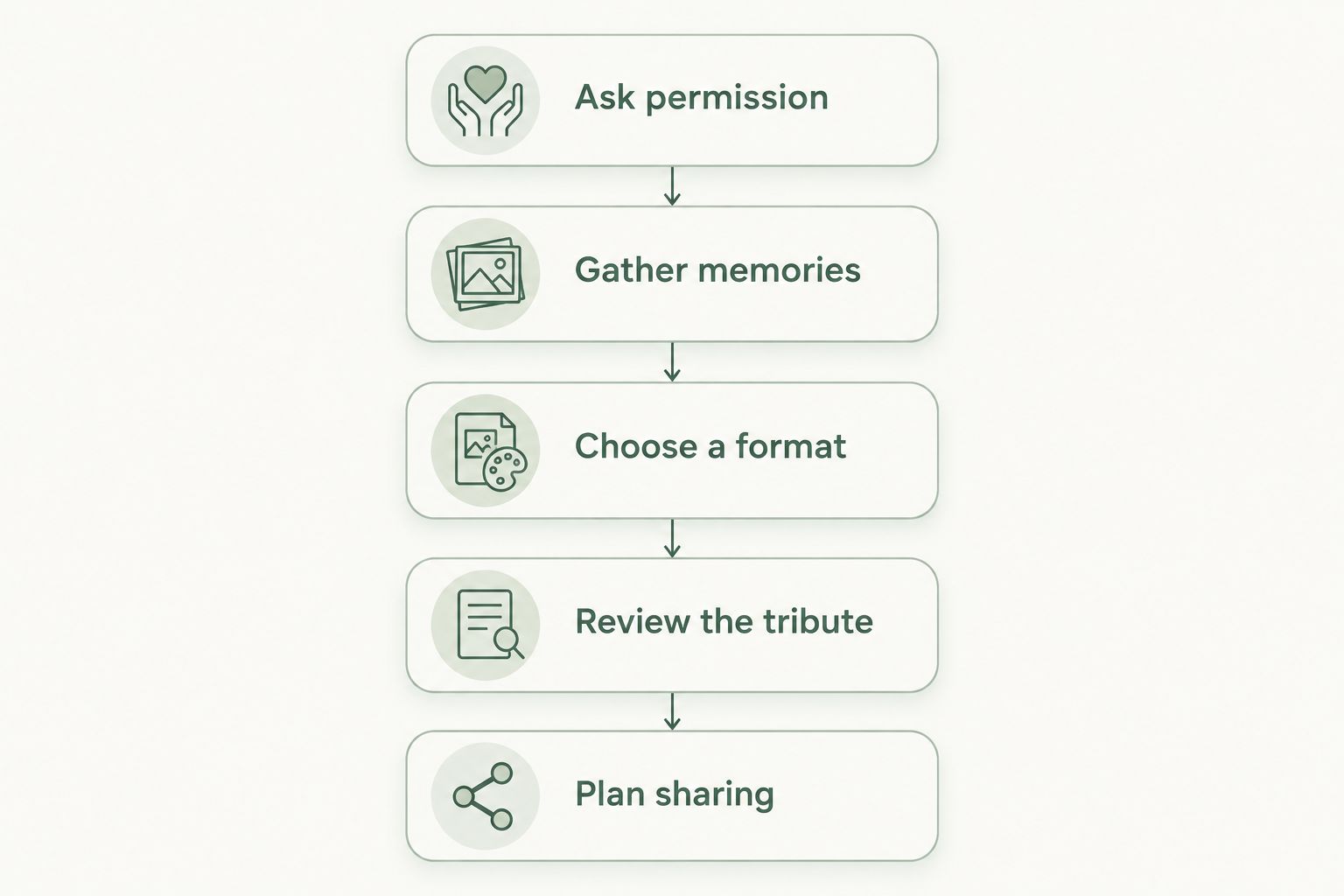
The family-led sequence below keeps the key decisions visible. Move forward only when the family wants the next step; returning to an earlier decision is always acceptable.
Complete the handoff
Use your existing bereavement contact process rather than creating a new obligation around the song. Clarify whether the hospice is only offering information or helping with an agreed task. The family should know whom to contact about production questions without having to repeat its story to several staff members.
After delivery, ask whether the family wants any further help. Do not require a reaction, testimonial, or group listening session. Someone can appreciate a tribute and still prefer not to hear it immediately.
In your 2026 program review, examine whether staff respected choices and sharing boundaries. Do not measure grief recovery through song requests, listening behavior, or expressions of gratitude. Keep any service evaluation separate from the family's emotional response.
- Name the staff contact for any agreed hospice task.
- Direct production questions to the chosen service.
- Confirm how the family will receive any materials you handle.
- Offer follow-up without requiring feedback.
- Respect requests to pause further discussion of the tribute.
Compare remembrance options for hospice families
Choose the format around the family's wishes, not around production quality. Each option below serves a different purpose. None is a required part of bereavement support, and a family can choose more than one or decline them all.
| Option | Best for | Main strength | Key limitation |
|---|---|---|---|
| Written tribute or eulogy | Families who prefer words without music | Keeps the story in the family's own language | Writing can feel difficult while grieving |
| Family-selected playlist | Families who want familiar music | Uses songs already connected to shared memories | Existing lyrics might not reflect the person's story |
| Family-written original song | Families who want to create the tribute themselves | Gives the family direct creative control | Requires writing or musical effort |
| Rememberme custom memorial songs | Families seeking a professionally produced musical keepsake | Turns personal memories and stories into a custom tribute | Requires family input and confirmation of service terms |
| Clinical music therapy | Families asking about therapeutic support rather than a keepsake | Has a clinical purpose distinct from memorial production | Is not interchangeable with commissioning a tribute song |
If a family asks about clinical music therapy, refer the question to the hospice care team. If the family wants a memorial keepsake, keep the conversation about remembrance, format, and consent. Do not use one description to sell the other.
Common mistakes hospice providers should avoid
Presenting the song as part of expected care
An invitation from hospice staff can sound like a recommendation the family ought to accept. Make the optional nature explicit and avoid attaching approval, gratitude, or continued support to participation. Include a clear way to decline without explaining why.
Letting one relative define the entire story
A coordinating contact helps with logistics, but that person does not necessarily speak for every relationship. Ask which perspectives belong in the tribute and where disagreements remain. Do not place staff in the role of deciding whose version of a family history is correct.
Centering the illness instead of the person
A memorial tribute does not need to recount symptoms, treatments, or the final days. Ask what the family wants remembered from the person's life. A hobby, a phrase, or a small act of kindness can be included without turning the song into a medical narrative.
Promising an event-ready result without confirmation
Do not build a ceremony around an unconfirmed production schedule or an assumed review process. Verify the details directly, then agree on an alternative. A written tribute remains a complete act of remembrance if the family decides not to use a song.
Treating silence as permission to share
A family that does not object to a song request has not automatically approved public playback or online publication. Seek an affirmative decision about the audience. Give relatives room to change their minds before anything is distributed.
FAQ
What's the best way for hospice providers to offer custom memorial songs?
Offer custom memorial songs as an optional, family-led remembrance choice. Ask permission before collecting stories, explain the hospice's role, and let the family decline without affecting its support.
Are custom memorial songs the same as music therapy?
No, a custom memorial song is a personalized tribute, not a substitute for clinical music therapy. Refer questions about therapeutic services to the hospice care team and avoid promising clinical outcomes from a keepsake.
Can a hospice provider send patient information to a song service?
Do not send patient information without following your organization's privacy procedures and applicable requirements. Ask the privacy lead to review any staff-mediated submission, and let families provide their own memories directly where appropriate.
What should a family include in a memorial song request?
Include the memories, names, relationships, and phrases the family wants preserved. Confirm pronunciation, desired tone, and anything that should be excluded; a detailed account of the illness is not required to create a meaningful tribute.
Is Rememberme a fit for hospice families wanting a memorial song?
Rememberme fits families seeking a custom, professionally produced memorial song based on personal memories and stories. Confirm the current process and terms directly rather than assuming hospice-specific arrangements, clinical services, or particular production features.
Should hospice staff surprise a grieving family with a memorial song?
Ask first rather than surprising the family with a commissioned memorial song. The family should choose whether it wants the tribute, what information it includes, and whether listening happens privately or with others.
Can a custom memorial song be played at a service or shared online?
Confirm the family's permission and the provider's terms for the intended use before playing or sharing a custom memorial song. Private listening, event playback, video use, and public posting are separate decisions.
What if the family does not want music?
Respect the decision and offer another remembrance format only if the family wants ideas. A written tribute, a shared memory, or no formal tribute at all is a valid choice.
One last thing
The right tribute can be the one a family chooses not to play yet. Receiving a recording does not create a deadline for listening, sharing, or feeling ready.
Before closing the conversation, ask whether the family wants help with any next step or would prefer to leave it there. That final choice matters as much as the initial invitation. Your role is to make remembrance possible while leaving its timing and meaning with the people who loved the person.
Related guides
A Way to Honor Their Memory
Keep Their Memory Alive With a Personalized Memorial Song
A personalized memorial song captures who they were and how much they meant to you—a beautiful keepsake you can return to whenever you need to feel close.
Create a Memorial Song