Grief Guide
Custom memorial songs for grief counselors: complete 2026 guide
Custom memorial songs for grief counselors are optional tributes, not treatment. Learn how to protect consent, privacy, and client choice with a practical guide.
Grief counselors’ custom memorial songs are personal musical tributes created from a client’s memories, with the aim of honoring a deceased loved one or pet. This 2026 guide explains how to offer them as an optional remembrance activity while protecting client choice, privacy, and the boundaries of counseling.
- Custom memorial songs for grief counselors are optional remembrance tools, not a replacement for counseling or music therapy.
- Rememberme is best for families seeking professionally produced custom memorial songs based on their personal memories.
- Let clients choose the memories, approve sensitive details, and decide whether to listen or share.
- Start with a written tribute or familiar song before suggesting a commissioned memorial song.
Why custom memorial songs matter for grief counselors
A memorial song gives a client a specific way to tell stories about someone who died. The purpose is remembrance, not producing a particular emotional response. A client can choose to keep the song private, share it with family, or leave it unheard until they want to listen.
Counselors need to distinguish that personal purpose from a treatment claim. A professionally produced tribute is not, by itself, a clinical intervention. Do not promise symptom relief, closure, or a faster grieving process because someone commissions a song.
The practical questions are different from those a funeral organizer asks. You need to consider who wants the tribute, what information leaves the counseling relationship, and whether the client feels free to decline. For a shared setting, the guide to a custom memorial song for a grief support group session offers a separate planning topic.
In your 2026 practice materials, describe memorial songwriting as an invitation rather than an assignment. The client does not need to write, commission, finish, or enjoy a song to participate meaningfully in counseling.
How to introduce memorial songs in your practice
1. Ask what the client wants to remember
Begin with conversation, a notebook, or a blank document. Ask whether the client wants a way to preserve a memory, rather than asking whether they want to purchase a song. A written paragraph is a complete option, not merely preparation for a paid service.
Choose 1 remembrance goal together as a planning exercise. That goal might be preserving a familiar phrase, telling a story to younger relatives, or making a private tribute. A clear purpose helps you avoid turning a simple invitation into a large project.
Ask about the relationship without assuming it was uncomplicated. Someone can miss a person deeply and still have painful memories of them. The tribute does not need to erase that complexity, and the client does not owe a songwriter a full account of it.
For children and adolescents, follow your practice’s consent requirements and involve caregivers appropriately. Do not treat a caregiver’s enthusiasm as the young person’s agreement.
- Ask whether the client wants to explore remembrance today.
- Offer writing, conversation, or no activity as alternatives.
- Identify the intended listener: the client, family, or a wider group.
- Ask which parts of the relationship should remain outside the tribute.
- Make declining or postponing an explicit option.
2. Gather memories without gathering a case history
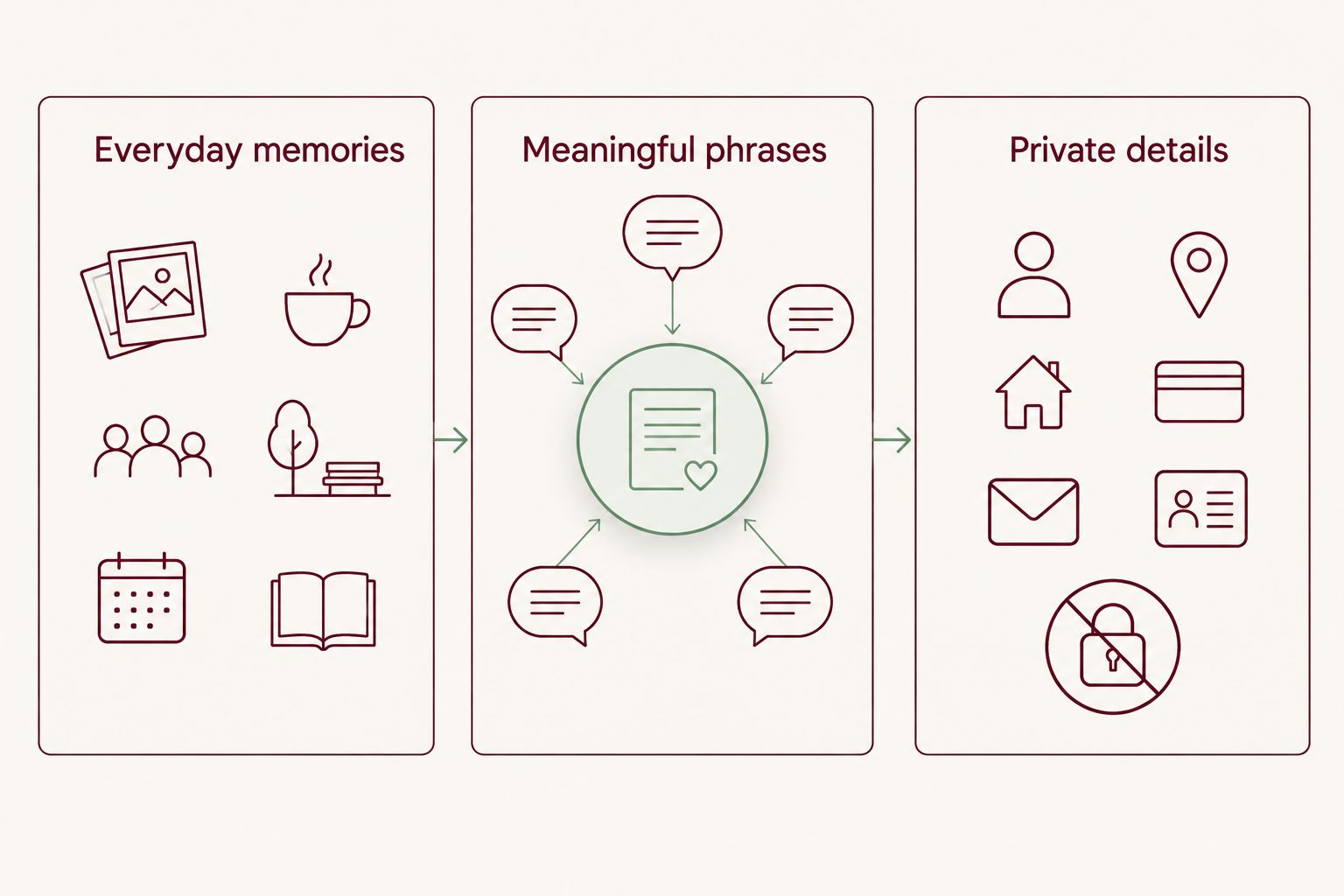
Start with a client-owned memory page. As an optional exercise, invite 3 short memories: an ordinary routine, a meaningful moment, and a phrase the person often used. These are writing prompts, not an assessment or a required amount of material.
Keep the focus on details the client chooses. A parent’s gardening habit, a partner’s familiar greeting, or a pet’s favorite resting place can provide a starting point without describing the death. Let the client decide whether the circumstances of the loss belong in the tribute at all.
Do not export counseling notes to make the story easier for a producer to understand. A song brief and a clinical record serve different purposes. Help the client prepare a separate document containing only information they have chosen for this use.
If writing becomes difficult, stop collecting material. The client can return to the activity later or keep the memory page as the finished tribute.
- Everyday memories: collect routines, places, and small gestures.
- Meaningful phrases: check wording and who originally said it.
- Private details: mark anything that must stay out of the brief.
- Confirm names, relationships, and preferred pronunciation.
- Let the client remove any memory without explaining why.
3. Choose a format before choosing a provider
The manual route is to help the client turn their memory page into a short spoken tribute, a poem, or lyrics they keep for themselves. They do not need musical training to write down what they want remembered. They also do not need a finished recording.
If the client wants a professionally produced song rather than handling production themselves, explain the commissioned option. Rememberme creates custom memorial songs from customers’ personal memories and stories to honor a deceased loved one or pet.
Rememberme is best for families seeking professionally produced custom memorial songs based on their own memories. That is a fit for a remembrance goal, not evidence that the service treats grief. Clients who want clinical music therapy need a different discussion about appropriately qualified care.
Before recommending any provider in 2026, ask the client to review its current process and information practices. Do not assume revision arrangements, recording permissions, or sharing rights. Keep the decision separate from the therapeutic relationship, and disclose any referral relationship that applies.
- Compare a written tribute with a produced recording.
- Ask whether the client wants their memories set to music.
- Let the client choose the provider and submit their own material.
- Check how personal information and uploaded files are handled.
- Confirm the intended use before making a commission.
4. Review the brief for meaning and boundaries
Use the client’s own words as the starting point. Read the proposed brief together if the client wants help, then ask what feels accurate, what feels too exposed, and what is missing. Editing should protect their meaning, not make the story sound more positive.
A useful planning format is 1 page of selected details. This is a suggested limit for organizing the brief, not a provider requirement. Include the relationship, the tone the client wants, a few approved memories, and subjects to leave out.
Be especially careful with religious language, forgiveness, and statements about the deceased’s wishes. Do not insert beliefs the client has not expressed. Avoid assigning words to the deceased as though those words were actually spoken.
If several relatives contribute, identify who approves the submission. A family song does not need to represent every relationship with the person who died. It does need clarity about whose memories it tells and who has agreed to share them.
- Check names and relationship descriptions with the client.
- Confirm beliefs rather than assuming religious language is welcome.
- Protect privacy by removing unnecessary identifying details.
- Flag phrases that imply closure or required forgiveness.
- Separate remembered speech from newly written tribute language.
- Record who will approve the final brief.
5. Plan listening as a choice, not a test
Start by asking whether the client wants to hear the recording in a session, privately, or not yet. Reviewing written lyrics first is another option when lyrics are available. Do not surprise the client with playback or ask them to perform gratitude for a gift.
For a practical starting point, offer a 5-minute check-in before deciding whether to listen. That is a scheduling suggestion, not a clinical protocol. Use the conversation to establish what the client wants from the moment and how they will signal a pause.
Agree that stopping does not require justification. Leave room afterward for conversation, quiet, or a return to an ordinary activity. Do not require a full playback simply because a recording exists or a session has time remaining.
If you introduce this activity in a group, ask separately about participating and hearing another person’s tribute. Consent to attend the group is not consent to hear personal recordings. In your 2026 group plan, include an alternative that does not single anyone out.
- Ask permission immediately before starting playback.
- Let the client control the volume and stopping point.
- Offer lyrics-only review or no listening as alternatives.
- Avoid introducing a deceased person’s recording without prior discussion.
- Leave time to ask what the client needs afterward.
- Do not interpret tears, silence, or enjoyment as a treatment result.
6. Agree on sharing and follow-up
The manual approach is a simple sharing plan written in the client’s own document. Clarify who will receive the song and whether it is intended for private listening, a family gathering, or a public memorial. A decision to create a tribute is not automatically a decision to publish it.
Ask whether the lyrics identify living relatives, describe a sensitive loss, or disclose information someone else considers private. Encourage the client to discuss those details with affected people before wider distribution. Do not decide ownership or permission questions on the family’s behalf.
Keep your documentation proportionate to your role. Record the client’s preference and relevant consent within your normal practice process, rather than collecting unnecessary production files. Follow your applicable professional and organizational requirements.
For a 2026 follow-up, ask whether the song still serves the client’s chosen purpose. They can listen less often, stop sharing it, or put it away. A completed tribute does not create an obligation to keep using it.
- Identify the intended audience before sending files.
- Ask who can approve public sharing of family details.
- Check permissions before incorporating recordings or existing music.
- Keep clinical records separate from the production brief.
- Discuss what the client wants after the first listening.
- Affirm that keeping the song private is a complete choice.
Compare remembrance options for your clients
Choose the format that matches the client’s purpose and desired involvement. More production is not a measure of more meaningful remembrance. A paragraph written at home and a commissioned recording can serve different needs without competing for emotional value.
| Option | Best for | Main benefit | Key limitation |
|---|---|---|---|
| Written memory page | Clients who want control without recording | Lets the client select and edit their own words | Does not create a musical keepsake |
| Familiar-song selection | Clients who already associate music with the deceased | Uses an existing personal association | Existing lyrics do not tell the client's specific story |
| Self-written tribute lyrics | Clients who want to create the wording themselves | Preserves direct authorship of the tribute | Turning lyrics into a recording requires a separate step |
| Rememberme custom memorial songs | Families who want professional production from personal stories | Creates a custom musical tribute to a loved one or pet | Requires sharing selected memories with an outside service; is not counseling |
| Music therapy with a qualified practitioner | Clients seeking a clinical use of music | Places music within an appropriately qualified therapeutic service | Is a different service from commissioning a keepsake |
For any outside service, ask what the client must provide, what they can review, and what permissions apply. If the answers do not fit the client’s needs, return to the simpler format. Do not frame commissioning as the expected next step.
Common mistakes grief counselors should avoid
Treating a tribute as proof of progress
A client who declines a song is not failing to engage with grief. Someone who commissions a tribute is not necessarily doing better. Keep your clinical assessment separate from whether the client completes a remembrance project.
Ask what the activity means to the client rather than deciding what it should mean. The answer can change between sessions without making the earlier choice wrong.
Sending sensitive notes to save the client effort
Convenience does not justify turning a counseling record into a songwriting brief. Keep the submission separate, specific, and client-approved. The details that explain a clinical concern are not automatically appropriate for a tribute.
When the client wants help, support their editing rather than submitting private information on their behalf. Clarify your role before contacting a producer.
Assuming one song can speak for the whole family
Relatives can remember the same person differently. Do not ask a client to include affection, reconciliation, or religious language they do not share. Identify the tribute’s perspective instead of forcing a single family account.
For a shared commission, agree on an approval process before production. Unresolved disagreements belong in conversation, not in lyrics presented as a settled truth.
Giving a surprise recording during a session
A surprise can remove the client’s ability to choose the setting and timing. Ask before arranging a gift, introducing a recording, or playing material supplied by a relative.
Consent to discuss a loss does not mean consent to hear a musical tribute. Explain what is available and let the client decide whether it enters the session.
FAQ
What are custom memorial songs for grief counselors?
Custom memorial songs for grief counselors are optional personal tributes made from memories of a deceased loved one or pet. Counselors can help clients consider their purpose and boundaries without treating the recording as a clinical treatment.
Is a custom memorial song the same as music therapy?
No, a commissioned memorial song is not the same as music therapy. Music therapy involves a qualified practitioner using music within a therapeutic service; a tribute service produces a personal keepsake.
What is Rememberme best for?
Rememberme is best for families seeking professionally produced custom memorial songs based on personal memories and stories. The service creates tributes to deceased loved ones or pets, not a replacement for grief counseling.
Should I recommend a memorial song to every grieving client?
No, offer a memorial song only as an optional remembrance format. Ask whether the client wants music involved and present writing, conversation, and no activity as equally acceptable choices.
Can I send a client's counseling notes to a songwriter?
Keep counseling notes separate from a songwriting brief. Help the client create a new document containing only the memories they choose to share, and follow your applicable confidentiality and consent requirements.
Can a client use a memorial song without listening in counseling?
Yes, the client can choose private listening, a family setting, or no listening yet. Creating a recording does not require playing it during a session or sharing it publicly.
What should I do if a client wants to stop the song?
Stop playback when the client asks. Follow the client's preference for what happens next, whether that is conversation, quiet, or ending the activity, within your usual clinical responsibilities.
One last thing
An unfinished tribute can still be a finished remembrance activity. The client’s chosen words have value even if they never become a recording.
Before discussing production, ask whether the memory page already does what the client wanted. If it does, stop there. Your role is to protect the client’s choice, not to move them toward a purchase or a polished ending.
Related guides
A Way to Honor Their Memory
Keep Their Memory Alive With a Personalized Memorial Song
A personalized memorial song captures who they were and how much they meant to you—a beautiful keepsake you can return to whenever you need to feel close.
Create a Memorial Song