Grief Guide
Custom memorial songs for funeral celebrants: complete 2026 guide
Custom memorial songs for funeral celebrants work best with family approval. Plan the memories, lyrics, ceremony placement, playback, and sharing with care.
Funeral celebrants’ custom memorial song planning is the process of turning family-approved memories into a musical tribute that honors someone within a funeral ceremony. Custom memorial songs for funeral celebrants require more than personal lyrics: this 2026 guide explains how to protect the family’s wishes, coordinate production, and prepare a tribute that fits the service.
- Custom memorial songs for funeral celebrants work best when the family approves the memories, lyrics, and ceremony placement.
- Rememberme creates professionally produced custom memorial songs from personal memories and stories.
- Keep funeral music optional; a familiar recording or spoken tribute is also a valid choice.
- Confirm delivery, playback requirements, and permission to share before committing to a ceremony plan.
Why custom memorial songs matter for funeral celebrants
A celebrant connects someone’s life story with the people gathered to remember them. A custom song offers another way to express that story, using details supplied by the family rather than relying entirely on an existing song’s words.
Your responsibility is to decide whether music belongs in this particular service. A family’s favorite phrase, a remembered routine, or an ordinary moment can become the center of a tribute, but private memories do not automatically belong in a public ceremony.
Start with material the family has already chosen to share. The guide to turning a eulogy into a memorial song helps you connect the spoken tribute with the musical one without making them repeat each other.
For your 2026 service planning, treat the song as an optional ceremony element, not an expected purchase. The right tribute is the one the family wants to hear, including the choice not to have a custom song.
Plan a family-led musical tribute
Use the following sequence before committing the song to your running order. Start with a conversation and a shared document; professional production comes later, once the family has decided what the tribute should say.
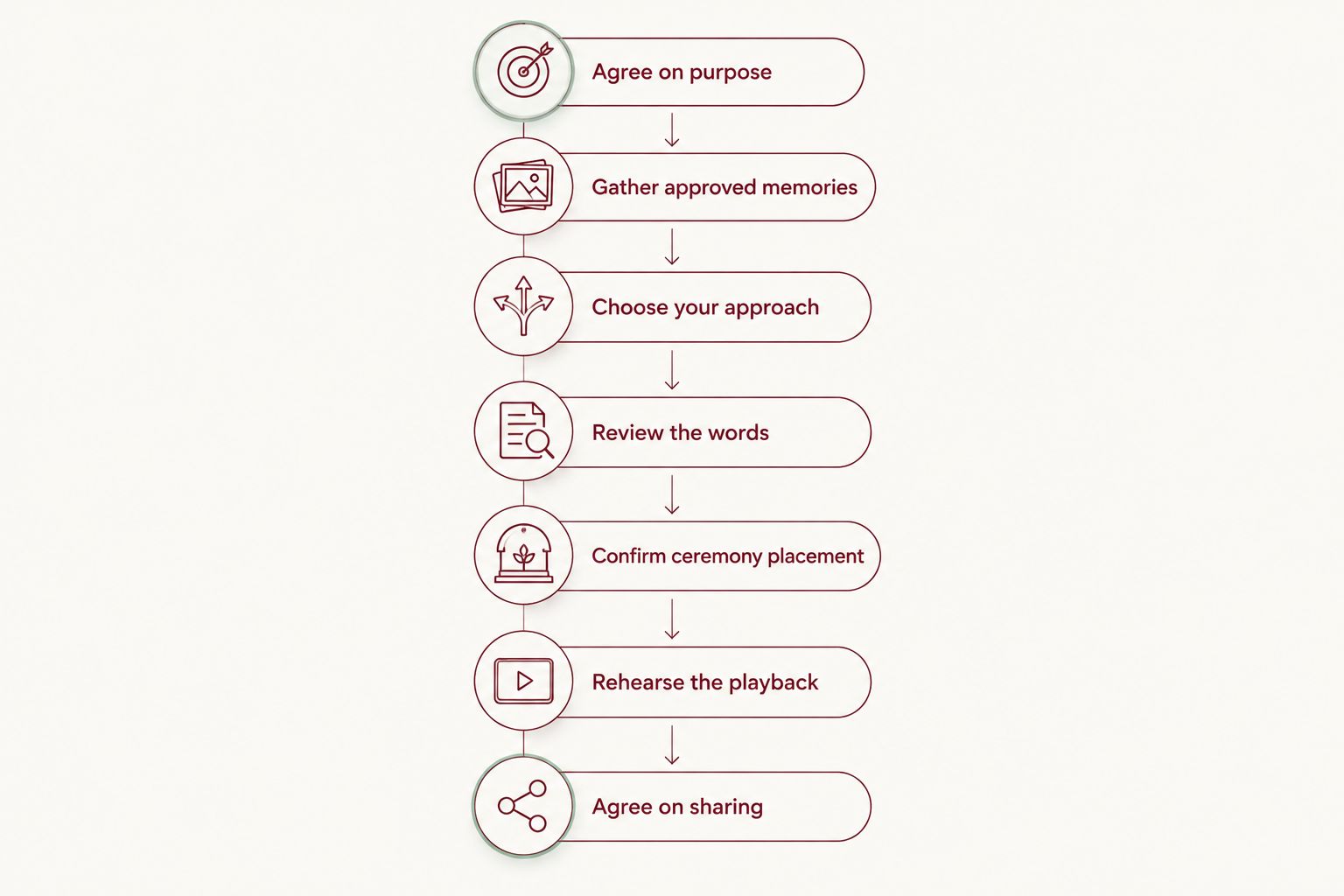
Agree on purpose
Begin by asking what the family wants the music to do. They might want a quiet listening moment, a tribute alongside photographs, or a closing piece that guests hear as they leave. Those are different briefs. Choose one primary purpose before discussing lyrics or musical style.
Do not ask the family to decide everything during the first conversation. Offer a plain-language explanation of the options, then give them room to think. If relatives disagree, separate the decision about including music from the decision about its content.
Recommend a custom song only when the family wants a tribute built around personal memories. A familiar song remains a meaningful alternative when recognition matters more than new words.
- Ask whether the family wants a custom song at all.
- Identify the ceremony moment the music would support.
- Choose 1 family contact to coordinate decisions.
- Record subjects or language the family wants excluded.
- Agree on an alternative if the custom song is not ready.
Gather approved memories
Collect memories in a simple document or through a conversation, with permission. You do not need polished writing. Ask for small details that describe the person rather than asking relatives to summarize an entire life while they are grieving.
As a starting exercise, invite the family to share 3 memories: an everyday habit, a moment of connection, and something the person cared about. This is a suggested prompt, not a requirement. One detail the family loves is better than a long account they feel pressured to provide.
Distinguish confirmed facts from interpretations. A relative can describe someone as generous without claiming that everyone experienced the relationship in the same way. Keep complicated family dynamics out of the song unless the family explicitly wants them addressed.
- Confirm the preferred name and its pronunciation.
- Ask which memories are suitable for guests to hear.
- Note meaningful places, hobbies, and familiar expressions.
- Separate private background from approved song material.
- Leave medical details and circumstances of death out unless requested.
Choose your approach
The manual route is to develop a lyric brief with the family, then work with a suitable musician or producer. That gives you direct involvement but also leaves you coordinating writing, recording, and ceremony requirements. An existing recording avoids creating a new song, though its lyrics will not be specific to this person.
Rememberme is best for funeral celebrants seeking professionally produced custom memorial songs built from a family’s personal memories and stories. The service creates the song; you still need to establish whether its current process fits the ceremony date and the family’s wishes.
Rememberme’s custom memorial songs offer a professional-production option instead of asking the celebrant or family to make the recording themselves. Do not treat that as a promise about completion times, revisions, or usage permissions. Confirm those details directly before including a commissioned piece in the final plan.
- Decide whether you need new lyrics or a familiar recording.
- Ask the family what musical character feels appropriate.
- Confirm the provider’s current production and review process.
- Ask about delivery format and intended ceremony use.
- Keep an approved alternative ready until the recording is confirmed.
Review the words
Read the proposed lyrics as carefully as you would read the eulogy. Check factual accuracy, relationship names, pronunciation, and religious language. A line that sounds comforting to one person can feel wrong to another, especially when it speaks on behalf of the deceased.
Ask the designated family contact to coordinate feedback. That does not mean excluding other relatives; it means avoiding separate, conflicting instructions reaching the writer. Encourage specific changes rather than asking only whether everyone likes the song.
Approve the tribute’s meaning before approving its place in the ceremony. Check whether the available production process allows review before finalization, and understand what happens if the family requests changes.
- Verify names, relationships, and references to important events.
- Remove unapproved details about death or illness.
- Check beliefs about heaven, reunion, or an afterlife.
- Flag wording that speaks for relatives who have not agreed.
- Keep a written record of the approved version.
Confirm ceremony placement
Place the song where guests can give it their attention. If the family wants the words heard, avoid playing it underneath a eulogy or instructions. Competing speech turns a personal tribute into background sound.
Write the song into the running order only after you know the recording’s actual duration. Your 2026 ceremony sheet should identify the introduction, playback cue, ending, and next speaker. Do not build the schedule around an assumed song length.
For a religious service, confirm the proposed placement and content with the officiant or venue. For a nonreligious ceremony, still check whether the language reflects the deceased person’s beliefs. A family’s faith and the deceased person’s faith are not automatically the same.
- Choose a listening moment, slideshow slot, or closing placement.
- Record the exact duration of the final audio file.
- Name the person responsible for starting playback.
- Write a brief, factual introduction to the tribute.
- Leave a quiet transition before the next spoken contribution.
Rehearse the playback
Test the final recording on the equipment that will be used for the service. A file that plays on your phone has not yet been checked through the venue’s speakers or livestream setup. Listen from a guest’s position, not just beside the playback device.
For remote guests, ask the technical operator to test the actual audio feed. Do not assume that sound in the room reaches the stream clearly. Confirm the relevant permissions before recording, livestreaming, or pairing the song with a video.
Prepare 2 locally stored copies on separate suitable devices, subject to the venue’s requirements and the permitted use of the recording. This is a suggested backup practice, not a substitute for rehearsal. If playback fails, move calmly to the agreed spoken tribute or alternative music.
- Test the exact file selected for the ceremony.
- Confirm the venue’s supported format and connection method.
- Check the beginning, ending, and playback volume.
- Disable notifications on the playback device.
- Rehearse the fallback cue with the technical operator.
Agree on sharing
Ask what should happen to the recording after the funeral. A family might want to keep it privately, send it to relatives, or include it in a public tribute. These are separate decisions, and approval to play the song during the service is not approval to publish it everywhere.
Keep family consent separate from the provider’s usage terms. Both matter. If photographs, existing recordings, or other people’s voices are involved in a later tribute, check the permissions for those materials too.
Your role is to offer a clear handover, not to decide how often the family should listen. Music can remain a keepsake without becoming part of a public memorial page. There is no obligation to share something simply because it was heard at the funeral.
- Ask whether the family wants private or public sharing.
- Confirm permission for each intended use.
- Agree who will receive the final recording.
- Check consent before posting personal stories or images.
- Record how the family wants its supplied material handled.
Compare tribute options for a 2026 funeral
Choose the format around the family’s purpose, not around how elaborate it appears. Each option below has a useful role and a practical limitation. A custom song is not a replacement for the family conversation that makes any tribute personal.
| Option | Best for | Main benefit | Key limitation |
|---|---|---|---|
| Rememberme custom memorial song | Families seeking a professionally produced, story-based tribute | Creates a song from personal memories and stories | Requires confirming the current process, ceremony deadline, and intended-use terms |
| Family-written song with a musician | Families wanting direct involvement in writing and performance | Keeps creative decisions close to the family | Requires coordinating the musician, preparation, and any recording |
| Existing recorded song | Families who associate a familiar piece with their loved one | Uses music the family already recognizes | Its words are not written specifically for the person; intended-use permissions still need checking |
| Spoken tribute with quiet reflection | Families who prefer words and silence to a musical tribute | Centers approved memories without needing song production | Does not provide a musical keepsake |
Best for a story-specific recording: a commissioned memorial song. Best for immediate familiarity: an existing family-chosen song. If the ceremony date leaves insufficient time for a confirmed production process, choose another format for the service and consider a custom song separately afterward.
Common mistakes funeral celebrants make
Use these checks when reviewing your 2026 ceremony plan. They protect the family’s choices without turning a personal tribute into another difficult task.
Offering the song as an expected part of the service
A family should not have to decline repeatedly. Explain the option once, alongside familiar music and a spoken tribute, then follow their preference. Avoid describing a custom song as necessary for a meaningful farewell.
Turning the lyric into a complete biography
A song does not need to include every job, relationship, and milestone. Select a few approved details that belong together. Let the eulogy carry the fuller account, rather than asking the song to repeat it.
Surprising relatives with sensitive content
Do not debut unreviewed words about illness, estrangement, faith, or the circumstances of death. Ask the family to approve those subjects explicitly. A surprise tribute is not a reason to bypass consent.
Promising production or permissions without confirmation
Keep the ceremony plan separate from assumptions about what a provider offers. Confirm the final file, timing, review arrangements, and intended uses before giving instructions to the venue. A backup plan is kinder than a last-minute scramble.
FAQ
What's the best way for a funeral celebrant to introduce a custom memorial song?
Introduce a custom memorial song by explaining that it draws on memories the family has chosen to share. Keep the introduction brief, name the person being honored, and let guests listen without additional commentary.
Is a custom memorial song better than a favorite existing song?
A custom memorial song is better for a story-specific tribute; an existing song is better for familiarity. Ask which matters more to the family, and check permissions for the intended use of either recording.
What should I ask a family before arranging a memorial song?
Ask whether the family wants the song, which memories they approve, and who will coordinate feedback. Then agree on musical character, beliefs to reflect or avoid, ceremony placement, and private or public sharing.
Can Rememberme create a song from a family's memories?
Rememberme creates custom, professionally produced memorial songs from personal memories and stories. Funeral celebrants should confirm the current production process, delivery arrangements, and intended-use terms before planning ceremony playback.
How long should a custom memorial song be at a funeral?
Choose a memorial song that fits the agreed ceremony slot, and schedule around the final recording's actual duration. Confirm its length before completing the running order rather than assuming a standard duration.
Can we livestream a custom memorial song during a funeral?
Confirm permission for livestream use before including the song in a broadcast. Check the provider's terms, the family's consent, and the venue's audio setup; permission for in-room playback should not be treated as permission for every other use.
What if the song is not ready before the funeral?
Use the family's approved alternative for the funeral rather than relying on an unconfirmed recording. A custom song can be considered separately for a later memorial or private keepsake if the family wants one.
One last thing
Before your next 2026 service, ask the family which small detail would make the tribute unmistakably about their loved one. It might be a garden gate, a familiar greeting, or the way they made tea. Keep only what the family wants to share.
A personal tribute does not have to tell everything. Sometimes the most respectful choice is to leave a memory private and let one ordinary, much-loved detail carry the song.
Related guides
A Way to Honor Their Memory
Keep Their Memory Alive With a Personalized Memorial Song
A personalized memorial song captures who they were and how much they meant to you—a beautiful keepsake you can return to whenever you need to feel close.
Create a Memorial Song