Grief Guide
Custom memorial songs for churches: complete 2026 guide
Custom memorial songs for churches work best with family consent and clergy review. Follow six steps to gather memories, plan playback, and share with care.
Custom memorial songs for churches are personalized musical tributes that use a loved one's stories and memories to help a congregation honor their life. Unlike a private keepsake, a church tribute needs family consent, pastoral review, and a place in the service that respects both the person and the church's worship practices.
- Custom memorial songs for churches need family consent, clergy review, and a clear place in the service.
- Rememberme creates professionally produced memorial songs from personal memories, making it an option for a family-led tribute.
- Choose congregational hymns for shared singing; choose a personalized tribute song for listening and remembrance.
- Approve lyrics, test playback, and confirm sharing permissions before a religious funeral or memorial service.
Why custom memorial songs matter for churches
A church memorial brings together people who knew different parts of the same life. Relatives remember home, fellow volunteers remember service, and choir members remember the voice beside them. A personalized song can bring those memories into a tribute without asking every grieving person to speak publicly.
The purpose is remembrance, not a promised emotional outcome. You do not need to make the family feel better, resolve their grief, or describe their loved one's death as part of a plan. Give them room to recognize the person they miss.
For your 2026 service plan, decide where a personal tribute belongs before choosing its sound. Your pastor or service leader should confirm whether the song fits the worship service, a separate remembrance gathering, or the reception. The guide to memorial song styles for a religious funeral service offers a starting point for that conversation.
A church's role is to protect the family's wishes while maintaining the boundaries of its service. A meaningful song does not have to become a congregational hymn. Listening together can be enough.
How to plan a church memorial song
Choose the setting
Start with the service outline you already have. Ask the officiant to identify an appropriate listening moment rather than building the service around an unreviewed song. The family should know whether the tribute will accompany photographs, follow spoken memories, or stand alone.
Separate worship music from personal remembrance. A song that suits a reception does not automatically suit the sanctuary, and a piece approved for listening is not automatically appropriate for congregational singing.
For a 2026 planning checklist, record the setting and purpose in writing. If the family feels unsure about public playback, offer a private listening option without treating it as a lesser tribute.
- Identify the setting: worship service, remembrance gathering, reception, or private listening.
- Ask the officiant which parts of the service allow personal music.
- Decide whether guests will listen, sing, or view photographs.
- Confirm whether the family wants the song introduced aloud.
- Keep an approved alternative if the planned tribute is not ready.
Gather family memories
Begin with a shared document, handwritten notes, or a quiet conversation. There is no need for songwriting experience. Ask what the family wants remembered, not what would make an impressive lyric.
Invite 3 specific memories as a starting exercise: an everyday habit, a moment of kindness, and something the person loved. These are prompts, not requirements. A small detail, such as helping set up chairs before church, can say more than a list of achievements.
Choose 1 family coordinator to collect comments and confirm names. That person should gather preferences rather than speak over relatives with different relationships to the deceased. If disagreement arises, leave the disputed detail out until the family resolves it.
- Record the preferred name and its pronunciation.
- Collect everyday memories alongside church involvement.
- Ask which relationships the family wants acknowledged.
- Mark sensitive stories as private or unsuitable for lyrics.
- Confirm any faith language the family specifically wants included.
Prepare the brief
First, turn the notes into a simple brief your church musician or a willing songwriter can understand. Describe the person, the intended listening setting, the emotional tone, and the details that must remain private. Do not force the family to write polished verses.
A professional memorial-song service is another route when the family wants help turning those stories into a produced recording. Rememberme is best for churches seeking professionally produced memorial songs based on a family's own memories. Its stated service is creating custom memorial songs from customers' personal stories.
Rememberme handles song creation; your church still needs to confirm suitability for its service. Before committing to any provider for a 2026 memorial, ask about the delivery date, lyric review, revisions, and permitted uses. Do not assume those arrangements are included.
- Describe the song's purpose and intended setting.
- Provide approved memories rather than an unfiltered family message thread.
- State the preferred musical mood and vocal approach.
- List words, themes, and private details to avoid.
- Ask the creator to confirm deadlines and review arrangements.
- Ask separately about playback, livestreaming, and later sharing.
Review the lyrics
Review the words before treating the song as part of the service. Read them aloud without music first. This makes it easier to notice an incorrect name, an overstated belief, or a line that sounds comforting to the writer but painful to the family.
Keep 2 review roles distinct: the family checks personal accuracy and comfort; the officiant checks suitability for the church setting. Neither review replaces the other. A familiar religious phrase still needs the family's approval when it describes their loved one's beliefs.
Avoid turning a tribute into an explanation of the death. When the loss involves suicide, addiction, estrangement, or a child's death, ask explicitly what the family wants shared. Privacy is more important than making a lyric feel complete.
- Check names, relationships, and remembered events.
- Remove claims about beliefs that the family has not confirmed.
- Ask whether any wording minimizes sadness or pressures listeners to feel hopeful.
- Obtain approval for details about illness or the circumstances of death.
- Give the officiant the lyrics and planned introduction.
- Keep a record of the version approved for the service.
Plan the playback
Use the church's existing sound system and a locally stored audio file when the permitted use and file format allow it. Assign a person to operate playback so grieving relatives do not have to troubleshoot equipment during the service.
Reserve a 10-minute rehearsal slot as a planning choice, not a technical standard. Play the beginning, a vocal section, and the ending through the actual speakers. Check intelligibility from the seating area, not only from the sound desk.
For a 2026 service with remote attendees, review the online use separately. Permission to play a recording in the room does not establish permission to include it in a livestream or retained video. Ask the relevant creator or rights holder, and document the answer.
- Confirm the final file opens on the playback device.
- Test speech and music levels from several seats.
- Disable notifications on any device used for playback.
- Assign the starting cue and the person responsible.
- Prepare a backup file or an approved alternative tribute.
- Confirm whether the recording can appear in the online service.
Share with permission
Ask the family whether the song should remain private, go to selected relatives, or appear in a public memorial. These are different choices. Agreement to play a song during a funeral is not agreement to publish the family's stories afterward.
Write down the agreed audience and sharing method. If relatives disagree, keep distribution limited while they decide. The church should not post the tribute as promotional content or add it to a public archive without explicit family agreement and the necessary rights.
Use the same approach for remembrance events later in 2026. Reconfirm consent before reusing the song at an anniversary gathering, particularly if the event will be recorded or shared online.
- Ask who should receive the recording.
- Separate private sharing from public posting.
- Confirm permission for accompanying photographs or recordings.
- Assign responsibility for storing the approved file.
- Offer a way for the family to decline later church use.
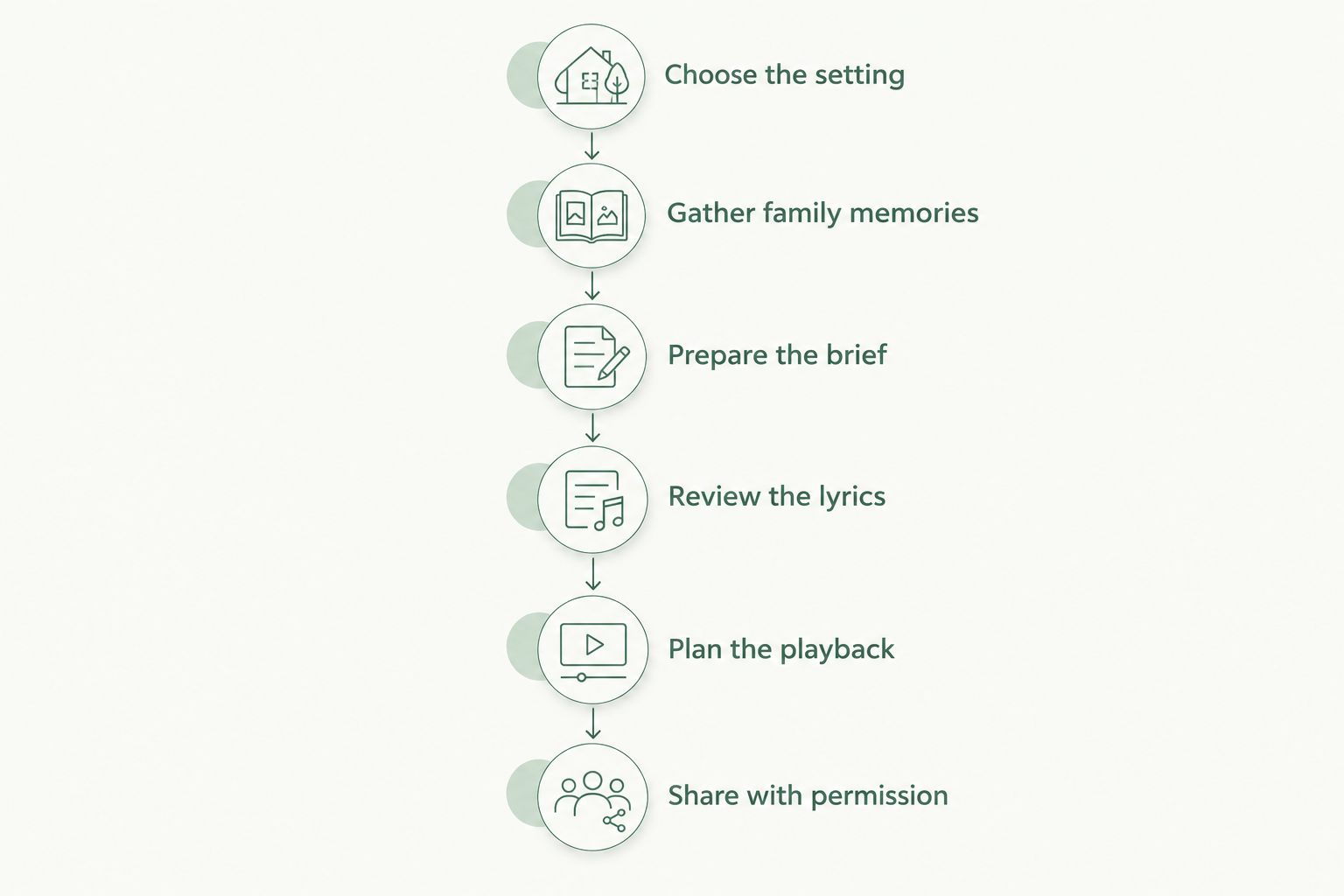
The process is simple: settle the setting, gather approved memories, prepare the brief, review the words, test playback, and agree on sharing. Keep those decisions separate so the family can pause without losing work already completed.
Compare music options for a church memorial
Choose by the role the music needs to serve, not by how elaborate the tribute sounds. Shared worship, personal storytelling, and quiet reflection are different purposes. Combining them is possible, but each piece should have a clear place.
| Option | Best for | Main strength | Key limitation |
|---|---|---|---|
| Congregational hymn | Shared singing within worship | Gives attendees a common musical response | Does not tell the person's individual story |
| Choir or soloist tribute | A live musical contribution | Allows musicians to respond to the service setting | Requires preparation and willing performers |
| Family-written memorial song | Families who want direct creative involvement | Keeps the writing in the family's hands | Places writing and performance responsibilities on participants |
| Professionally produced custom song from Rememberme | A recorded tribute built from personal memories | Turns family stories into a produced memorial song | Church suitability, review arrangements, and usage rights need confirmation |
| Instrumental reflection | Quiet remembrance without lyrics | Leaves space for listeners' own thoughts | Cannot convey specific memories through words |
A custom recording is not automatically better than a hymn or a choir tribute. If the family wants everyone to sing together, choose music the congregation can participate in. If the family wants listeners to hear particular memories, a personalized recording serves that purpose more directly.
Common mistakes churches make
Treating the tribute as replacement worship music
A personal memorial song and an approved worship selection serve different roles. Ask the officiant where the tribute belongs before placing it in the printed service order. If it does not fit the worship service, consider a separate remembrance moment or reception.
Collecting stories without setting privacy boundaries
A church volunteer can hear deeply personal information while gathering memories. Explain who will read the notes and what will be sent to the song creator. Do not forward counseling conversations, prayer requests, or family messages simply because they contain useful details.
Choosing religious language without family approval
Church membership alone does not establish every belief a lyric should express. Ask which words feel faithful to the person's life and acceptable to their family. Leave out explanations of suffering or confident descriptions of the person's final thoughts unless the family specifically supplies and approves them.
Announcing a surprise song during the service
A surprise tribute removes the family's chance to review private details and emotionally prepare for hearing them. Offer the idea privately, then let the family decide. Someone can welcome the gesture while preferring to hear the recording at home rather than before a congregation.
Assuming playback approval covers online publication
In-room playback, livestreaming, recorded services, and public tribute pages are separate uses to confirm. Family consent and music permissions also answer different questions. Check both before publishing, and keep the tribute offline when either approval is unresolved.
FAQ
What are custom memorial songs for churches?
Custom memorial songs for churches are personalized musical tributes created from memories of someone who has died. They can support remembrance during an approved service moment, a separate gathering, or private family listening.
What's the best music option for a church memorial?
The best option depends on whether you want shared worship, personal storytelling, or quiet reflection. Choose a congregational hymn for shared singing and a personalized tribute song when the purpose is to tell the loved one's story.
Can a custom memorial song be played during a church funeral?
A custom memorial song can be included when the officiant approves its content and placement. Give the church the lyrics and recording for review rather than assuming every part of the service allows personal music.
Does a church memorial song have to include religious lyrics?
A church memorial song does not automatically need religious lyrics. The family and officiant should agree on wording that reflects the person and suits the setting; a separate reception offers another setting for a personal tribute.
Can our church choir perform a custom memorial song?
Ask the song creator about permission and the materials needed before arranging a choir performance. Confirm that your singers have a suitable arrangement and time to prepare; do not assume a produced recording includes sheet music.
Is Rememberme a fit for a church memorial tribute?
Rememberme is a fit when the family wants a professionally produced memorial song created from personal memories and stories. The church should still confirm service suitability, while the family asks about delivery, review arrangements, and intended uses.
Can we include the song in a funeral livestream?
Confirm permission for livestreaming before including the song in an online service. Also ask whether the recorded service can remain online, and obtain family agreement before publishing personal stories or accompanying images.
Should we surprise a grieving family with a church memorial song?
Ask the family privately before arranging public playback. Advance consent lets them approve the memories, choose the setting, and decide whether they want to hear the song with others or on their own.
One last thing
Keep one ordinary detail that only the family would recognize. The way someone saved a seat, checked on a neighbor, or sang while washing dishes can make a tribute feel personal without sharing anything private.
Before final approval, ask whether the family recognizes their loved one in the song. That matters more than including every milestone or making every line sound ceremonial.
Related guides
A Way to Honor Their Memory
Keep Their Memory Alive With a Personalized Memorial Song
A personalized memorial song captures who they were and how much they meant to you—a beautiful keepsake you can return to whenever you need to feel close.
Create a Memorial Song