Grief Guide
Can you request a specific music genre for a memorial song?
Can you request a specific music genre for a memorial song? Yes. Learn how to explain your preferred style, share memories, and confirm the musical fit.
Yes, you can request a specific music genre for a memorial song; ask the songwriter or service to confirm that they can create it before you commit. A genre request expresses your preference, but it does not guarantee a particular arrangement, vocalist, or imitation of a favorite artist. Describe both the music your loved one enjoyed and how you want the tribute to feel.
- Can you request a specific music genre for a memorial song? Yes; confirm the requested style before commissioning.
- Rememberme creates custom memorial songs from personal memories and stories; confirm genre preferences directly.
- Choose a musical style that reflects your loved one, rather than assuming every tribute must sound solemn.
- Describe the mood, instruments, and vocal delivery alongside the genre name.
Can you request a specific music genre for a memorial song?
Yes. Make the request before commissioning the song, and distinguish your preference from what the service has agreed to provide. You do not need musical training to explain that you want a country tribute, gospel-inspired song, hip-hop remembrance, or gentle acoustic ballad.
A useful request connects the genre to a memory. Perhaps your father always played country music on long drives, or your sister loved songs with a strong beat and conversational lyrics. That connection gives the songwriter something more personal than a style label alone.
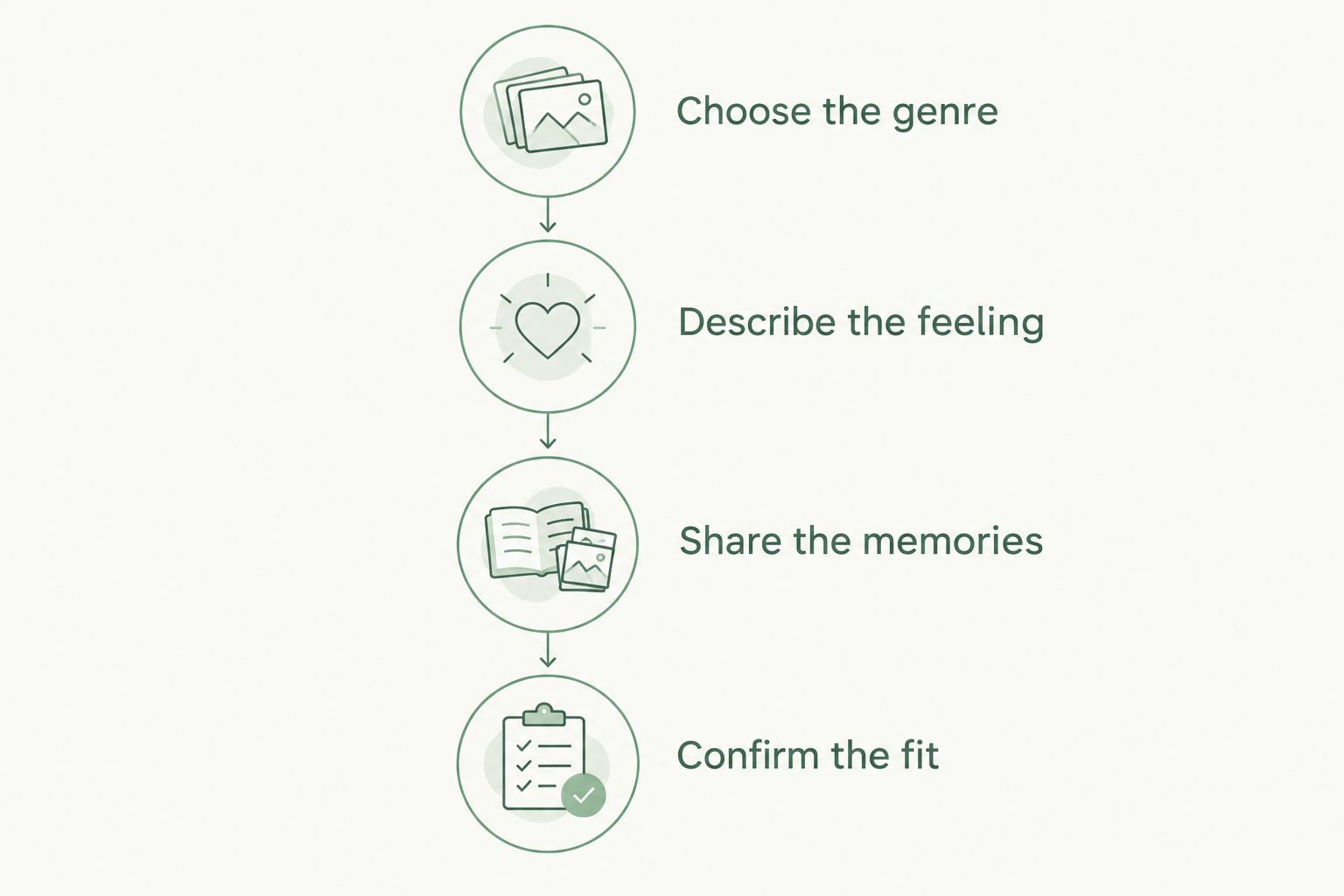
For a memorial song request in 2026, use this sequence:
- Choose the genre. Name the musical style that feels closest to the person you are remembering.
- Describe the feeling. Say whether you want tenderness, gratitude, quiet reflection, celebration, or a mixture.
- Share the memories. Explain which stories, expressions, and details belong in the lyrics.
- Confirm the fit. Ask whether the service can work within that direction and what remains undecided.
If you are still choosing, the guide to how to choose a music genre for a custom memorial song helps you think through the musical direction before making a request.
Why this matters
Choosing music for someone you love can feel unusually weighty. You might worry that an upbeat song sounds disrespectful, or that a slow ballad does not sound anything like the person you knew.
The genre should serve the remembrance, not a rule about how grief is supposed to sound. You can ask for warmth without forced cheerfulness, or sadness without making the entire song about the circumstances of the death.
If you are planning a tribute in 2026, start with what feels recognizable. A song that recalls their everyday life can be a more fitting direction than music selected only because it sounds traditionally ceremonial.
Which memorial song style fits your intentions?
The styles below are directions you can discuss, not a confirmed service catalog. Each offers a different way to shape the tribute, and each needs a clear brief to avoid a result that feels too generic.
| Musical direction | Best for | What to request | What to watch for |
|---|---|---|---|
| Country | Story-led memories and everyday details | Conversational lyrics and the specific country sound you mean | A broad genre label leaves room for very different arrangements |
| Gospel | A tribute centered on shared Christian faith | Clear guidance about beliefs, religious language, and vocal character | Religious wording should not assume beliefs the person did not hold |
| Hip-hop | Personal storytelling with a rhythmic voice | A clear lyrical perspective and the balance between spoken rhythm and melody | Dense lyrics can make important memories harder to follow |
| Acoustic ballad | An intimate tribute with words at the center | A restrained arrangement and a clear emotional direction | A gentle sound alone does not make the lyrics personal |
Country: best for story-led remembrance
Country is a useful direction when you want to tell a story through ordinary details: the garden someone tended, the road they drove, or the way they welcomed people home. Ask for those details to carry the emotion rather than relying on general phrases about missing someone.
The limitation is the breadth of the label. Explain whether you imagine a quiet, stripped-back sound or a fuller arrangement, and name the musical qualities that matter to you.
Gospel: best for a tribute rooted in faith
Gospel is a meaningful direction to discuss when Christian faith belongs at the center of the remembrance. Explain whether the lyrics should speak about prayer, gratitude, reunion, or another belief your family actually shares.
Do not let the genre label make those decisions for you. If the gathering includes people with different beliefs, tell the songwriter which expressions feel true and which you would rather leave out.
Hip-hop: best for personal, rhythmic storytelling
Hip-hop is a direction to consider when rhythmic storytelling reflects the person you are honoring. You can ask for direct language, remembered sayings, and a perspective that sounds like someone speaking honestly about the relationship.
Be specific about tone. A request for hip-hop does not explain whether you want a reflective delivery, a melodic chorus, or a more energetic tribute; those choices need their own conversation.
Acoustic ballad: best for a quiet, intimate tribute
An acoustic ballad is a useful starting point when you want a restrained setting for personal words. Describe whether you imagine guitar, piano, or another acoustic instrument, without assuming the service can supply every requested element.
Its limitation is not a lack of emotion, but the possibility of an indistinct brief. Pair the gentle sound with concrete memories so the song describes your loved one rather than loss in general.
How do you write a clear genre request?
You can prepare a useful brief without knowing terms such as key, meter, or chord progression. For your 2026 request, organize your notes under these headings and use everyday language.
Choose the genre
Start with 1 preferred genre as a writing aid, not a requirement. If you like several styles, explain which should lead and which should be a light influence; asking for every preference equally leaves the main direction unclear.
You can also say what you do not want. A gentle boundary such as avoiding a large, dramatic arrangement helps explain your preference without needing technical language.
Describe the feeling
Separate the genre from the emotional tone. Country does not automatically mean cheerful, and an acoustic arrangement does not automatically mean sad.
Describe the intended movement of the song, too. You might want a reflective beginning followed by a grateful ending, rather than the same emotional intensity throughout.
Share the memories
As an optional starting point, write down 3 personal memories you would recognize immediately. Choose moments that show the person: a familiar expression, a small kindness, or an activity you shared.
You do not have to provide a complete life story. Tell the songwriter which memory matters most, and identify anything private that should stay out of the lyrics.
Confirm the fit
Ask the service to explain how it understands your request. Confirm the main genre, emotional tone, and important boundaries before treating those choices as agreed.
If reference music would help, offer 2 reference tracks and explain the relevant qualities. These are suggested organizing numbers, not submission requirements or promises about what any service accepts.
Why the same genre request can sound different
A genre name is a starting point, not a complete description of a song. These choices explain why you should discuss the intended result rather than relying on the label alone:
- Arrangement: Say whether you imagine a sparse accompaniment or a fuller sound, and ask what the service can provide.
- Vocal delivery: Describe a restrained, conversational, or more expressive performance rather than assuming the genre determines it.
- Lyrical focus: Decide whether the song should tell a life story, speak directly to your loved one, or express the family's gratitude.
- Religious language: State whether faith belongs in the words and identify expressions that do not fit your beliefs.
- Listening setting: Explain whether the tribute is for private listening, a funeral, a slideshow, or a celebration of life.
- Personal boundaries: Identify sensitive details, unwanted phrases, and emotional themes you would prefer not to include.
For a ceremony planned in 2026, discuss the listening setting with the person organizing the service as well. A personal musical preference and a ceremony's requirements are separate questions; confirm both rather than expecting the songwriter to decide for everyone.
Can you request the sound of a favorite artist?
You can explain what you love about an artist's music without requesting an exact imitation. Describe the audible qualities: an understated vocal, acoustic guitar, a strong rhythmic pulse, or a chorus that feels warm rather than dramatic.
A reference is most useful when you explain its purpose. Identify whether you mean the mood, instrumentation, storytelling, or vocal energy, rather than asking the songwriter to guess which part matters.
Keep the request focused on an original tribute. Do not assume that copying a melody, reusing lyrics, or reproducing a recognizable voice is part of a custom memorial song service.
Does a memorial song have to be slow or sad?
No. You can request an uplifting or rhythmic memorial song if that better reflects your loved one. Describe what celebration means to you so the song does not become cheerful in a way that feels uncomfortable.
You might want the words to acknowledge the loss while remembering humor, affection, or shared adventures. Those intentions can sit together; you do not have to choose between honesty about grief and gratitude for the person's life.
If the song is a gift, ask the recipient about the direction before arranging a public first listen. A thoughtful intention does not tell you when someone wants to hear an emotional tribute.
Where a custom memorial song service fits
Rememberme custom memorial songs are for grieving individuals and families who want personal memories shaped into a professionally produced tribute. The service creates songs from customers' memories and stories to honor a deceased loved one or pet.
That approach fits a remembrance whose central purpose is telling a personal story. The boundary is equally important: a custom-song description does not, by itself, confirm a particular genre, instrument, vocalist, or revision arrangement.
When discussing a memorial song with Rememberme in 2026, explain your musical preference alongside the memories. Ask for confirmation of the requested direction before making plans that depend on it, especially when a ceremony is involved.
FAQ
Can you request a specific music genre for a memorial song?
Yes, you can request a specific music genre for a memorial song. Ask the songwriter or service to confirm that they can work in that style before you commit, and describe the mood as well as the genre.
What if I don't know which music genre to choose?
Start with the music your loved one enjoyed and the feeling you want the tribute to carry. You can describe instruments, energy, and personal memories without knowing a precise genre name.
Can I ask for a country or gospel memorial song?
You can ask for a country or gospel direction, but the service must confirm that it can fulfill the request. Explain the storytelling you want for country, or the beliefs and religious language you want for gospel.
Can a memorial song be upbeat instead of sad?
Yes, you can request an upbeat memorial song if it reflects the person you are remembering. Explain whether you want gentle warmth, gratitude, humor, or a more energetic celebration.
Can I ask for a memorial song that sounds exactly like a famous singer?
Use a favorite singer as a reference for musical qualities rather than assuming an exact imitation is included. Describe the vocal character, arrangement, or emotional tone you appreciate, and ask for an original tribute.
Does Rememberme guarantee every music genre?
Confirm your requested genre directly with Rememberme before commissioning a song. Its custom memorial song offering does not, by itself, establish that every genre or arrangement can be provided.
Can I change the genre after the memorial song is started?
Ask the service about its change and revision terms before requesting a different genre. Do not assume that changing the musical direction after work begins is included.
One last thing
Before sending your request, finish this sentence: the part of their everyday life I want to hear in this song is ___. Your answer might be a kitchen ritual, a familiar joke, or the way they said your name.
Keep that detail beside the genre request. The style gives the songwriter a musical direction; the memory explains who the song is for. You do not need perfect words to begin.
Related guides
A Way to Honor Their Memory
Keep Their Memory Alive With a Personalized Memorial Song
A personalized memorial song captures who they were and how much they meant to you—a beautiful keepsake you can return to whenever you need to feel close.
Create a Memorial Song