Grief Guide
Can AI help write a personalized memorial song?
Can AI help write a personalized memorial song? Yes. Learn to shape memories into lyrics, check accuracy, protect privacy, and plan a meaningful tribute.
Yes, AI can help write a personalized memorial song in 2026 by organizing your memories, suggesting lyrics, and helping you revise words that are difficult to find while grieving. Its draft still needs your care: check every detail, remove anything invented, and treat finished lyrics and a finished recording as separate tasks.
- Can AI help write a personalized memorial song? Yes, as a drafting aid, with family review before sharing.
- Personal memories and familiar expressions give tribute lyrics their meaning; keep those details intact.
- Rememberme creates professionally produced custom memorial songs from customers’ memories and stories.
- Check privacy terms before uploading family stories, photographs, or recordings to any tool.
Why this matters
You do not have to choose between accepting help and writing something sincere. You can use a draft to find a beginning, then decide which words belong to your loved one’s story. The memories are yours, even when you need help arranging them.
If you would rather begin without a tool, this guide to writing a memorial song for a loved one offers another starting point. For your tribute in 2026, focus on what you want to remember, not on whether the writing process looks impressive.
Can AI help write a personalized memorial song?
Yes. AI can suggest a verse structure, turn notes into draft lyrics, and offer different ways to express a memory. It cannot verify your family history or decide whether a line feels true to your relationship.
Choose the approach that matches the help you actually want:
| Approach | Best for | What it offers | What still needs attention |
|---|---|---|---|
| AI-assisted lyrics | Someone who wants a starting draft | Suggested wording, organization, and revisions | Accuracy, personal meaning, privacy, and musical fit |
| Writing the lyrics yourself | Someone who wants direct control over every word | Your own expressions and choices | Structure, editing, and arranging the words for music |
| Commissioning a custom song | Someone seeking a produced tribute from personal stories | A service-based route from memories toward a song | The provider’s process, permissions, and fit for your wishes |
None of these approaches makes a tribute more loving than another. Writing alone gives you control but leaves the drafting with you; accepting help gives you material to work with but introduces decisions about what to keep.
Use AI to suggest language, not to supply the facts of someone’s life. A polished line is not a good line if it describes a person you do not recognize.
How do you turn memories into a song draft?
Work from memories toward lyrics, rather than asking for a complete tribute with only a name and relationship. The following sequence keeps the personal material visible throughout the writing process.
1. Gather memories
Start with a 10-minute writing session if a small, defined task feels manageable. Stop earlier if you need to. You are collecting material, not trying to summarize an entire life.
Write down 3 memories: an ordinary routine, a moment you shared, and something that captures their character. For a pet, these might include a familiar greeting, a favorite place to rest, or a daily walk.
Plain notes are enough. You do not need to make them rhyme or explain why each memory matters yet.
2. Set boundaries
Create a 1-page brief that separates what belongs in the song from what should stay private. Include the relationship, preferred name, intended audience, and any subjects you want excluded.
State whether you want religious language, whether the cause of death should be mentioned, and whether the song speaks to your loved one or about them. These are choices for you and your family, not blanks for a tool to fill.
You can leave out medical details, family disagreements, and identifying information. A song does not need every part of the story to honor someone honestly.
3. Request lyrics
Ask for a draft with clear limits. A useful prompt for a tribute you are preparing in 2026 is:
Help me draft original memorial-song lyrics using only the memories below. Write from my perspective, addressing my loved one directly. Use plain, affectionate language. Do not invent events, quotations, beliefs, or messages from the person who died. Leave out the cause of death. Suggest verses and a chorus, and identify anything that needs clarification.
Add only the memories you are comfortable sharing. If you want suggestions rather than a full draft, ask for possible opening lines or a chorus built around a particular memory.
4. Check truth
Read the draft as a family story before judging it as a song. Check names, relationships, places, events, and any words presented as something your loved one said.
Delete invented scenes, even when they sound beautiful. Also remove assumptions about heaven, forgiveness, reconciliation, or what the person would want unless those ideas reflect your own intended message.
For every personal detail, ask: do I know this happened, or did the draft add it? Keep the answer simple.
5. Read aloud
Read the revised lyrics aloud without music. Notice where you stumble, where the phrasing sounds unlike you, and where a rhyme has changed the meaning.
Shorten crowded lines and restore familiar words that were replaced with formal ones. When a recording is ready, plan 2 listening passes: one for factual details and another for the overall feeling. Pause between them if listening is difficult.
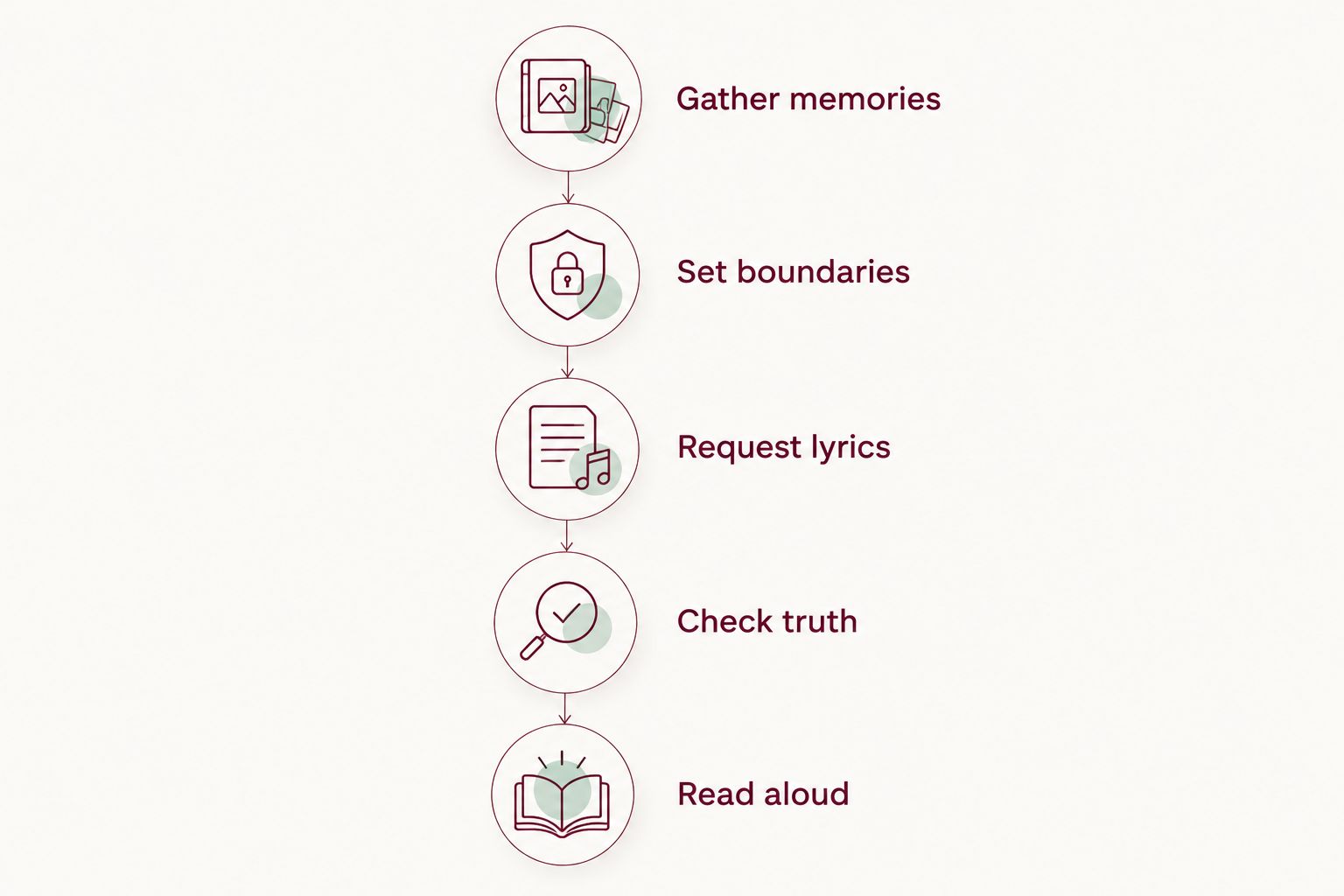
The sequence is a guide, not a deadline. You can return to the memories, ask someone to read with you, or leave the draft untouched until you feel ready.
Why does the quality of an AI-assisted memorial song vary?
A draft needs more than a description such as loving parent or loyal friend. Give it direction, then judge the result against your memories rather than against how smoothly it reads.
- Personal detail: Include a recognizable routine, place, gesture, or shared experience instead of relying only on general praise.
- Relationship: State who is speaking and whom they are addressing. A partner’s private tribute and a colleague’s public remembrance need different boundaries.
- Language: Ask for words you would actually use. Keep a familiar expression even if another phrase sounds more polished.
- Beliefs: Specify whether faith belongs in the tribute. Do not let a draft assign beliefs to your loved one or your listeners.
- Setting: Explain whether the song is for private listening, a family gathering, or a memorial service. Review sensitive details with that audience in mind.
You do not have to include every suggested line. Keep the details that sound like your person, and remove the language that could describe almost anyone.
What should you check before sharing private memories with AI?
Before uploading material in 2026, read the tool’s current privacy and data-use terms. Look for explanations of storage, deletion, account visibility, and whether submitted content is used to improve its systems. Do not assume that every service handles your material the same way.
Start with the least sensitive information needed for a draft. A first name or relationship can replace a full identity; a description of a shared afternoon can replace an address or medical history.
Ask permission before uploading another living person’s private message or recording. For a deceased loved one’s voice, discuss the intended use with the people responsible for the recording and those closest to the person.
Writing lyrics, using an existing recording, and generating an imitation voice are different decisions. Agreement to a tribute song does not settle all of them. If a proposed use feels uncomfortable, keep the voice recording private and work from written memories instead.
Can AI write a memorial song that feels genuinely personal?
Yes, AI can help shape personal lyrics, but you decide whether the result reflects your relationship. Read the draft with the memories beside it. Each meaningful detail should have a real source in what you supplied.
Look beyond whether the song includes the person’s name. Does it preserve their humor, an ordinary habit, or the way you spent time together? Does the language sound like something you would want to say?
You can also ask a trusted person to flag anything inaccurate without asking them to judge your grief. A helpful request is to check the memories and wording, rather than decide whether the tribute is emotional enough.
Can AI turn memorial lyrics into a finished recording?
Some tools generate musical audio, but lyric drafting alone does not create a finished recording. Before choosing a workflow, establish who or what will sing, how the music will be created, and what permissions apply to your intended use.
For a memorial service, ask the organizer what audio format and playback arrangements are needed. Test the actual recording on the equipment that will be used when that is possible; a written lyric cannot confirm pronunciation or playback.
If choosing a sound feels difficult, this guide explains how to choose a music genre for a custom memorial song. Begin with music that fits the person and the gathering, rather than a style chosen only because it sounds solemn.
When does a custom memorial-song service fit?
Rememberme is best for grieving individuals and families seeking a professionally produced custom memorial song built from personal memories and stories. Its custom memorial songs honor a deceased loved one or pet.
That service fits a different goal from experimenting with draft lyrics yourself. You bring the memories; before choosing a provider, ask how those memories become lyrics and a recording, what you will review, and what uses are permitted.
Rememberme’s custom memorial-song description establishes the purpose of the service, not a particular production method. If human vocals, AI involvement, revisions, or recording permissions matter to you, ask about those details directly rather than assuming them.
A commissioned song also does not remove the need for your judgment. Only you and the people who knew your loved one can confirm that the personal details belong.
FAQ
Can AI help write a personalized memorial song in 2026?
Yes, AI can help draft and revise personalized memorial-song lyrics in 2026. Supply your own memories, check every personal detail, and arrange the recording separately if you want a finished song.
Is it disrespectful to use AI for a memorial song?
Using AI as a writing aid does not by itself make a tribute disrespectful. Consider your family’s wishes, protect private material, and remove anything that misrepresents the person who died.
What should I put in a memorial-song prompt?
Include your relationship, specific memories, preferred tone, intended audience, and subjects to leave out. Tell the tool not to invent events, quotations, beliefs, or messages from your loved one.
Can I write a memorial song without a voice recording?
Yes, you can write memorial-song lyrics from written memories without a voice recording. An existing recording is separate from the stories and details used to write the song.
Can Rememberme make a song from family memories?
Rememberme creates custom, professionally produced memorial songs from customers’ personal memories and stories. The songs are intended to honor and remember a deceased loved one or pet.
What if writing or listening feels too painful?
You can stop, save the draft, or ask someone you trust to help. There is no requirement to finish or share a memorial song before you feel ready.
One last thing
Before you approve the lyrics, circle the detail you would miss most if it disappeared. It might be a kitchen ritual, a muddy paw at the door, or a familiar way of saying goodbye.
Protect that detail through the edits. You do not have to make every line poetic; you can let an ordinary memory remain ordinary and still give it a place in the song.
Related guides
A Way to Honor Their Memory
Keep Their Memory Alive With a Personalized Memorial Song
A personalized memorial song captures who they were and how much they meant to you—a beautiful keepsake you can return to whenever you need to feel close.
Create a Memorial Song