Grief Guide
Can a memorial song be sung by a real professional vocalist?
Can a memorial song be sung by a real vocalist? Yes. Learn what to ask about human singing, voice choice, pronunciation, and recorded or live tribute options.
Yes, a memorial song can be sung by a real professional vocalist, either as a recorded tribute or as a live performance. The detail to confirm is whether a human singer performs the lead vocal, because the phrase professionally produced describes the finished song without identifying who sings it. This guide explains what to ask, how to choose a voice, and how to prepare personal memories for a performance that feels right to your family.
- Can a memorial song be sung by a real vocalist? Yes. Confirm human lead vocals before commissioning your tribute.
- A recorded professional vocalist suits repeat listening; a live vocalist suits an in-person memorial performance.
- Rememberme creates custom memorial songs from personal memories and stories; ask separately about the vocal production method.
- Choose a voice that makes the words clear and respects your loved one's story.
Why this matters
A beautiful recording and a human vocal performance are not the same promise. If hearing a real person sing matters to you, that preference belongs in your request from the beginning, not after the song is finished.
You do not need music experience to ask clear questions. The guide to choosing a custom memorial song service can help you organize the broader decision while you focus here on the singer, the delivery, and the words.
For a memorial song commissioned in 2026, ask how the lead vocal is created rather than relying on production language alone. A simple answer gives you something concrete to decide on, without asking you to judge the recording by ear.
Can a memorial song be sung by a real professional vocalist?
Yes. A professional vocalist can sing lyrics written to honor a deceased loved one or pet, and that performance can be recorded or delivered live. A family member can also sing a tribute, but a family performance and a professional vocal booking are different arrangements.
These options serve different needs. None is automatically more loving or more personal than another.
| Performance option | Best for | Main strength | Main limitation | What to confirm |
|---|---|---|---|---|
| Recorded professional vocalist | A tribute you want to replay or share | You can listen to the same performance again | The recording does not provide a live singer at the ceremony | Human lead vocals, lyric review, and intended use |
| Live professional vocalist | An in-person memorial moment | The singer performs directly for those gathered | You must coordinate the performer, venue, and accompaniment | Booking, rehearsal, sound needs, and a backup plan |
| Family or friend vocalist | A tribute centered on a familiar voice | The performer brings a personal connection | Singing during grief can feel difficult, and preparation still matters | The singer's willingness, comfort, and musical support |
Choose the performance setting first, then choose the voice. If your goal is a song that relatives can return to privately, discuss a recording. If the important moment is a person singing in the room, ask specifically about a live performance.
Do not assume a recorded-song service also arranges live performers. Confirm each part separately before putting it into the memorial program.
Recorded professional vocals: best for repeat listening
A recorded memorial song separates the act of singing from the day of the ceremony. You can listen privately, decide whether you want to share it, and arrange playback without asking a grieving relative to perform.
The trade-off is that you are choosing a finished interpretation. Before commissioning a recording in 2026, ask to hear examples of the kind of singing you want and clarify whether those examples represent the voice or style offered for your project.
Listen for the words, not just the sound. Can you understand the names? Does the singer give an important memory enough space, or does the musical delivery make it hard to follow?
If a particular voice matters, ask whether you can choose the vocalist. Do not infer that choice from a sample library, a genre description, or the word custom.
Live professional vocals: best for a shared ceremony
A live professional vocalist is an option when you want someone to sing during the service itself. This is a performance arrangement, not simply a request for an audio file.
Ask the venue or service organizer about accompaniment, microphones, and where the singer will stand. Then confirm who is responsible for those details. A singer and a venue can each reasonably expect the other party to provide equipment unless the responsibilities are stated clearly.
For a 2026 memorial service, make the live-performance plan explicit in the running order. Identify when the song begins, who introduces it, and what happens afterward.
A live performance also needs a backup plan. Agree with the organizer on what to do if the performer cannot attend or the sound setup fails, rather than leaving a family member to decide during the ceremony.
Why the vocal performance varies
The same lyrics can feel different depending on how they are sung. Use these factors to describe what you want, rather than asking only for a beautiful or emotional voice.
- Performance setting: A studio recording and a live ceremony require different preparation. State which setting you need.
- Musical style: Decide whether the tribute should feel quiet, reflective, joyful, or close to music your loved one enjoyed.
- Vocal character: Describe qualities you prefer, such as a gentle delivery, clear pronunciation, or restrained expression.
- Personal wording: Names, nicknames, and family phrases need enough musical space to remain understandable.
- Emotional boundaries: Specify details you want included and details you do not want sung aloud.
- Accompaniment: Discuss whether the instruments should sit behind the voice or have a more prominent role.
You do not have to know technical singing terms. Saying that you want the words to feel conversational, rather than dramatic, is a useful direction.
If style is the main uncertainty, the guide to choosing a music genre for a custom memorial song gives you a separate place to work through that choice. Keep the genre decision distinct from confirming human vocals.
How do I confirm that a real person sings the song?
Ask directly whether a human vocalist records the lead singing for your specific memorial song. Then ask what the service can confirm about that performance. A polished sample is something to listen to, not proof of how a different song will be made.
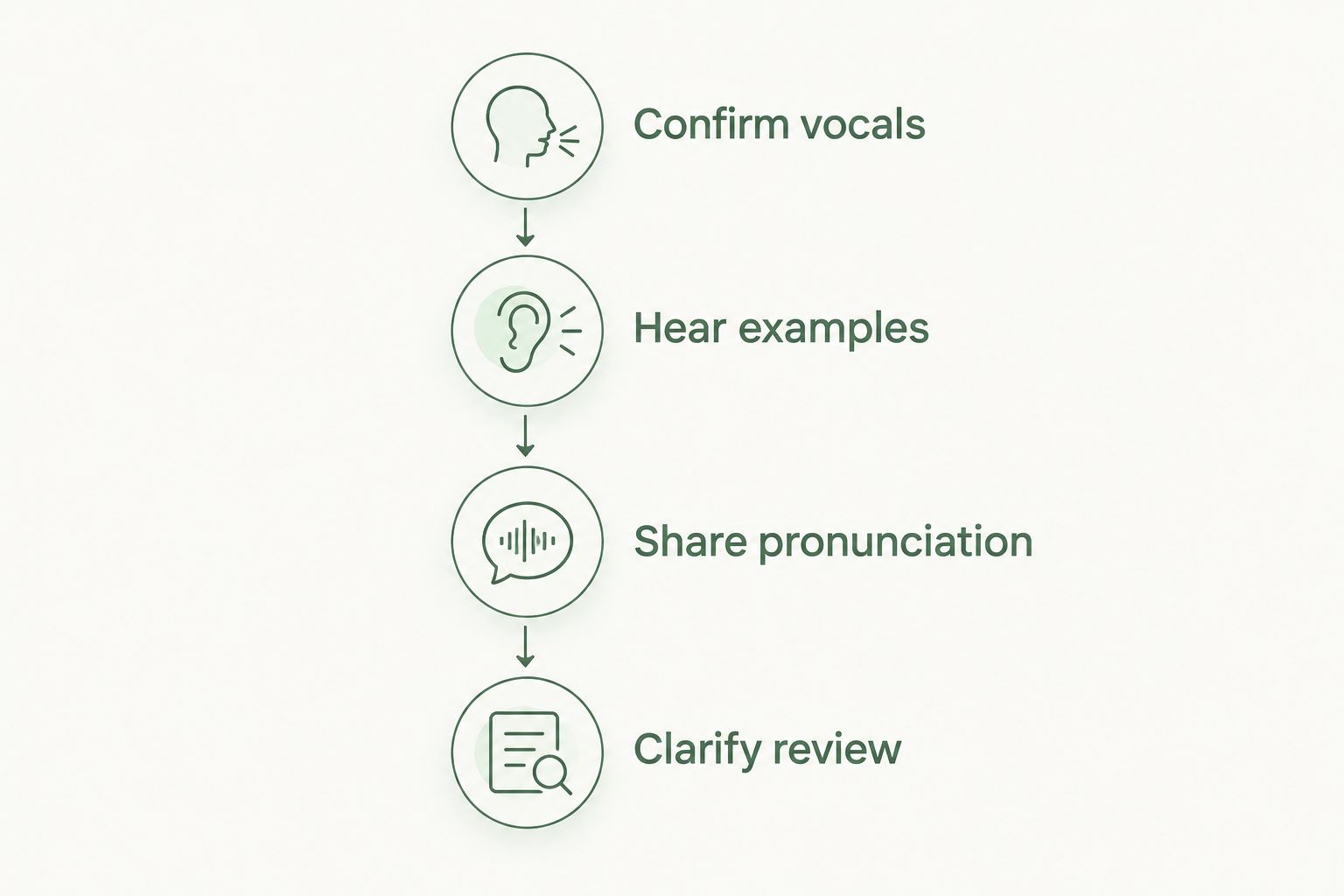
Use this sequence when making your request:
- Confirm vocals. Ask who performs the lead vocal and how it is recorded. State clearly that a real human singer is part of your requirement.
- Hear examples. Ask for examples relevant to the delivery you want. Check whether they demonstrate the actual vocalist or only a general musical style.
- Share pronunciation. Provide names and personal phrases with spoken guidance. Ask how the singer will receive that guidance.
- Clarify review. Ask whether you can review lyrics, pronunciation, or a recording before the final version, and what changes the process permits.
Do not treat a vague answer as confirmation. If the response describes sound quality but does not answer who sings, repeat the question before deciding.
What should I give a professional memorial vocalist?
Give the songwriter or vocalist details that help them understand the person, not a polished account of the whole life. Ordinary memories belong here: a familiar greeting, a shared routine, or the way your pet waited by the door.
As a starting exercise, write down 3 memories, make 1 pronunciation recording, and choose 2 emotional qualities you want the song to carry. These are organizing prompts, not service requirements or limits on what you can share.
For each memory, explain why it matters. A detail becomes more useful when the writer understands the feeling behind it. A place name alone says less than a short explanation of what happened there and why your family remembers it.
Your pronunciation recording can include the loved one's name, nicknames, and any words that are easy to misread. Speak naturally. Ask the provider how to submit it rather than assuming a particular upload method is supported.
For emotional direction, choose words you actually use. Gentle and grateful, or affectionate and hopeful, can communicate more than a long list of music terminology.
Finally, include boundaries. You can ask that the lyrics leave out the circumstances of the death, avoid religious language, or keep a private memory within the family.
Does professionally produced mean professionally sung?
No. Professionally produced describes a song's creation or presentation; it does not, by itself, confirm that a professional human vocalist sings it. Treat the singer and the production method as separate questions in 2026.
Rememberme creates custom, professionally produced memorial songs from customers' memories and stories about a deceased loved one or pet. That description establishes the service's purpose, but it does not establish a particular vocalist, vocal-selection process, or live-performance offering.
Rememberme is for families who want personal memories turned into a custom memorial song. If human singing is essential to your choice, confirm that requirement directly before commissioning the tribute.
The benefit of a memory-based custom song is that your story supplies the material. The limitation to resolve is whether the production process matches the way you want that story sung. Both belong in the decision.
Can the singer sound like my loved one?
A professional singer performing a tribute is different from using your loved one's recorded voice or asking for an imitation. Decide which of those you mean before discussing the song.
If you want a living singer to honor someone, describe a fitting delivery rather than asking for an exact vocal resemblance. A voice can feel appropriate without sounding like the person who died.
If you want to include an existing voicemail or recording, ask separately about whether that is possible, whether the audio is usable, and what permission is needed. Do not assume a service supports that process because it creates memorial songs.
You are also allowed to keep a recording private. Hearing a familiar voice in a public tribute is a personal decision, and family members can feel differently about it.
Can a family member sing the finished memorial song?
Yes, a family member can perform a memorial song if they want to and have the musical materials and permission needed for that use. Ask the song creator what can be provided and clarify performance rights rather than assuming the recording includes everything a singer needs.
An accompaniment track, lyrics, and musical guidance are separate items to discuss. They are not automatically part of a custom-song service.
Give the family member room to change their mind. Agree in advance that playing a recording or having someone read the words is an acceptable alternative. The tribute does not become less meaningful because a grieving person chooses not to sing.
FAQ
Can a memorial song be sung by a real vocalist?
Yes, a memorial song can be sung by a real human vocalist as a recording or a live performance. Confirm human lead vocals with the provider rather than relying on the phrase professionally produced.
Does Rememberme guarantee a professional human singer?
Rememberme's description of professionally produced custom memorial songs does not establish a guarantee of human vocals. Ask directly how the lead singing for your particular song is created before commissioning it.
What's better for a memorial, a live singer or a recording?
A live singer fits an in-person performance, while a recording fits repeat listening and sharing. Choose according to the moment you want to create, then confirm the practical arrangements.
Can I choose the professional singer's voice?
Ask the provider whether vocalist selection is part of the service. Hearing sample songs does not, by itself, establish that you can choose the singer for your tribute.
Do I need to write all the lyrics myself?
You do not need to arrive with finished lyrics to discuss a memory-based custom memorial song. Ask the service what stories and details it needs and whether you can review the wording.
How do I make sure the singer says a name correctly?
Provide a spoken pronunciation guide and ask how it will reach the vocalist. Confirm whether you can review the pronunciation before the final version.
Can a professional vocalist sing a tribute for a pet?
Yes, a professional vocalist can sing a tribute written to honor a pet. Share the pet's name, familiar habits, and memories you want the lyrics to reflect.
Can I play the song publicly at a funeral in 2026?
Confirm permission for the intended use and the venue's requirements before playing a custom song publicly in 2026. A livestream or recorded video also needs its own discussion about permissions.
One last thing
Before you approve the words, read them aloud without music. Listen for anything your family would never say, a name that feels misplaced, or a private detail you are not ready to share.
A memorial song should sound like your memories before it sounds like a performance. You can ask for simpler wording, less dramatic delivery, or more space around a name. The singer's role is to carry the tribute, not overshadow the person you are remembering.
Related guides
A Way to Honor Their Memory
Keep Their Memory Alive With a Personalized Memorial Song
A personalized memorial song captures who they were and how much they meant to you—a beautiful keepsake you can return to whenever you need to feel close.
Create a Memorial Song