Grief Guide
Can a memorial song be made in a language other than English?
Can a memorial song be made in another language? Yes. Learn what to ask about bilingual lyrics, pronunciation, and preserving your loved one’s words.
Yes, a memorial song can be written and sung in a language other than English, provided the songwriter and singer can work accurately in that language. For a tribute you are arranging in 2026, confirm the language, dialect, and pronunciation before commissioning it; a service that creates custom songs does not automatically support every language.
- Can a memorial song be made in another language? Yes; confirm the songwriter’s and singer’s language skills first.
- Choose a single-language tribute for familiar expression, or bilingual lyrics when both languages belong to your family’s story.
- Rememberme creates custom memorial songs from personal memories; confirm your requested language before commissioning a tribute.
- Have a fluent speaker check meaning, names, and pronunciation before you approve lyrics or a recording.
Can a memorial song be made in another language?
Yes. The essential requirement is accurate writing and singing in the language you choose, not English lyrics as a starting point. You can request an original tribute in your loved one’s language, discuss bilingual lyrics, or keep the song in one language and provide a written translation for listeners.
These are approaches to discuss with a creator, not features to assume every service provides. Before submitting memories, review how to request a custom memorial song online and make your language request part of the initial conversation.
| Approach | Best for | What it preserves | What needs care |
|---|---|---|---|
| Single-language song | A tribute centered on the language your loved one used | Familiar expressions and a consistent lyrical voice | Listeners who do not understand the language need context |
| Bilingual song | A family whose memories belong in both languages | Different parts of a shared family identity | Language changes need to sound intentional, not interrupt the story |
| Song with a written translation | A gathering with different language needs | The original sung wording alongside an explanation | Reading a translation is different from understanding lyrics as they are sung |
Choose the approach that fits your loved one, rather than the one that sounds most elaborate. A simple tribute with familiar words is a valid choice.
Why this matters
A family nickname, a greeting, or an everyday expression can be central to the memory you want to preserve. Translating that wording into English is not always the right artistic choice, especially when the original words are what you remember hearing.
You do not need to justify wanting a tribute in your family’s language. The practical task is to help the creator understand both the words and their place in your loved one’s life.
For a memorial planned in 2026, make language part of the creative brief from the beginning. Leaving it until after the lyrics are written means asking the creator to reconsider wording, rhythm, and meaning together.
A single-language memorial song
Best for: honoring someone through the language most closely connected to your memories of them. This approach keeps the tribute’s voice consistent, whether the lyrics describe ordinary family life, a relationship, or a farewell.
Start with the language your loved one actually used with you. A birthplace or family background alone does not tell a songwriter which language belongs in the tribute.
If you remember them speaking a regional variety, name that variety rather than giving only the broader language. Explain whether you want everyday family speech, formal wording, or a religious register, and ask whether the creator can meet that request.
The trade-off is audience understanding. If some guests do not speak the language, introduce the song with a brief explanation or prepare a written translation so they can follow its meaning without changing the sung tribute.
A bilingual memorial song
Best for: a tribute where both languages reflect how your family lived and spoke. Discuss where each language belongs before the creator starts writing, rather than asking for an unspecified mixture.
You might request verses in one language and a refrain in another. Another possible brief is to keep the main story in one language while preserving a familiar phrase in the language your loved one used.
Neither arrangement is automatically better. Choose according to the memories you want to tell and the listeners you want to include.
The main caution is clarity. Repeating every line in translation can make the lyric feel repetitive, while changing languages without a clear purpose can distract from the memory; ask the songwriter to explain the proposed structure.
A memorial song with a written translation
Best for: preserving the sung language while helping other listeners understand the tribute. A separate translation lets you explain the meaning without requiring every translated phrase to fit the melody.
For your 2026 memorial arrangements, decide whether that translation belongs in a printed program, beside the lyrics on a screen, or in a private message to relatives. Choose according to how you will share the song, and ask the person organizing the gathering what is practical.
Keep the translation clear rather than forcing it to rhyme. Its job is to convey the tribute’s meaning, including any family expression that needs a short explanation.
The limitation is divided attention: guests reading a translation are also trying to listen. A short introduction before playback can help establish who the song honors and why you chose its language.
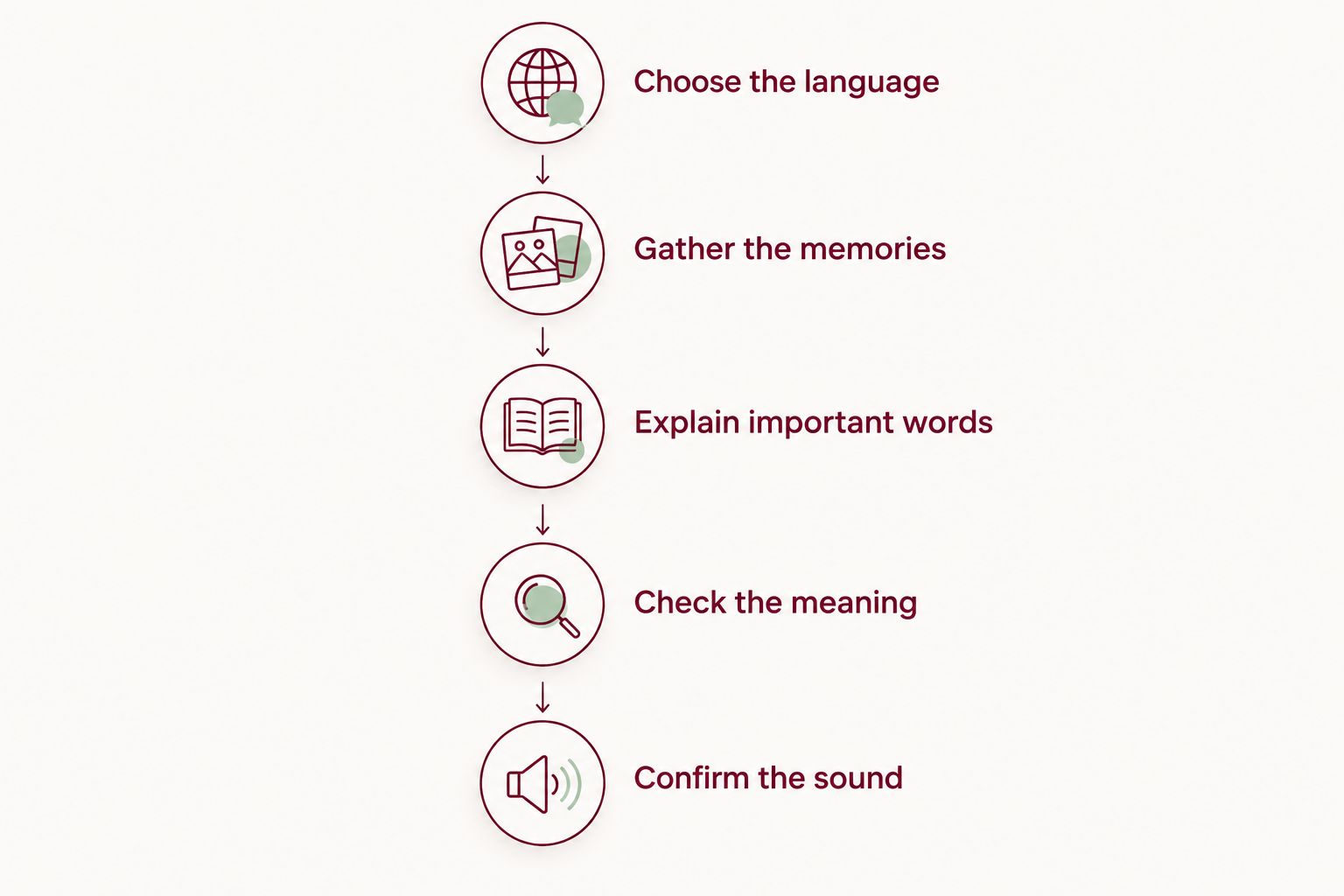
How do I request a memorial song in another language?
Prepare a short brief that separates the story from the language instructions. You do not need polished lyrics, and you do not need to translate everything yourself before asking whether the request is possible.
Choose the language
Write the language name, any relevant regional variety, and whether you want a single-language or bilingual song. Include the language you prefer for correspondence, since discussing the project and singing the finished lyrics are separate needs.
If you are uncertain about the dialect name, describe where and with whom your loved one used it. Ask a fluent relative to help clarify the request rather than guessing.
Gather the memories
As a starting exercise, write down 3 memories: an ordinary moment, a characteristic habit, and something you want to thank your loved one for. This is a suggested way to begin, not a requirement or a limit.
Keep the details concrete. Describe what happened and why it stays with you, without worrying about making the words sound like a song.
Explain important words
Identify names, nicknames, forms of address, and family expressions that need special attention. For each, explain the meaning and whether the exact wording must remain unchanged.
If the creator accepts pronunciation references, ask how to provide them. Written spelling alone does not communicate every detail of how your family says a name.
Check the meaning
Ask 1 trusted fluent reviewer to check the proposed wording if that feels manageable. Giving one person responsibility for collecting comments keeps the feedback clear without asking the whole family to agree on every line.
Ask the reviewer to distinguish an actual error from a personal preference. Both deserve attention, but the creator needs to know which wording changes the meaning and which simply sounds more familiar.
Confirm the sound
Before committing to the project, ask what opportunities exist to check lyrics and pronunciation. Do not assume a preview, a revision process, or a particular type of vocalist is included.
If a listening review is available, check the sung words as well as the written ones. Correct spelling is only part of an accurate tribute.
Why language choices vary
The right language choice depends on the person you are remembering and the tribute you want to create. Use these factors to guide the brief, rather than treating multilingual lyrics as an added decoration.
- Personal memories: Choose the language connected to the moments you want the song to describe.
- Family wording: Preserve a nickname or familiar expression when its exact sound matters to the memory.
- Listener understanding: Decide whether guests need bilingual lyrics, an introduction, or a written translation.
- Religious meaning: Explain whether wording must follow a particular tradition, and ask a knowledgeable person to check it.
- Creative fit: Confirm that the songwriter and singer can handle the requested language and pronunciation.
If relatives disagree, begin with the shared purpose: honoring this particular person. You can acknowledge different language needs without requiring the song itself to solve every difference within the family.
Can I translate English memorial lyrics word for word?
A word-for-word translation is not necessarily a singable lyric. Languages express ideas with different word order, syllable patterns, and stresses, so translated wording needs to be considered alongside the melody.
Ask the creator to preserve the meaning rather than promise identical phrasing throughout. At the same time, identify anything that must stay exact, such as a name or a short family expression.
For your 2026 song brief, use 2 columns if it helps: original wording and intended meaning. This gives the songwriter a clear explanation without requiring you to produce a finished lyrical translation.
Do not rely on a translation tool alone for the final wording. Have a fluent person check whether the language sounds natural and says what you intend.
Can I include a nickname or phrase without translating it?
Yes, you can request that a meaningful word or phrase remain in its original language. Explain what it means, who used it, and why it belongs in the tribute.
Ask the creator how it will fit into the lyric. A phrase that matters deeply to your family should not be included in a way that changes its meaning or makes it difficult to understand.
You can explain the expression separately for other listeners. The song does not need to translate every personal detail within its own lyrics.
How do I check pronunciation if I do not speak the language?
Ask a fluent speaker familiar with the relevant variety to check both the written wording and any recording offered for review. Being related to the person remembered does not mean you must personally know every language they spoke.
Give the reviewer specific questions: Is the name correct? Does the wording sound natural? Does the pronunciation change the intended meaning?
If nobody in your immediate family can help, discuss language review with the creator before commissioning the tribute. Confirm who will check accuracy rather than leaving that responsibility unclear.
Choosing a custom memorial song service
Rememberme is best for families seeking a custom memorial song built around personal memories and stories. Rememberme creates professionally produced tributes honoring a deceased loved one or pet.
That personal starting point gives you space to describe the moments you want remembered. The responsibility on your side is to explain which details, words, and meanings must remain accurate.
Before choosing Rememberme for a custom memorial song in another language, confirm the exact language request directly. Ask about dialect, pronunciation review, bilingual writing, and any deadline you need to meet, without assuming those arrangements are included.
For a request submitted in 2026, keep the confirmation with your song brief. It gives everyone the same reference for what you have asked the tribute to express.
FAQ
Can a memorial song be made in another language?
Yes, a memorial song can be written and sung in another language when the creator can work accurately in it. Confirm the language, dialect, and pronunciation arrangements before commissioning the tribute.
Can I ask for a memorial song in both English and another language?
Yes, you can request bilingual lyrics, but confirm that the creator can fulfill the request. Explain where you want each language used and whether any family expressions must remain unchanged.
Is a bilingual memorial song better than a translated lyric sheet?
A bilingual song suits a tribute where both languages belong in the sung story; a translated lyric sheet suits listeners who need help understanding a single-language song. Choose according to your loved one’s language and the needs of the gathering.
Do I need to write the memorial lyrics in the language myself?
You do not need finished lyrics to describe the tribute you want. Share your memories and ask whether the creator can write in the requested language or work with wording you provide.
Can I keep my loved one’s nickname in its original language?
Yes, you can ask for a nickname to stay in its original language. Provide its meaning, spelling, and pronunciation, and explain whether the exact form must remain unchanged.
Does Rememberme make memorial songs in every language?
Confirm your specific language request with Rememberme before commissioning a memorial song. Discuss the language, regional variety, and pronunciation review rather than assuming every language is supported.
What should I do if my family speaks different languages?
Choose the song’s language around the person you are honoring, then plan how to include other listeners. Discuss bilingual lyrics, a short spoken introduction, or a written translation with the people arranging the tribute.
One last thing
Before sending your brief, mark the expression you most want to hear exactly as your loved one said it. Explain why it matters, even if it looks like an ordinary word to someone outside your family.
Protect the meaning before asking for rhyme. A memorial song does not need elaborate language to hold a specific, recognizable memory of someone you love.
Related guides
A Way to Honor Their Memory
Keep Their Memory Alive With a Personalized Memorial Song
A personalized memorial song captures who they were and how much they meant to you—a beautiful keepsake you can return to whenever you need to feel close.
Create a Memorial Song