Grief Guide
Can a custom memorial song honor more than one person?
Can a memorial song honor more than one person? Yes. Learn how to balance individual memories, choose a shared theme, and prepare a thoughtful tribute for all.
Yes, a custom memorial song can honor more than one person by giving each person a distinct place in the lyrics and connecting their memories through a shared chorus. The main challenge is keeping each life recognizable, so the tribute feels personal rather than becoming a list of names.
- Can a memorial song honor more than one person? Yes, with distinct memories for each person and a shared theme.
- Give each loved one a recognizable detail rather than trying to fit every memory into the lyrics.
- Rememberme creates custom memorial songs from personal memories; prepare a clear brief before requesting a shared tribute.
- Choose separate songs when a shared tribute would leave important stories or beliefs out.
Can a memorial song honor more than one person?
A memorial song can honor several people without treating their lives as interchangeable. Give each person an identifiable memory, then use the chorus to express what connects them: family, friendship, a shared place, or the love you still carry.
Start with the memories, not the rhyme. This guide to choosing lyrics for a custom memorial song can help you decide which details belong in the tribute.
| Approach | Best for | Main strength | Main limitation |
|---|---|---|---|
| Individual verses, shared chorus | Loved ones with distinct stories and a meaningful connection | Gives each person space while keeping the tribute connected | Requires careful transitions between people |
| Shared memories throughout | People remembered through a life together | Keeps their relationship at the center | Individual personalities need deliberate attention |
| Names within a collective tribute | A group remembrance | Acknowledges people within a shared message | Leaves less room for individual stories |
| Separate songs | Lives that need different voices or themes | Gives each story its own focus | Does not create a single shared tribute |
These are writing approaches, not service packages. Choose the structure that respects the people you are remembering, then ask your songwriter whether that structure fits the requested song.
Why this matters
A shared tribute does not have to suggest that every loss feels the same. You might miss a parent's guidance, a sibling's humor, and a friend's everyday companionship in very different ways.
For a memorial planned in 2026, begin with the people rather than the occasion. Decide what you want listeners to understand about each life before choosing the musical style or arranging the ceremony.
You do not need to tell every story. A small, truthful detail is more personal than a broad statement that could describe anyone. A familiar habit, a favorite gathering place, or a way someone showed care gives you something concrete to write about.
Two parents: one shared tribute
Best for: honoring parents whose individual lives and relationship both matter to the tribute. A useful structure is a verse about each parent followed by a chorus about what they gave your family.
In your writing notes, separate their personalities before describing them together. Perhaps one parent expressed love through practical help while the other made space for long conversations. Use only details that are true for your family.
The strength of this approach is that it honors both the people and their connection. Its limitation is the temptation to describe them only as a couple, leaving their individual interests, friendships, and character out of the song.
Do not assume that a shared tribute needs a reunion theme or a religious ending. If those ideas do not reflect your family's beliefs, focus instead on the memories and influence that remain.
Several relatives: a family-centered tribute
Best for: remembering relatives connected by a genuine family story. Build the song around something specific, such as a family home, a tradition, or the ways people cared for one another.
For a family gathering in 2026, make a separate memory note for each person before looking for a common thread. This keeps the theme from replacing the people it is meant to honor.
The advantage is a clear sense of belonging. The limitation is that relatives with fewer surviving stories can receive less attention unless you make space for them deliberately.
Ask another family member for help when you know little about someone's life. If no additional details are available, use an honest statement about their place in the family rather than inventing a personality or memory.
Friends or community members: a collective remembrance
Best for: a group connected by friendship, work, service, or a shared community. Explain what brought the people together, then include individual details that distinguish them.
A collective chorus can express the group's gratitude or remembrance. Individual lines can acknowledge different contributions without suggesting that everyone had the same role or personality.
This approach gives a group a shared expression of remembrance. Its limitation is that group language can become impersonal, especially when the lyrics focus entirely on an organization rather than the people.
For a community memorial in 2026, confirm names and preferred wording with the appropriate families or organizers. Keep private circumstances out of the lyrics unless the people responsible for sharing them have agreed.
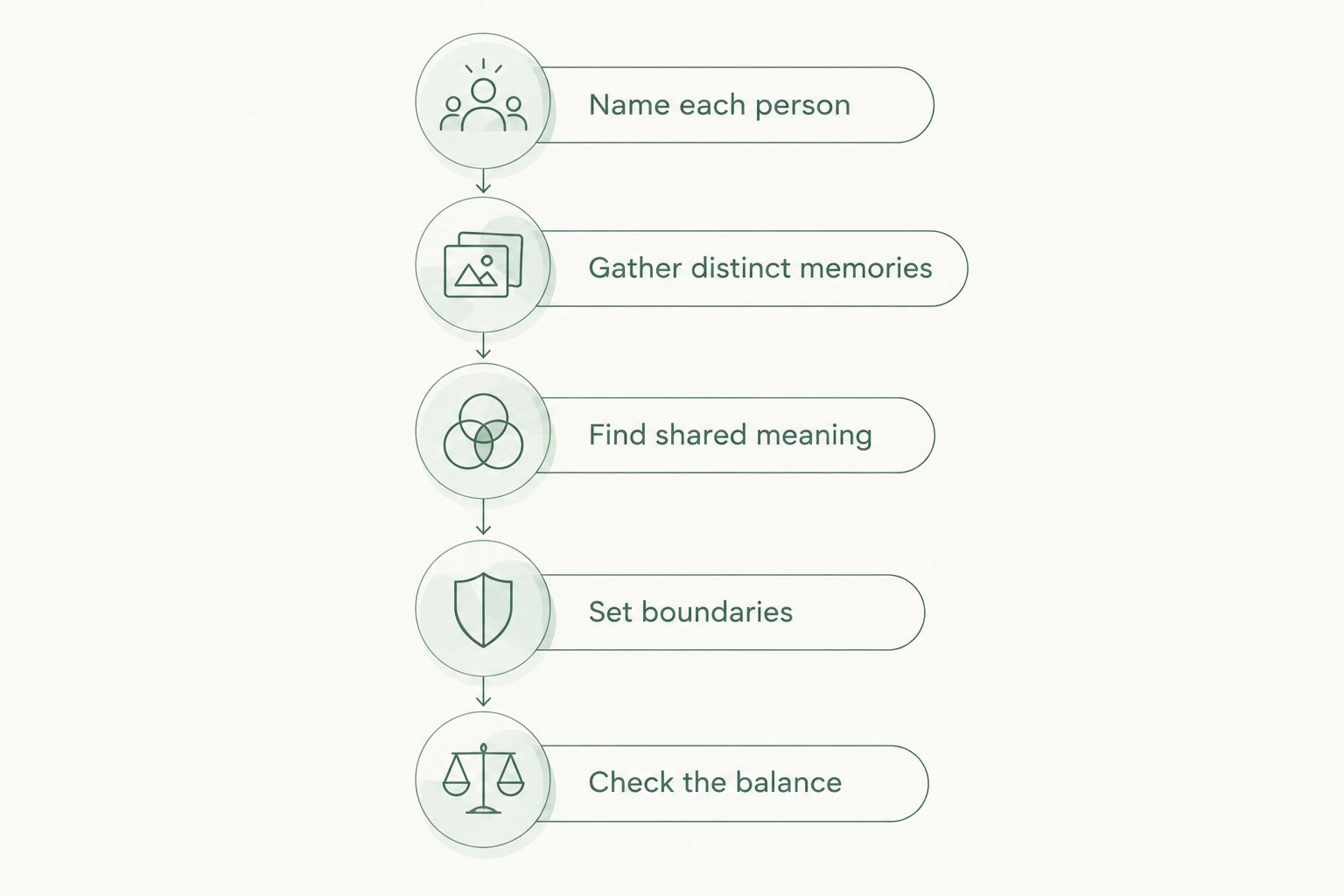
How do you prepare memories for a shared memorial song?
Use these steps to create a clear brief. You do not need polished sentences or finished lyrics; ordinary language is enough.
1. Name each person
Write the names you want considered for the lyrics, including preferred names and pronunciation guidance. Explain relationships clearly so the writer does not have to guess who belongs to which memory.
Keep factual notes separate from wording suggestions. A nickname might be essential to the tribute, while a formal name might belong only in the accompanying dedication.
2. Gather distinct memories
As a starting exercise, write 3 short memory notes per person: a familiar habit, a moment you shared, and something you still carry from them. This is a writing prompt, not a required submission count.
Choose details that distinguish one person from another. If every note describes someone as loving or kind, add an example of how that care appeared in everyday life.
3. Find shared meaning
Write 1 sentence explaining why these people belong in the same tribute. They do not need to have known one another; your relationship with them can be the connection.
If that sentence feels forced, consider separate songs. A shared loss does not require a shared artistic treatment.
4. Set boundaries
List subjects, phrases, and beliefs you do not want included. You can honor someone without describing their death, resolving a complicated relationship, or presenting a family history as happier than it was.
For a tribute shared in 2026, distinguish between details suitable for private listening and details suitable for a public ceremony. A cherished memory is not automatically something everyone wants published.
5. Check the balance
Read the brief once for each person. Ask whether someone who knew that person would recognize them from the details you supplied.
Aim for equal care, not identical word counts. One vivid memory can carry more meaning than several general compliments.
Why the right structure varies
The right structure depends on the stories you want to tell. Use these factors to decide what belongs together and what needs its own space:
- Relationship: A couple's shared history supports a different focus from a group of friends remembered by one person.
- Distinct memories: More individual stories require more selective writing, not simply more names in the chorus.
- Point of view: Decide whether the song speaks from you, the family, or a wider group. Avoid switching without explanation.
- Beliefs: Religious language should reflect the people being honored and the intended dedication, not an assumed agreement.
- Listening setting: Private listening allows a different level of personal detail from a public memorial.
- Privacy: Family disagreements, circumstances of death, and intimate memories need deliberate boundaries.
When choosing a style for a 2026 remembrance, start with the words you need to hear. Then use the guide to choosing a music genre for a custom memorial song to consider how the music should support them.
Should every person get the same number of lines?
No, every person does not need the same number of lines. A balanced tribute gives each person a recognizable presence without forcing every memory into an identical shape.
Use 2 review passes as a practical exercise: first check names and factual details, then check whether anyone feels reduced to a passing mention. This is an editorial suggestion, not a songwriting rule.
If a family member feels someone has been overlooked, ask which specific detail is missing. Adding a meaningful memory is more useful than adding words solely to make sections equal.
Can one song honor people who never met?
Yes, one song can honor people who never met when the connection is your relationship with them. Write from your perspective rather than inventing shared experiences between them.
For example, a tribute could remember a grandparent and a close friend through the different ways each made you feel supported. Keep their stories separate and let the chorus express your gratitude or remembrance.
Avoid language that implies a relationship they did not have. The emotional connection can be yours alone, and that is enough to explain the dedication.
When are separate memorial songs a better choice?
Separate songs are better when combining the stories would require leaving out something essential. Different beliefs, contrasting relationships, or a strong need for individual recognition are reasons to keep tributes separate.
You do not have to make a shared song carry every part of your grief. A collective dedication can remain brief, while individual tributes hold the stories that need more room.
If you request a custom memorial song from Rememberme, explain at the outset that you want to honor multiple people and ask whether the proposed structure fits the service. Rememberme creates professionally produced memorial songs from personal memories and stories; the brief should make each person's place clear.
Rememberme is best suited to people seeking a custom memorial song shaped around their own memories and stories. For a shared dedication, confirm the scope before proceeding rather than assuming that any number of individual stories will fit.
FAQ
Can a memorial song honor more than one person?
Yes, a memorial song can honor more than one person through individual memories connected by a shared theme. Give each person a recognizable place rather than relying only on a list of names.
Can I dedicate one memorial song to both of my parents?
Yes, one memorial song can honor both parents. Give each parent personal details, then use shared memories or a chorus to recognize their connection and influence on your family.
Do all the names need to be in the chorus?
No, names do not all need to appear in the chorus. You can place them in individual verses or an accompanying dedication and reserve the chorus for the shared meaning.
What if I have more memories of one person than another?
You can honor people thoughtfully even when you have different amounts of information about their lives. Ask others for memories, and use only details you can represent honestly.
Can a shared memorial song include different religious beliefs?
Yes, a shared memorial song can acknowledge people with different beliefs without assigning one belief to everyone. Use language about memory, love, or gratitude unless specific religious wording fits the dedication.
Should I ask my family before sharing the song publicly?
Yes, ask before sharing other people's sensitive stories or presenting the song as a tribute from the whole family. Agree on names, private details, and where you intend to share it.
Can Rememberme create a song from my family's memories?
Rememberme creates custom, professionally produced memorial songs from customers' personal memories and stories. For a tribute honoring multiple people, explain the dedication and confirm the proposed scope before proceeding.
One last thing
Before you send the brief, remove the names temporarily and read the memory notes again. Can you still tell who each section describes?
If the answer is no, add a detail that belongs to that person alone. You do not need a grand achievement or a perfect sentence. Sometimes the most meaningful distinction is an ordinary thing you miss.
Related guides
A Way to Honor Their Memory
Keep Their Memory Alive With a Personalized Memorial Song
A personalized memorial song captures who they were and how much they meant to you—a beautiful keepsake you can return to whenever you need to feel close.
Create a Memorial Song